
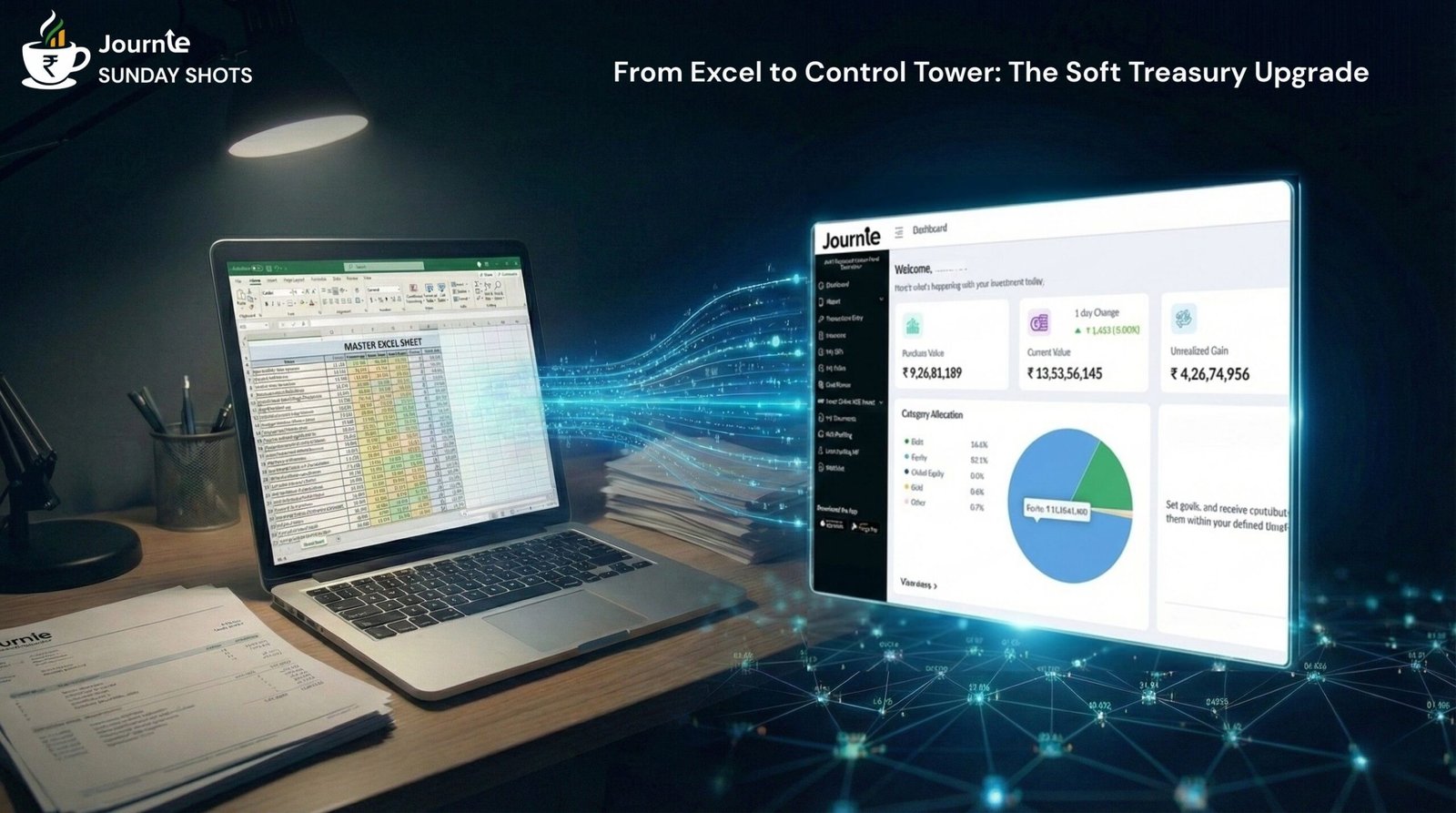

From Excel to Control Tower – The Startup Treasury Upgrade

10 AM. Coffee in hand. You’re staring at a dashboard that doesn’t exist yet.

The business is running. Revenue is coming in. The runway looks okay.

But one question refuses to go away:

Where is our cash really? And what is it doing for us right now?

This is a familiar moment for startup founders and finance leaders once the business moves past survival mode. Cash is no longer pocket change, but the systems around it still feel improvised.

The System Every Startup Relies On

Walk into most startup finance setups and you’ll find the same thing:
a master Excel sheet that decides everything about cash.

It tracks bank balances, expected collections, vendor payments, and a rough sense of runway. Usually updated late at night and often pulled together just before investor updates or board calls.

For a long time, this worked.

In the early stages, speed matters more than structure. Capital feels available. Decisions are instinct-driven. Cash in the bank means safety.

Treasury isn’t a function. It’s a task.

But as startups grow, hire more people, manage multiple accounts, and handle uneven cash inflows, that same Excel sheet softly becomes the most important and yet fragile system in the company.

What’s interesting is this: many startups today are holding more cash than they did a few years ago, yet managing it with the same early-stage processes.

The money evolved. The system didn’t.

The Soft Upgrade: From Cash Box to Control Tower

What’s changing isn’t just how much cash startups hold. It’s how intentional they’re becoming about managing it.

More founders are realizing that treasury isn’t just about returns. It’s about visibility, timing, and avoiding surprises.

Instead of asking: “How much do we have in this account?”
They’re asking: “What happens to runway if collections slip by two weeks?”

Instead of: “Can we earn a little extra yield?”
They’re asking: “Is idle cash sitting in the right place given what’s coming up?”

This shift doesn’t require a treasury desk or complex systems. It starts with a simple mindset change:
Treat cash like a living system, not a static balance.

The stress doesn’t show up on calm days. It shows up when a delayed customer payment, a large vendor bill, and an investor update land in the same week.
That’s when the old setup starts to creak.

The Three Dials That Matter for Startups

Strip away the jargon, and most future-ready startup treasuries are tuning just three dials: Visibility. Predictability. Rules.

1. Visibility: One Clean View of Cash

Startups rarely suffer from a lack of cash. They suffer from not knowing where it all sits.

Money gets spread across current accounts, FDs, debt funds, receivables, and advances. Each with its own login, statement, and update cycle.

Individually manageable. Collectively confusing.

The upgrade is simple: a single view that tells you, at any point,

Here is your cash by bucket — operating, near-term, core. And here’s how it has moved this week, quarter or entire financial year.

2. Predictability: A Runway Story, Not Just a Balance

A bank balance tells you where you stand today.
A cash-flow view tells you how much room you really have.

More startups are adopting rolling forecasts, often just 12–13 weeks, updated weekly. Not to be precise, but to be prepared. It connects sales, collections, vendor terms, loan repayments, interest, capex, and taxes into one coherent story.

No hero spreadsheets. No complex models.
Just a rhythm of looking ahead, adjusting early, and avoiding surprises.

3. Rules: Deciding What Cash Is Allowed to Do

Once visibility and predictability improve, the real upgrade comes from rules.

Instead of ad-hoc decisions like “park the surplus somewhere for now”, startups benefit from a simple playbook:

    • X months of operating buffer that stays safe and liquid.
    • Y months of core surplus that can be parked more efficiently into slightly higher-yielding, still-conservative options.
    • Z that’s been kept flexible for opportunities or shocks like acquisitions, down cycles, or strategic bets, with clarity on how quickly it can be pulled back.

Once rules exist, cash decisions stop being reactive. They become repeatable.

And that’s exactly what founders need when things get busy.

A Lighter Cockpit, Not a Control Room

The immediate reaction is predictable:
“This sounds great, but we’re still a startup and don’t have the size or team to build a treasury centre.”

And that’s the point.

You don’t need a treasury department.
You need just enough structure to remove uncertainty.

For many startups, that looks like:

    • One shared cash dashboard
    • A 30-minute weekly review of the next 12 weeks
    • A short-written note on where money can and can’t go

From there, structure grows naturally with scale.

The foundation remains the same: clarity, rhythm, and rules.

We see this shift up close. At Journie, much of our work today sits inside startup treasuries — helping businesses move from fragmented cash tracking to clearer visibility and more deliberate decision-making.

The tools matter, but the discipline they enable matters more.

Closing Thought: The Dashboard as a Mirror

Every phase of a startup has a different obsession.

Early on, it’s product-market fit. Then it becomes growth and burn. Then runway.

This phase is making the cash dashboard the new mirror. A daily reflection of how prepared, honest, and intentional the business really is.

Most startups already have the ingredients. Data. Intent. And often, more cash complexity than they realize.

The real question is simple: Will cash remain a number spread across accounts, or finally be treated as a system?

Until next Sunday — here’s to systems, processes, and the changes that are inevitable.

If you enjoy reading Sunday Shots — share it among your friends, family, or even strangers on WhatsApp, LinkedIn, and X.
Good insights travel best through good company.

Disclaimer: This update is for informational purposes only. Please consult a SEBI-registered advisor before investing.

Recent Blogs

Subscribe to Journie Shots — thoughtful, well-curated insights and market stories delivered every Sunday.