
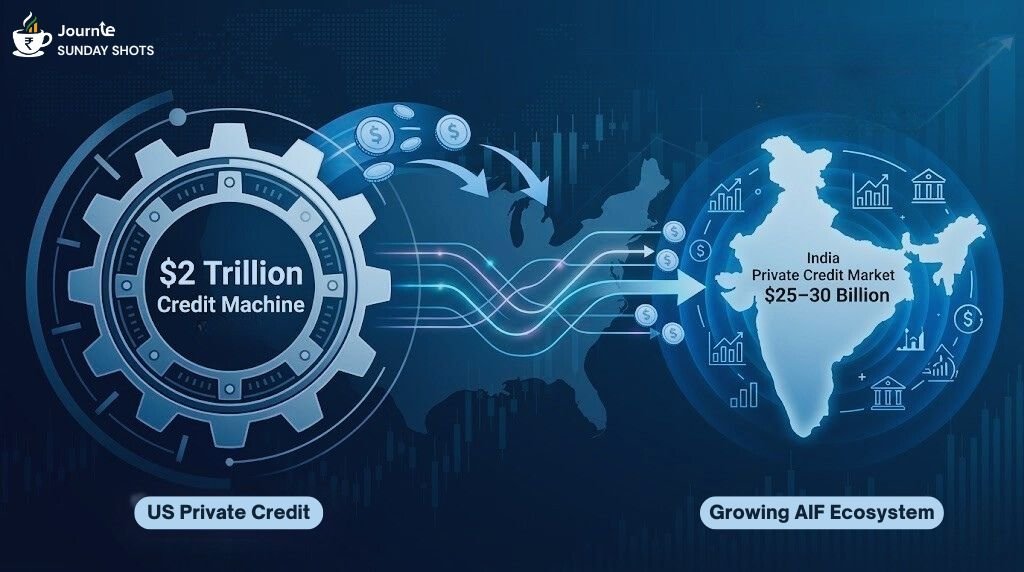

The $2 Trillion Credit Machine: Why Wall Street’s Private Lending Stress Matters for India

For more than a decade, private credit has been one of the most reliable sources of yield in global finance.

After the 2008 financial crisis, banks pulled back from riskier corporate lending as new regulations forced them to hold more capital. Into that gap stepped large asset managers.

Firms like BlackRock, Apollo, Blackstone, Ares and KKR began lending directly to companies, building what has now become a nearly $2 trillion global private credit market.

For investors searching for higher yields, the strategy looked compelling. Private credit funds often delivered 200–400 basis points more than traditional corporate bonds. Pension funds, insurance companies and sovereign wealth funds steadily poured capital into the space.

Over time, private credit became a major financing channel for mid-sized companies, particularly those backed by private equity.

For years, the system appeared stable. But in recent weeks, small cracks have started to appear.

And the first signals are beginning to show up in the United States.

The First Stress Signals

Several developments in the U.S. private credit market have recently caught investor attention.

  • BlackRock reportedly capped withdrawals in a $26 billion private credit fund after redemption requests exceeded the fund’s limits.
  • Morgan Stanley also restricted withdrawals in one of its private credit vehicles following a surge in investor exit requests.
  • Deutsche Bank recently disclosed around $30 billion tied to private credit portfolios, highlighting how closely traditional lenders are connected to this ecosystem.

Industry executives are also warning that default rates in private credit could rise over the coming years, particularly among technology borrowers.

None of these developments alone signal a crisis. But they highlight a structural vulnerability in how private credit works.

Most private credit funds lend through long-term, illiquid loans, while investors often expect some level of liquidity. When redemption pressure rises, fund managers are often forced to limit withdrawals or hold assets that rarely trade.

That liquidity tension is now drawing closer scrutiny from investors.

The Hidden Warning Sign: PIK Interest

Another issue investors are watching closely is the rising use of Payment-In-Kind (PIK) interest.

Instead of paying interest in cash, borrowers can pay interest by issuing additional debt, allowing lenders to record income even when no cash is actually received.

During strong economic cycles, such structures can work. But historically, rising PIK usage has often been an early signal that borrowers are struggling to service debt normally.

It is not necessarily a crisis indicator, but it is often viewed as a late-cycle signal in credit markets.

Why Technology Could Become the Pressure Point

One sector analysts are watching particularly closely is technology and software companies.

Many private credit loans are extended to private-equity-backed software firms, whose business models depend heavily on stable subscription revenues.

But the rapid rise of artificial intelligence is beginning to reshape parts of the software industry. AI is compressing pricing power in some segments while changing cost structures in others.

If margins shrink or revenue models shift, some borrowers could struggle to maintain the cash flows required to service their debt.

And that is why some industry executives believe default rates in private credit could gradually rise over the next few years.

So where does India fit into this story?

The India Angle

At first glance, India may appear insulated from these developments. The country’s private credit market is still much smaller than the United States, roughly $25–30 billion, compared with nearly $2 trillion globally.

But the sector has been growing rapidly. In 2025 alone, India saw more than $12 billion of private credit investments across over 160 deals, making it one of the fastest-growing credit segments in the country.

Most of this activity takes place through Alternative Investment Funds (AIFs) and global credit platyers. Major participants include global investors such as Blackstone, KKR, Brookfield and Apollo, alongside domestic players like Edelweiss Alternatives, Piramal Alternatives and Avendus etc.

Much of this lending flows into real estate development, mid-market corporate financing, acquisition funding and structured credit.

In many cases, these borrowers are companies that cannot easily access bank loans or public bond markets. Private credit fills that financing gap.

Why Global Stress Could Reach India

Even though India’s market is smaller, it remains closely linked to global capital flows:

  1. Foreign Capital: Global funds account for more than two-thirds of total funding in some segments. If investors withdraw capital from global funds, managers may slow new deployments into emerging markets.
  2. The AIF Liquidity Question: Most Indian deals are through Category II AIFs with multi-year lock-ins. While this limits sudden redemptions, a global slowdown could mean slower fundraising cycles and greater pressure on refinancing.
  3. Real Estate Exposure: Many Indian developers rely on private credit because banks have become more cautious. If global liquidity tightens, refinancing these loans could become more expensive or harder to access.

A Smaller System, For Now

One important distinction remains scale.

In the United States, private credit has grown large enough to potentially create systemic financial risk. In India, the sector is still relatively small.

Private credit assets of around $25–30 billion represent less than 1% of India’s GDP, and only a small portion of overall corporate lending.

Most credit in the Indian economy still flows through banks, NBFCs and public bond markets. That makes the system far less dependent on private credit than the U.S. financial system.

The bigger issue, however, goes beyond a few redemption restrictions.

When Risk Moves, Not Disappears

Private credit emerged after the financial crisis to fill the lending gap left by banks. And in many ways, it succeeded.

But as the market has expanded, the lines between traditional banking and shadow lending are beginning to blur again.

If stress appears, it may not resemble the banking crises of the past. There may be no sudden bank runs or dramatic collapses.

Instead, the signals could be quieter. Slower fundraising. Tighter liquidity. Harder refinancing cycles.

And that is why developments in the U.S. private credit market are being watched more closely. Because in modern finance, capital rarely stays confined to one market.

Sometimes the first signals appear far away, long before the ripple reaches everyone else.

Until next Sunday!

Disclaimer: This update is for informational purposes only. Please consult a SEBI-registered advisor before investing.

Enjoyed this week’s Sunday Shots? Share it across WhatsApp, LinkedIn, or X — and invite someone else into the conversation.
Subscribe to Sunday Shots for a fresh perspective delivered every week.

Recent Blogs

Lorem ipsum dolor sit amet, consectetur adipiscing elit. Ut elit tellus, luctus nec ullamcorper mattis, pulvinar dapibus leo.

Subscribe to Journie Shots — thoughtful, well-curated insights and market stories delivered every Sunday.