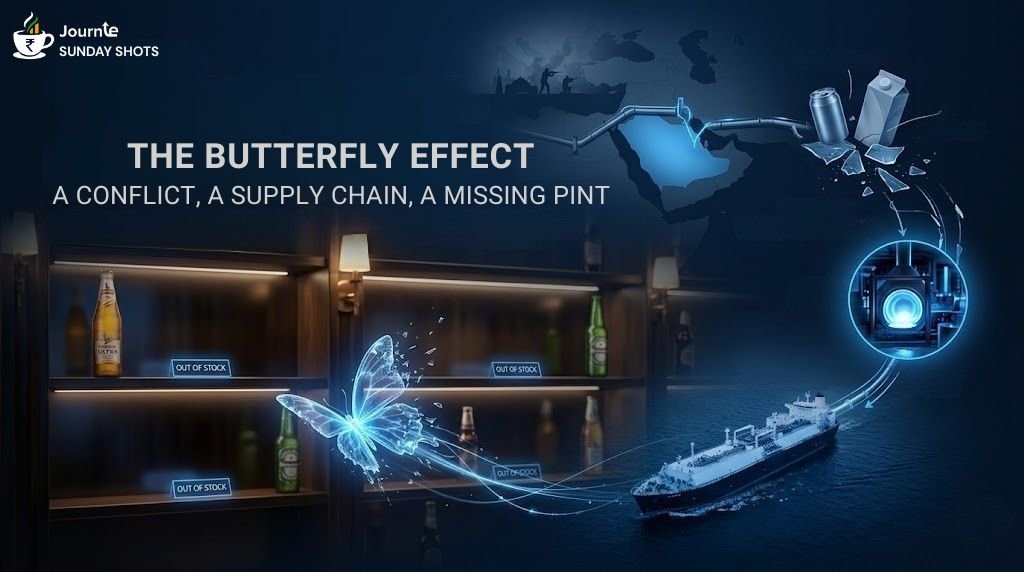

The Butterfly Effect: A Conflict, A Supply Chain, A Missing Pint
It’s the peak of an Indian summer.
The heat lingers a little longer in the evening. Conversations stretch. Glasses clink more often.
You order your usual cold pint.
The server pauses. “Out of stock, Sir.”
You assume it’s a spike in demand. Maybe a busy weekend. Maybe a supply delay.
But the real reason your premium lager is missing from the shelf is unfolding thousands of miles away — far from breweries, bars, or anything resembling a beer tap.
Welcome to the 2026 summer supply chain shock.
A Disruption Far From the Shelf
What looks like a local shortage is actually the result of a global disruption.
The ongoing Israel-Iran conflict has started to do what conflicts often do best: disrupt systems that seem completely unrelated at first glance.
Not just oil. Not just shipping routes. But something far less visible: industrial energy flows.
India is the world’s fourth-largest importer of natural gas, drawing roughly 40% of its supply from Qatar. As geopolitical tensions rise, supply tightens. Availability becomes uncertain.
And that’s where the story naturally shifts—from a geopolitical chessboard to a manufacturing floor.
The Shift: From Gas to Glass
To understand why Indian breweries are staring down a crisis, we have to look beyond the beer and focus on the bottle.
Glass manufacturing is a game of continuous heat. Furnaces run 24/7 at extremely high temperatures. They are not designed to be turned on and off. They are designed to stay on.
That continuity depends entirely on a steady, commercial supply of natural gas. When that supply tightens, the system doesn’t gradually adjust. It breaks.
Production slows. Output becomes unpredictable. Costs rise sharply.
Within weeks:
- Glass bottle prices have surged by roughly 20%
- Paper carton costs have nearly doubled, up by 100%.
Suddenly, a basic assumption: that packaging will always be available, no longer holds.
The Illusion of Alternatives
So, why not just switch to cans or plastic?
Because global supply chains don’t break in isolation. They gridlock.
Aluminium supply chains, delayed by ships rerouting around the Strait of Hormuz, have begun to strain. At the same time, surging petroleum costs are driving up the price of plastics.
There is no easy pivot. What looks like flexibility on paper turns out to be dependency in reality.
The Pressure Builds
For brewers, this couldn’t come at a worse time.
April and May are peak season. It is when volumes are highest and margins matter most.
But as input costs rise sharply and with the industry seeking 12-15% price hikes, pricing remains artificially constrained.
Alcohol pricing in India is not a free, fluid market. It requires individual state approvals. It moves slowly.
So, when costs rise overnight but retail prices don’t: Margins compress. Decisions change.
The Working Capital Squeeze
It’s not just the 15-20% spike in direct costs. It’s the hidden tax of time.
With global shipping routes diverted, transit times are suddenly 12 to 14 days longer.
For businesses, longer transit times plus higher input costs equal trapped working capital.
Inventory is stuck on the water, cash is tied up, and CFOs are left sweating over liquidity just as peak season kicks off.
When Prices Can’t Move, Supply Does
This is where the system reveals how it really works.
If you are sitting in a boardroom and you cannot raise prices, you don’t sell everywhere. You choose.
Supply is strategically directed toward markets where pricing is viable. States like Maharashtra or Karnataka that might allow emergency price revisions. Not because demand is weak, but because the unit economics no longer work. It becomes corporate triage.
Shortages begin to appear. Not uniformly across the country, but selectively. A soft form of rationing.
The View: Headwinds vs. Tailwinds
For those watching the markets, this creates a complex valuation puzzle.
Take the market leader, United Breweries (UBL). It trades at a premium multiple—roughly 70x P/E, reflecting its dominance in the Indian consumption story. That premium leaves it highly sensitive to sudden margin compressions.
Yet, the market is rarely one-dimensional. While the geopolitical headwind threatens margins, there are localized regulatory tailwinds.
Karnataka, which alone accounts for 13% of India’s beer consumption, recently proposed shifting to an “alcohol-in-beverage” tax structure.
If passed, this could drop the price of economy beer by 25–30%. A potential massive volume boom that could offset packaging inflation.
A Much Larger Signal
Beer is simply where the impact becomes visible first. But the system underneath is far broader.
The exact same packaging infrastructure supports the $5 billion bottled water market (which is already seeing 11% price hikes)—soft drinks, juices, and everyday FMCG goods.
Which means this isn’t just about one industry. It’s a masterclass in how modern supply chains are built.
Highly efficient.Deeply interconnected. And often, soundlessly fragile.
Most people look at markets through the lens of demand.
Are people buying more? Are prices rising? But moments like this tell a different story. Markets don’t break at the product level. They break at the dependency level.
Energy. Materials. Logistics. These are the foundational layers where real pressure builds—long before it ever reaches the consumer.
So, if your favorite premium pint costs a little more this summer or is remarkably hard to find, remember: you aren't just paying for the brew. You're paying the geopolitical premium of a highly connected world.
Until next Sunday!

Disclaimer: This update is for informational purposes only. Please consult a SEBI-registered advisor before investing.
Enjoyed this week’s Sunday Shots? Share it across WhatsApp, LinkedIn, or X — and invite someone else into the conversation.
Subscribe to Sunday Shots for a fresh perspective delivered every week.
Lorem ipsum dolor sit amet, consectetur adipiscing elit. Ut elit tellus, luctus nec ullamcorper mattis, pulvinar dapibus leo.