

The Weight of the Curve and the Clock

There is a specific kind of silence in the debt markets right now that isn’t really silence at all.

If you look at the headline numbers, everything seems orderly. But if you sit at a treasury desk, you can feel a subtle, grinding pressure. We are looking at a market where short-term liquidity has finally returned, yet long-term yields flatly refuse to budge.

It’s the story of two ends of the curve responding to very different forces, and the duration decisions that sit in between.

The Ghost of December

To understand the tension we are feeling in early March, we have to look back at the winter we just exited. Late last year, the short-term market broke character.

Commercial Paper (CP) rates — usually the predictable, boring workhorses of corporate funding, spiked sharply.

By late December, 3-6-month CP rates had moved into the 8.25%–8.60% range, with spreads widening to nearly 100–120 basis points over comparable T-Bills. For a market used to surplus liquidity, that was a clear signal of funding stress.

Some part of this is always discounted to the year liquidity jitters, but this time the spread shot up was much higher. It was a liquidity flash-freeze. Subdued government spending met massive tax outflows, and suddenly, the abundant liquidity we had all gotten used to vanished.

The Two-Lakh Crore Stabilization

The situation got so tight that the RBI had to step in decisively.

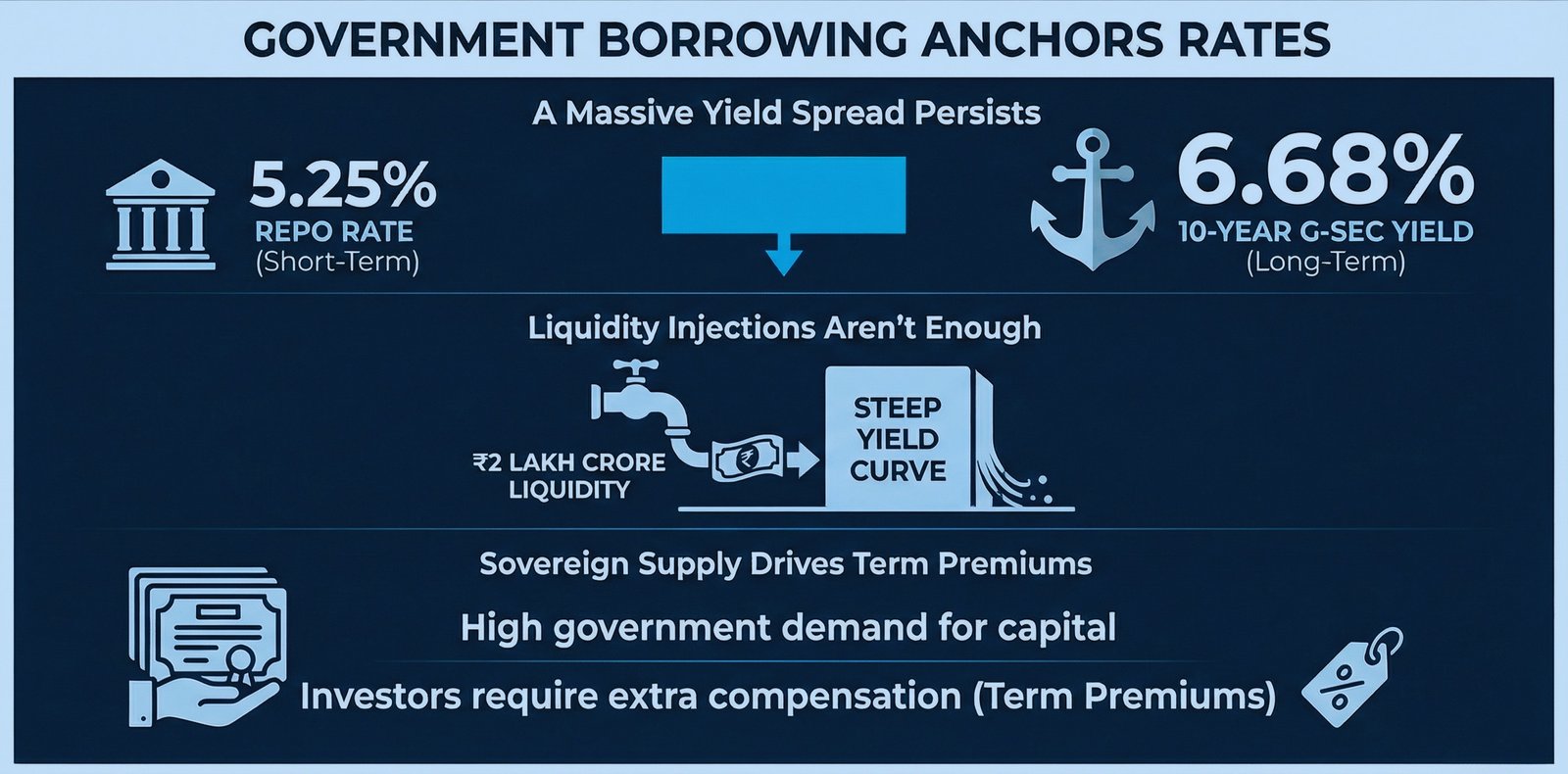
Between late January and early February, the central bank injected a staggering ₹2 lakh crore into the banking system. They used everything in the toolkit: a massive $10 billion Forex swap, ₹1 lakh crore in Open Market Operations (OMOs), and targeted Variable Rate Repo (VRR) auctions.

It worked. As of this month, system liquidity has eased and is back in a comfortable surplus, averaging around ₹70,000 crore per day. The short end of the market can finally breathe again.

But here is where the story gets really interesting.

The Heavy Anchor at the Long End

The RBI successfully extinguished the fire at the short end of the curve. You would expect the rest of the market to relax, right?

Instead, the long end did not respond proportionately.

Today, the benchmark repo rate sits at 5.25%, broadly steady through this phase. Yet, the benchmark 10-year G-Sec yield is stubbornly anchored around 6.68%. That is a massive spread. The long end is sitting at levels we haven’t seen since before the last tightening cycle, especially after a 125bps rate cut in less than a year.

Why is the long end so heavy despite a ₹2 lakh crore liquidity injection? It comes down to basic supply and demand.

The government’s borrowing calendar is massive. When sovereign supply (meaning the states and centre wants to borrow more form the market) is this fundamentally high, the term premium (the extra compensation investors demand for locking their money away for years) simply refuses to compress.

The curve remains noticeably steep, even when central bank liquidity is sloshing around the system.

The Illusion of Easy Carry

This creates an appealing, if frustrating, environment for anyone managing capital. You have a newly liquid short-end where rates remain elevated, and a heavy sovereign supply keeping long yields sticky.

On paper, it looks attractive. Short spreads offer carry. The mid-curve suggests roll-down.
But credit markets rarely offer free yield.

This is not a regime of easy carry. It is a regime of selective carry.

Picking Your Exposure: Rollover vs. Duration

When you park your capital in the short end, you face rollover risk. Yes, liquidity is in surplus today, at least on paper. But as December proved, liquidity cycles don’t move in straight lines. When it’s time to reinvest, the taps might be shut and funding costs could be entirely different.

Conversely, extending your maturity introduces severe duration risk. Long-term bonds are riskier, and because supply from both the states and the Centre is so high, there are fewer takers. If you extend, you are betting that the heavy supply pressure will eventually ease without eroding your capital in the meantime.

The Clock and the Basis Point

Yield alone is a lagging indicator. Spreads always widen before the broader risk reprices.

In an environment like this, simple portfolio questions suddenly become real risk decisions:

  • Are your allocations actually aligned with when the cash is needed?
  • Are those attractive short-term funding costs accurately reflecting the real pricing risk?
  • Is extending your maturity costing you more in hidden volatility than you are gaining in yield?

The curve is not distressed. It is calibrated. And calibrated markets require discipline.

Finding the Right Bucket

The real task for a treasury team today isn’t to constantly hunt for the highest-yielding bucket. It is to make sure you are standing in the right bucket when the next risk repricing happens.

Markets are not compensating us for taking on duration today, but visible carry without invisible duration risk is exceptionally rare.

Static yield chasing works perfectly—right up until the moment policy action, sovereign supply pressure, and bank funding conditions intersect. Because when the curve steepens, timing matters as much as price.

The question is: does the market's compensation match your clock?

Until next Sunday!
Disclaimer: This update is for informational purposes only. Please consult a SEBI-registered advisor before investing.

Enjoyed this week’s Sunday Shots? Share it across WhatsApp, LinkedIn, or X — and invite someone else into the conversation.
Subscribe to Sunday Shots for a fresh perspective delivered every week.

Recent Blogs

Lorem ipsum dolor sit amet, consectetur adipiscing elit. Ut elit tellus, luctus nec ullamcorper mattis, pulvinar dapibus leo.

Tomatoes Out, Netflix In: How India Just Rewrote Its Inflation Playbook

How India Just Rewrote Its Inflation Playbook

Every year, we are told the official inflation rate, and on paper, it usually doesn’t look that high. Yet when you pay your bills, renew subscriptions, refill groceries, or renegotiate rent, it often feels like your wallet is getting lighter much faster than the data suggests.

So, if you’ve felt a disconnect between the official inflation numbers and your actual monthly expenses over the last few years, you weren’t wrong.

Until last month, India was measuring a 2026 economy using a 2012 measuring stick. That officially changed on February 12, 2026, when the Ministry of Statistics completely overhauled the Consumer Price Index (CPI), shifting the base year to 2024.

This isn’t just a statistical update; it is a fundamental rewiring of how the Reserve Bank of India (RBI) views the economy, sets interest rates, and ultimately, how your investments perform.

More importantly, it officially acknowledges the economic transition of New India, a shift from subsistence-heavy spending toward diversified, digital, and discretionary consumption.

What is CPI, and Why Should You Care?

Think of the Consumer Price Index (CPI) just like the Nifty 50. But instead of tracking 50 large companies, it tracks a basket of items that a typical Indian household buys—food, rent, transport, healthcare, and education.

Each item gets a weight based on how much we spend on it. When the prices in this basket rise, the CPI rises. That is your official inflation number.

The RBI uses this exact number to decide interest rates. So, when the formula to calculate the CPI changes, everything downstream changes too.

The Basket Surgery: Retiring the VCR

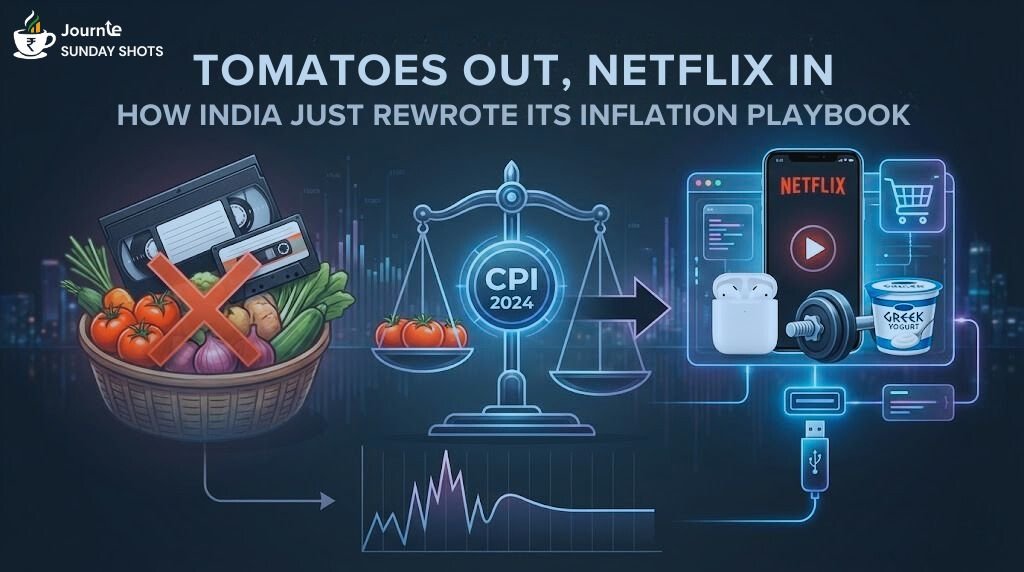
The old CPI was built on 2012 consumption patterns. Tracking VCR and DVD players in 2025 while ignoring OTT subscriptions that millions of households pay for every month was, frankly, absurd. We were measuring an India that no longer exists.

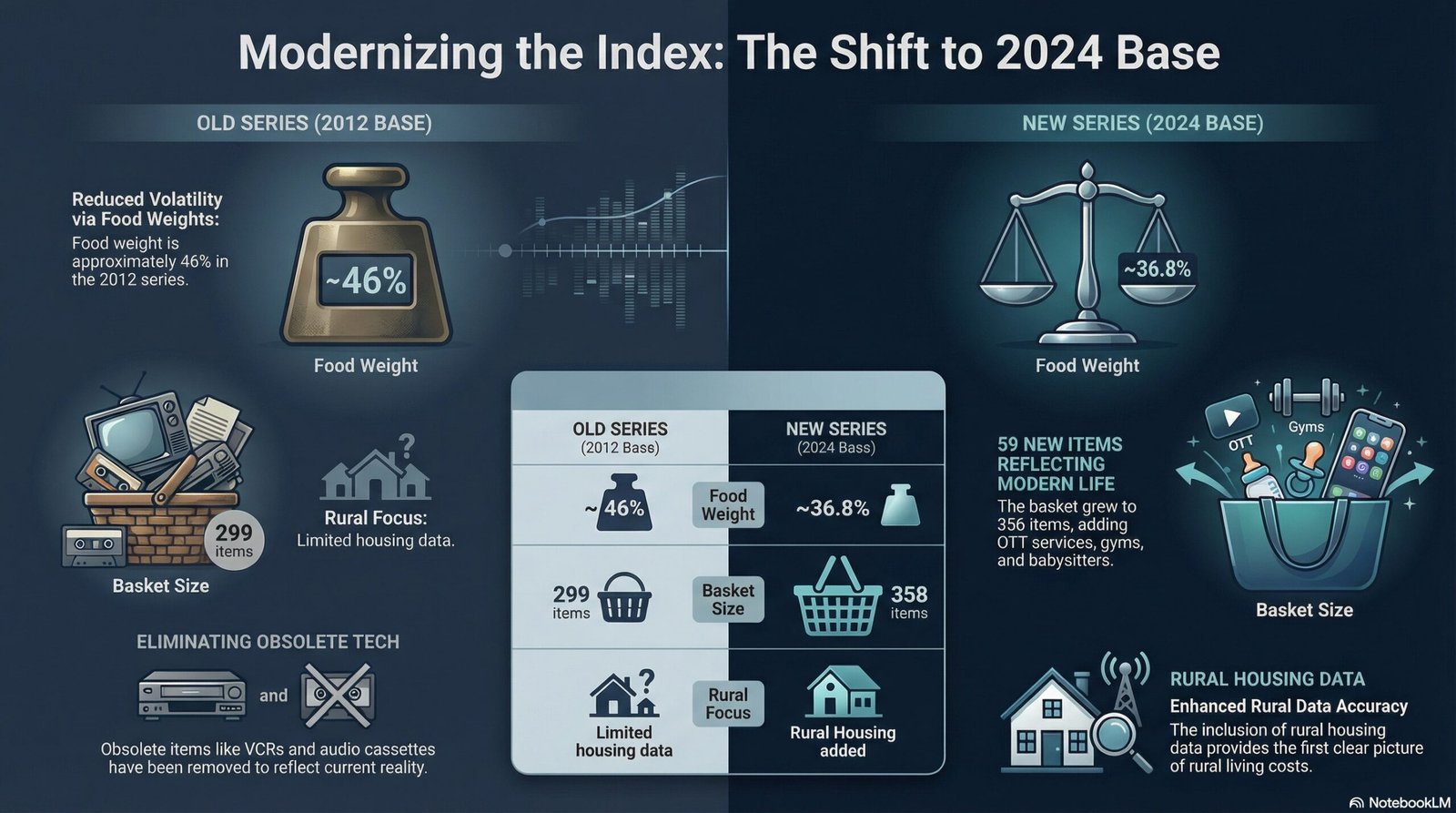
To fix this obsolescence, the government expanded the tracked items from 299 to 358 to reflect reality.

  • What’s Out: VCRs, DVD players, tape recorders, audio cassettes, second-hand clothing, and coir rope.
  • What’s In: OTT streaming subscriptions (Netflix, Prime), babysitters, gym equipment, value-added dairy (like Greek yogurt), smartphones, airpods, pen-drives and cleaner fuels (CNG/PNG).

Crucially, the methodology entered the 21st century. Instead of just paper-based surveys in local markets, officers are now using tablets to collect data.

For the first time, prices are being pulled directly from major e-commerce platforms across cities. If you buy it on Amazon, Flipkart, or Blinkit, it now counts toward the national inflation print.

Engel’s Law and the Great Rebalancing

There is a well-established economic principle called Engel’s Law: as household incomes rise, the percentage of income spent on food declines. Even if families spend more money on food in absolute terms, it occupies a smaller slice of their total consumption pie.

Under the old 2012 series, Food & Beverages made up a massive 45.86% of the CPI. This created a massive, misleading signal. A bad monsoon or a seasonal spike in tomato and onion prices would violently swing headline inflation.

But the RBI cannot control food prices with interest rates. It cannot make onions cheaper by raising the repo rate. Yet, these food-driven spikes repeatedly forced the central bank into difficult, hawkish positions.

The new CPI fixes

The new CPI fixes this distortion:

  • The Food Weight Drop: Food now accounts for 75%. Food price volatility will no longer hijack the headline number as violently.
  • The Housing Surge: The weight of Housing has jumped from 10.07% to 67%. This is a combined figure, as the increase is partly due to the first-time inclusion of Rural House Rent, which is a massive structural shift for the index.
  • The Global Standard: India adopted the UN’s COICOP 2018 framework, expanding from 6 broad groups to 12 divisions. Information and Communication now has its own dedicated weight, proving that telecom tariffs and data packs are now as essential as utilities.

In short, urban rents, telecom bills, and utility costs are now the real drivers of inflation, rather than seasonal vegetable spikes.

The "Apples-to-Oranges" Print

For the markets, predictability is everything. The first inflation print under this new series came in at a surprisingly cool 2.75% for January 2026.

You might see headlines comparing this to December 2025’s print of 1.33% (under the old math) and assuming inflation doubled. It didn’t.

Applying new weights to the exact same prices gives you a totally different number.

The government has released a linking factor to help economists back-test the data, but practically speaking, we are starting from a brand-new baseline.

The Downstream Ripple Effect

The CPI is the single most important number in the country. It influences borrowing costs, bond yields, wage indexation, and capital allocation decisions.

  • The RBI’s Next Move: With food-driven distortions minimized, RBI has a cleaner and more stable signal of underlying demand. A less volatile CPI strengthens the case for policy to respond to sustained demand trends rather than seasonal food spikes.
  • Real Returns: With inflation at 2.75%, fixed deposits and debt instruments now offer a stronger real return cushion.
  • Government Wages: The Dearness Allowance (DA) for nearly 50 lakh central government employees and 69 lakh pensioners is CPI-linked. Their future hikes will now represent actual, modern inflation.

The Capital Markets Angle

A less volatile CPI translates to a more predictable interest rate environment. A smoother inflation series compresses volatility premiums in debt and bond markets and stabilizes duration expectations.

For equities, a stable rate environment historically provides a strong foundation for sectors like real estate, auto, and consumer discretionary.

For foreign investors, it signals statistical credibility and structural maturity.

The government finally updated its economic software to match how we actually spend. Now, it’s time to ensure your portfolio is calibrated to the same reality.

The Lens Has Changed

Inflation has not disappeared. Tomatoes will still rise. Rent will still creep up. School fees will still inch higher.

But the way these forces aggregate into the headline number has changed. And that matters. Because capital flows react not just to inflation, but to the stability of inflation.

For over a decade, India’s macro story often felt noisy. Now, it may feel steadier. Whether that steadiness reflects economic evolution or statistical smoothing will reveal itself over time.

But one thing is clear: The ruler has changed.

India hasn’t rewritten its inflation story. It has simply changed the way we read it. And sometimes, the lens matters as much as the data.

Until next Sunday!
Disclaimer: This update is for informational purposes only. Please consult a SEBI-registered advisor before investing.

Enjoyed this week’s Sunday Shots? Share it across WhatsApp, LinkedIn, or X — and invite someone else into the conversation.
Subscribe to Sunday Shots for a fresh perspective delivered every week.

Lorem ipsum dolor sit amet, consectetur adipiscing elit. Ut elit tellus, luctus nec ullamcorper mattis, pulvinar dapibus leo.

The Day the Code Broke: Is This the End of the Indian IT Giant?

If you were watching the markets last week, you saw something rare.

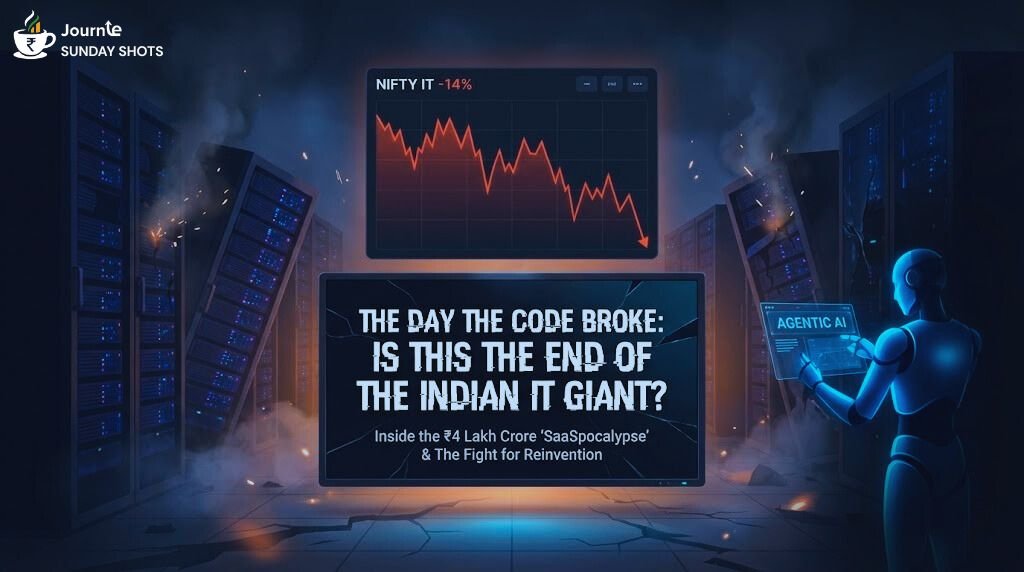
While the Nasdaq and US tech stocks hovered near recent highs amid AI optimism, India’s Nifty IT index sharply declined, down over 8% for the week and roughly 14% year-to-date.

In recent sessions, nearly ₹4 lakh crore in investor wealth evaporated from the sector. Giants like Infosys and Wipro saw 5-10% corrections mirroring global AI jitters.

This marks a stark break from the decades-old pattern: when US tech surges, Indian IT services typically follow.

But this time, US tech’s AI boom isn’t lifting Indian IT boats, it’s exposing their unique vulnerabilities amid FII outflows and automation fears.

The trigger? Not earnings, but capability gaps in the AI era.

The "SaaSpocalypse” Shock

The trigger wasn’t a bad earnings report or a new tax. It was a product launch.

When Anthropic unveiled Claude Cowork, an “Agentic AI” capable of autonomously coding, reasoning, and executing workflows that once required teams of engineers, the market didn’t celebrate. It recalibrated.

Wall Street analysts were quick to label the fear: The “SaaSpocalypse”.

The fear wasn’t that technology was growing. It was that technology was replacing.
And that distinction changes everything.

The Billable Hour Under Pressure

Indian IT’s success has long rested on a “Linear Growth” model:

More projects = More people = More billable hours = More revenue.

It was a model built on scale and efficiency. But Agentic AI introduces a structural tension into that equation.

If an autonomous system can complete in minutes what previously took a team of analysts days, the question is not whether productivity rises, it will.

The question is where the economic value shifts. Does it remain with the service provider, or migrate toward the AI creator?

Markets are betting that value accrues upstream: to those who build foundational models, chips, and platforms, not necessarily to those who integrate them.

The Double Whammy: AI + Rates

This structural fear is being compounded by a cyclical one.

The Great Decoupling, we are seeing isn’t just about robots. It’s about the Fed. Last week’s surprisingly strong US jobs data (130,000+ new roles) killed hopes of an early interest rate cut.

  • The AI Fear: “Clients won’t need us.”
  • The Macro Fear: “Clients can’t afford us.”

Caught in this pincer movement, Foreign Institutional Investors (FIIs) aren’t just selling; they are rotating.

They are buying the AI Creators (Nvidia, Microsoft) and dumping the Service Providers (TCS, Infosys).

But...We’ve Seen This Movie Before

Indian IT has faced existential predictions before. If you’ve been reading Sunday Shots for a while, a few months ago, we wrote about how Indian IT is written off every decade.

  • 1999: Critics dismissed Y2K as a one-time fluke. It built a global industry.
  • 2008: Global budgets froze in the crisis. Indian IT repositioned as a cost-efficiency partner.
  • 2015: Cloud automation was supposed to shrink outsourcing. Indian firms became migration specialists.

Each wave of disruption initially looked like a threat. Each became a pivot.

But this moment carries a nuance. Earlier transitions created new layers of work: migration, integration, and governance. Automation demanded deployment and monitoring.

Agentic AI does something subtler: it compresses the need for repetitive labor.

This isn’t merely cyclical. It’s a question of the model’s elasticity.

The Paradox: Fear vs Reality

But here is the twist that the panic-selling misses: The companies are actually doing fine.

Just days ago, Cognizant announced a 100% variable pay (bonus) payout because it hit its targets early. TCS and HCL Tech are winning deals.

The cash registers are ringing today. The crash is entirely about tomorrow.

The market is pricing in a future where the “Service Model” collapses, even while the companies post healthy profits right now.

The Pivot: From "Labor" to "Orchestration"

The giants aren’t sleeping. While the stock prices bleed, the boardrooms are pivoting from Labor Arbitrage to Intelligence Orchestration.

  • TCS has already trained over 350,000 employees in Generative AI. They aren’t trying to fight the AI; they are building the “Digital Twins” that run it.
  • Infosys is deploying Topaz, an AI-first service suite, into 80% of its client deals.
  • HCL Tech is winning massive contracts not to maintain legacy systems, but to migrate them so AI can use them.

Indian IT’s new bet is not that AI will increase billing hours. It is that enterprises will require trusted partners to integrate, secure, govern, and operationalize AI at scale.

Autonomous systems may generate output, but regulated enterprises still need oversight, compliance, and domain alignment.

The Final Code

The crash of 2026 is painful, but it is also a necessary de-rating.

The market is stripping away the growth at any price valuation and forcing these companies to prove their new worth.

The Linear Model is dying. But the Indian IT sector? It is simply shedding its old skin.

The winners of the next decade won't be the companies with the largest employee base. They will be the ones who can cannibalize their own revenue fast enough to sell the solution that replaces it.

Stay tuned. The code is changing, but the developers are still here.

Until next Sunday!
Disclaimer: This update is for informational purposes only. Please consult a SEBI-registered advisor before investing.

Enjoyed this week’s Sunday Shots? Share it across WhatsApp, LinkedIn, or X, and invite someone else into the conversation.
Subscribe to Sunday Shots for a fresh perspective, delivered every week.

Future of Wealth: An Interview with Rakesh Patil, Founder of Journie

Focus on solving real problems, not visible ones.

Many startups raise capital efficiently but manage treasury informally. Idle cash, ad-hoc allocation, unclear liquidity planning. Even large institutions continue to operate with fragmented processes, manual tracking, physical documentation, and reconciliation gaps.

In his recent conversation with SugerMint, Rakesh Patil, Founder of Journie, shares the thinking behind building 𝗝𝗼𝘂𝗿𝗻𝗶𝗲 𝗩𝗮𝘂𝗹𝘁, an institutional-grade treasury platform designed as a central treasury and investment layer structured around runway visibility, liquidity segmentation, governance readiness, and efficient capital deployment.

India–US Trade Reset: The Art of the Deal, Revisited

Ind-US-Trade-Reset-Feature-Image-sunday-shots

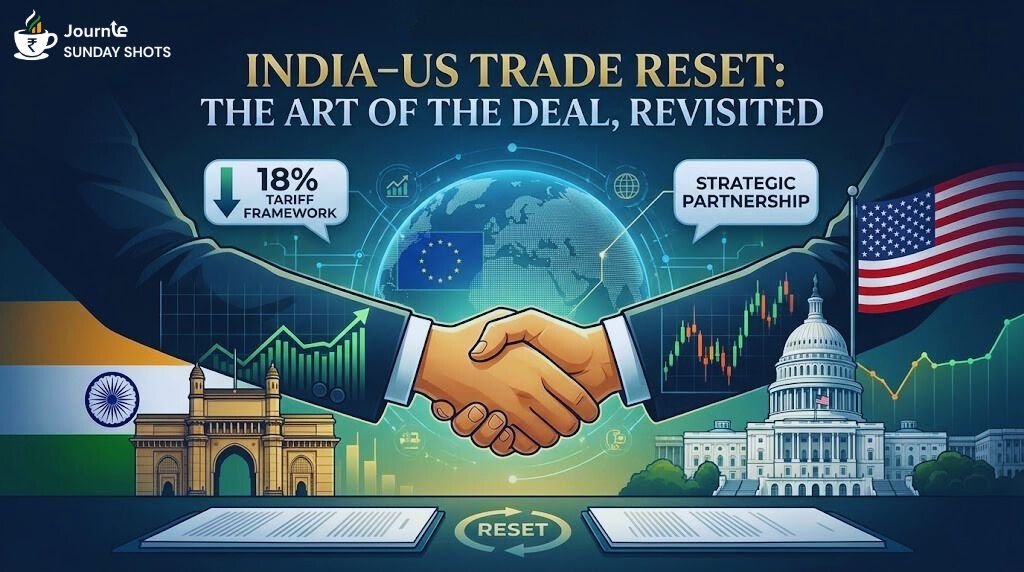
In classic finance as in life, markets don’t reward noise; they reward certainty. And over the past week, India found itself not just in the headlines, but at the centre of a subtle but meaningful shift in global trade dynamics.

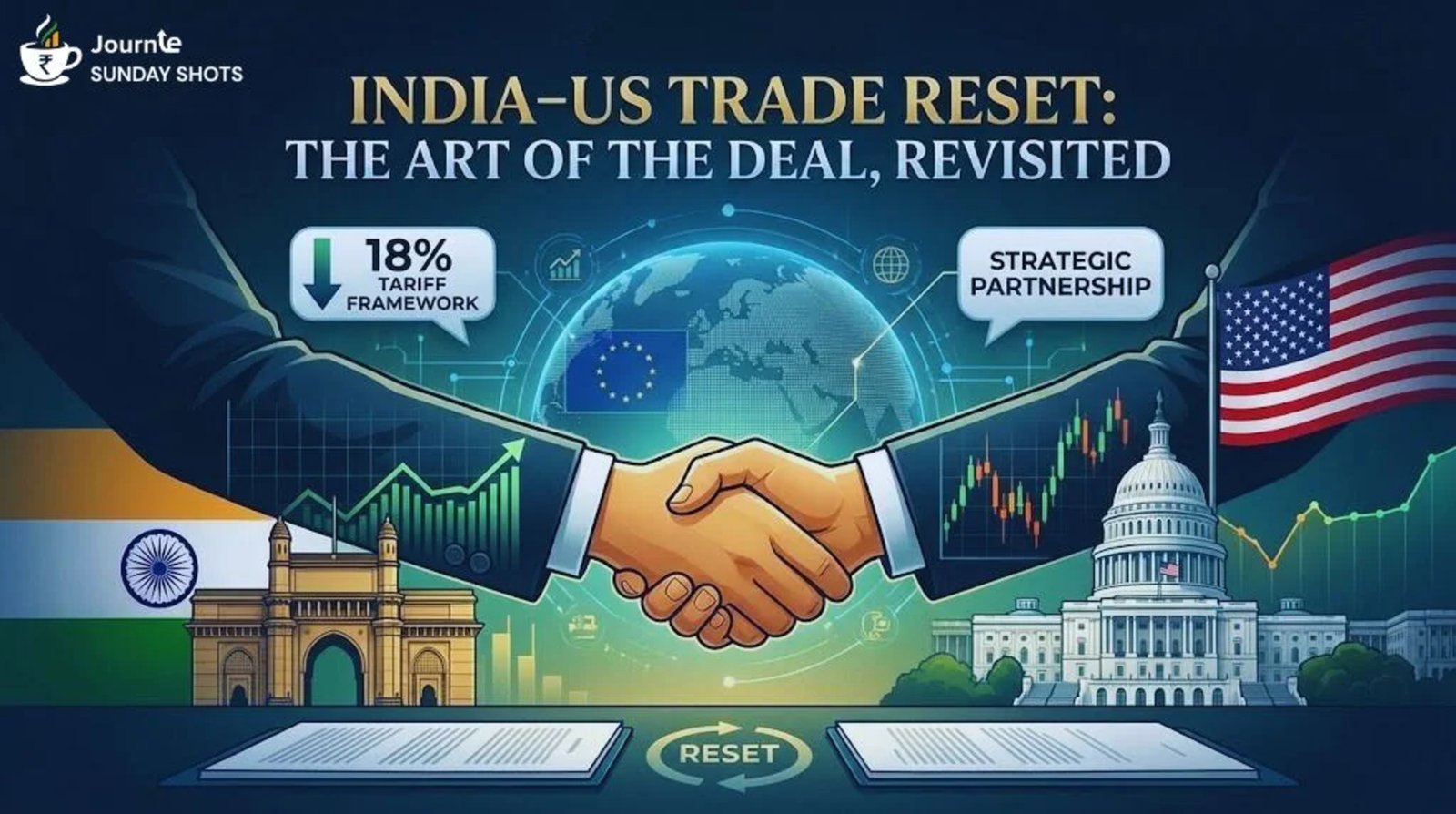
A potential trade agreement between India and the United States, involving an ~18% tariff framework and broader commitments to strengthen economic ties, has become more than a policy bulletin.

It’s a recalibration of trade, trust, and strategic positioning on the world stage, with implications that stretch well beyond headline figures.

Ghosts of the Trade Crisis Past

To fully appreciate this development, we have to rewind.

In August 2025, relations between New Delhi and Washington weren’t frigid; they were tense. A sharp escalation of tariffs had pushed duties on Indian exports into punitive territory, with effective rates nearing 50% once additional levies tied to energy imports were layered in.

This wasn’t just about trade terms. It was geopolitics expressed through tariff rates — a pressure tactic linked to strategic choices around energy sourcing and foreign policy alignment. Indian exporters felt it acutely, especially across labour-intensive sectors from textiles to engineering.

The question wasn’t whether there would be a resolution, it was when, and on what terms.

What’s Been Announced (and What’s Still in Progress)

This week, both sides signalled meaningful progress.

The United States indicated plans to reduce tariffs on Indian goods from 50% tariff towards an ~18% framework, addressing one of the largest overhangs in the bilateral trade relationship. India, in turn, has signalled openness to calibrated tariff reductions on select US imports as part of a broader bilateral agreement.

A formal joint statement and legally binding framework are expected by mid-March 2026, marking the shift from signalling to execution.

Markets responded quickly to the development. Equity indices stabilized, the rupee strengthened, and export-linked segments saw an immediate sentiment lift as policy uncertainty began to clear.

The Context Markets Didn’t Miss

The timing wasn’t incidental.

Just days earlier, the Union Budget had unsettled markets. Higher taxes on trading (STT) and a perception of policy tightening triggered a sharp risk-off reaction.

Against that backdrop, the trade reset acted less like a stimulus, and more like a counterweight. Not reversing the budget’s intent, but restoring confidence that India’s external positioning remained steady, pragmatic, and globally aligned.

Markets didn’t celebrate. They exhaled.

Behind the Scenes: Why Now?

This wasn’t a lightning strike. It was a slow pivot.

Over the last 12–18 months, India has methodically diversified its trade and strategic relationships.

  • A long-pending free trade agreement with the European Union finally crossed the line, giving India a structural hedge against single-partner dependence.
  • New corridors opened with smaller but strategically relevant partners like New Zealand and Oman.
  • Energy sourcing widened with strategic $2.8 billion Uranium supply agreement with Canada (in progress).
  • Even supply-chain engagement with China was approached with calibrated pragmatism, particularly around securing inputs like critical APIs and chips.

The signal to Washington was soft, but unmistakable: India has options.

A prolonged standoff would not have isolated India; it would have risked isolating the US from one of the world’s most consequential growth stories.

Seen in that light, this reset looks less like a concession and more like a recalibration, one aimed at restoring predictability between two large democracies navigating a fragmented global order.

What Changed: The Core Economic Shift

The new framework doesn’t eliminate tariffs. But two shifts matter.

First, the reduction from punitive peaks to a predictable tariff corridor materially improves competitiveness for Indian exporters relative to Asian peers.

Second, and more important — markets dislike uncertainty more than high rates. The removal of a visible policy overhang changes behaviour: order commitments, capital allocation, and risk pricing adjust accordingly.

This is not just about cost economics. It’s about visibility.

Beneficiaries: And the Limits of the Headline Narrative

Immediate sentiment beneficiaries include export-oriented sectors with established US exposure:  textiles and apparel, gems and jewellery, and auto ancillaries.

The math is simple: At an 18% tariff, Indian exporters now hold a clear pricing advantage over competitors in China (~34%), Vietnam (~20%) or Bangladesh (20%). For the first time in years, the tariff differential works for India, not against it.

Crucially, the official text explicitly mentions a “preferential tariff rate quota for automotive parts”—a massive, documented win for the auto ancillary sector.

Medium-term beneficiaries are broader capital flows. As uncertainty fades, foreign allocations tend to stabilize, often before fundamentals visibly improve.

Still unclear are the details that will ultimately matter most:

  • Product-specific tariff schedules
  • Rules of origin and compliance costs
  • Sector-level access and exclusions

These will define real trade flows, not the early market reaction.

Fine Print vs Public Posturing

As with most trade negotiations today, public claims have run ahead of policy text.

The quoted $500 billion figure is real, but nuanced. The document confirms India’s “intent to purchase” this amount over the next 5 years. It is not an immediate commitment, but a long-term potential procurement list focused on Energy, Aircraft (Boeing), Precious Metals, and Technology Products (specifically GPUs).

Similarly, on Russian oil, the MEA’s rebuttal was swift but nuanced: “Energy security for 1.4 billion people is the supreme priority.” Purchases will follow commercial viability and price, not just political pressure.

The timeline reveals a diplomatic win for New Delhi: The US will cut tariffs to 18% first (via Executive Order expected within days), while India’s corresponding tariff reductions will only kick in after the formal legal pact is signed in mid-March.

The sequencing favours early confidence, while concessions remain conditional on legal closure.

What to Watch Next

From here, outcomes will hinge on execution. Three signposts matter:

  • The Domestic Fortress: While Commerce Minister Piyush Goyal confirmed that Dairy and Staple Crops are protected, the document reveals specific openings. The document points toward selective openings in premium agricultural categories, including tree nuts, select fruits, and ethanol-linked products.
  • The Legal Text: Expected by mid-March, which will determine the exact duty cuts.
  • Implementation Timelines: Because trade impact arrives through phases, not press releases.

This is where credibility is earned.

The Takeaway: A Strategic Reset

This potential India–US agreement isn’t a simple tariff rollback. It’s a strategic reset.

It’s about reducing one of the largest blocks of policy risk India has faced in global commerce. A move from friction toward managed partnership, reflecting a broader realignment of trade, energy security, and geopolitics.

The markets reacted with measured relief. Execution now matters more than the announcement.

And whether this becomes durable economic architecture, or just another chapter in global recalibration, will be decided over time.

Until Next Sunday!

Disclaimer: This update is for informational purposes only. Please consult a SEBI-registered advisor before investing.

‘I sometimes feel stuck, overthinking every decision’: India’s Gen Z knows how to invest, so why aren’t they doing it?

Gen Z in India gets investing better than any generation before it. Yet many still don’t act.

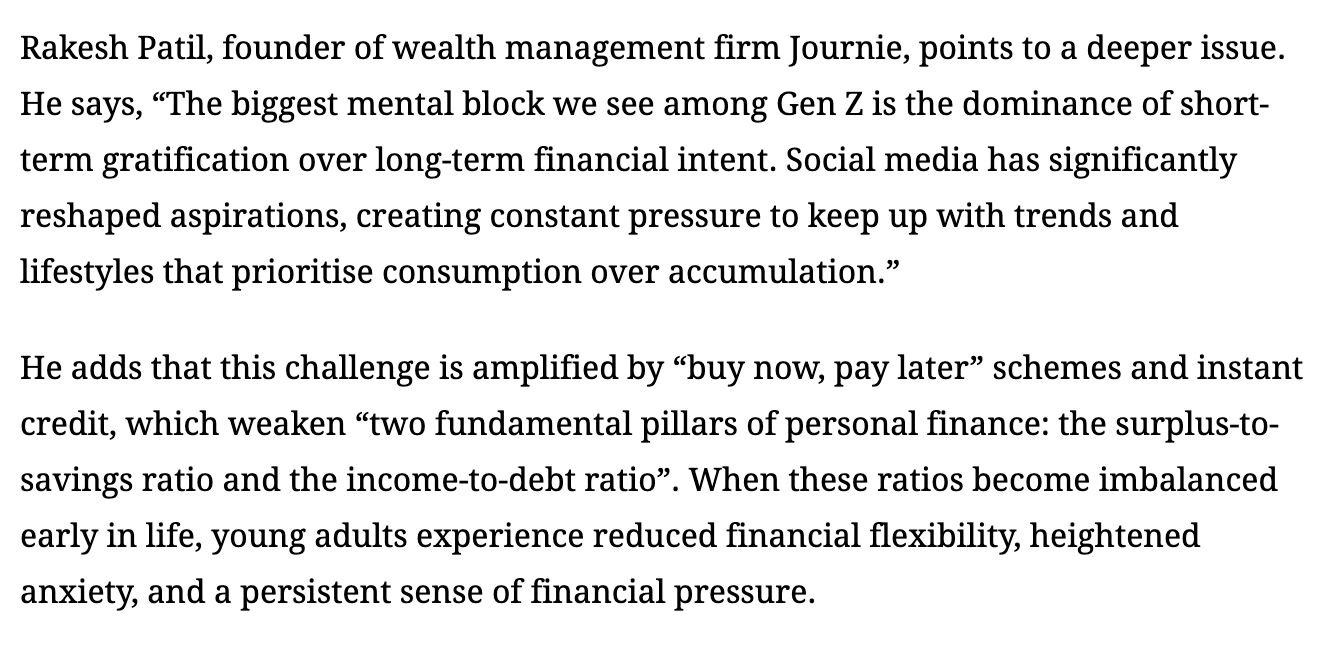
This surfaced in a recent The Indian Express feature, with insights from our founder Rakesh Patil.

What’s getting in the way isn’t a lack of knowledge. It’s a world built for instant gratification.

Easy credit, buy now, pay later, and social media-driven lifestyles quietly push spending ahead of saving. When this starts early, financial flexibility shrinks long before compounding can do its job.

India-EU FTA: The 18-Year Handshake That Shields India from Global Trade Storms

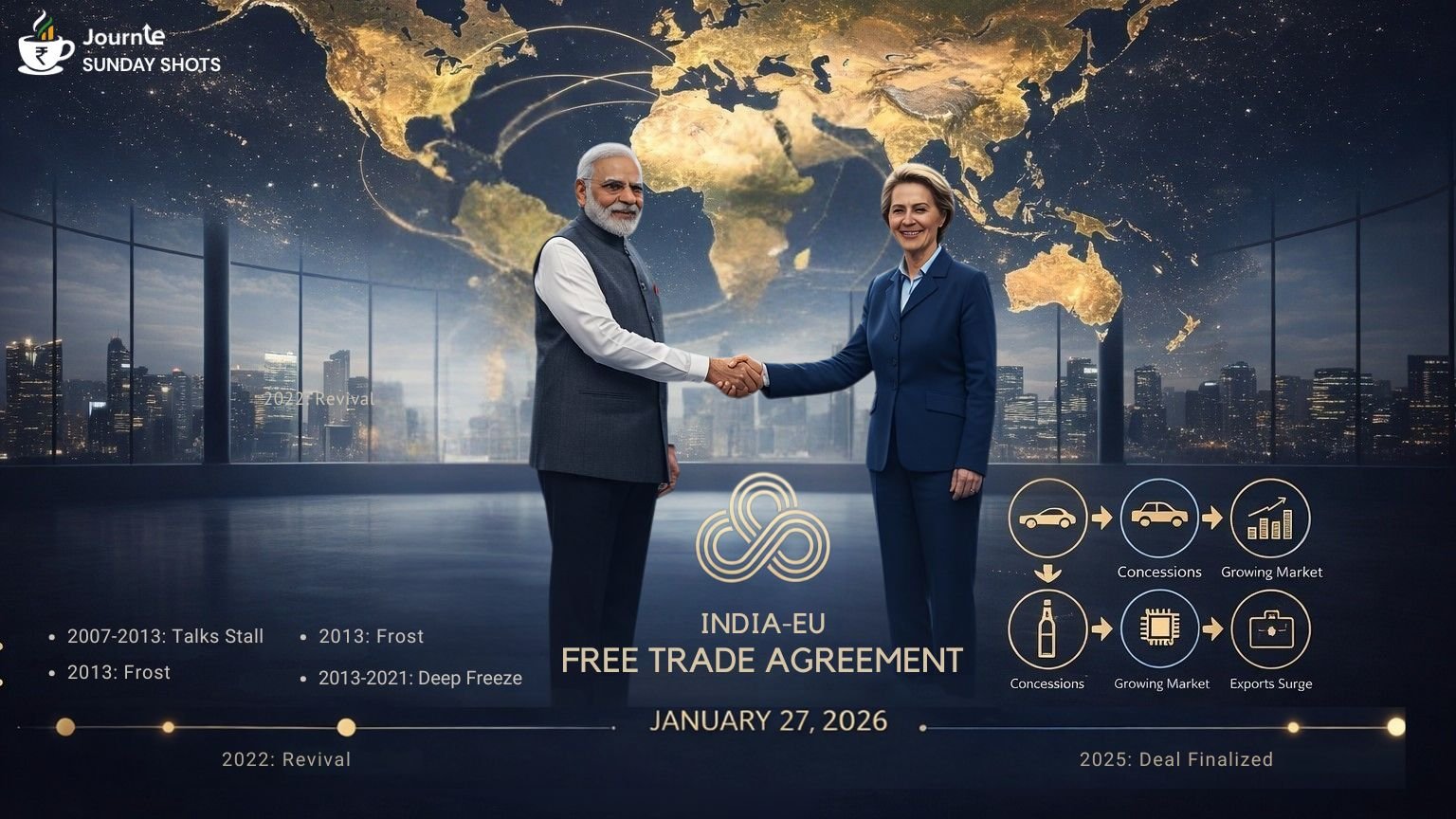
India-EU FTA: The 18-Year Handshake

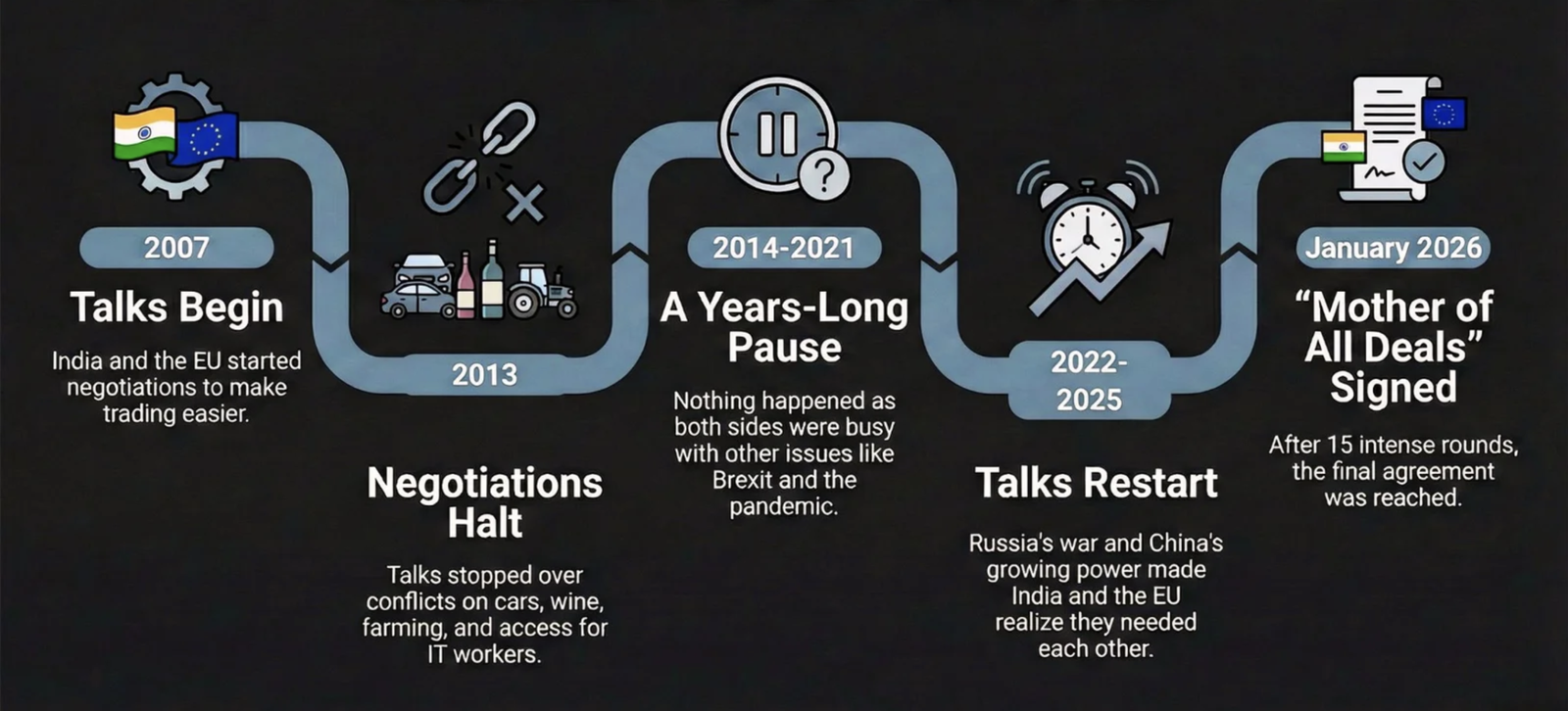
It started in 2007. The world was a very different place, then. The first iPhone had just been released; and “streaming” meant standing by a river.

Diplomats from New Delhi and Brussels sat down to discuss a trade deal, optimistic it would be done quickly. However, that initial meeting sparked an 18-year marathon.

Negotiations stalled, collapsed, and froze for nearly a decade. Finally on January 27, 2026, at the 16th India-EU Summit in New Delhi, the deadlock finally broke and that marathon conversation finally ended with a handshake in New Delhi. Leaders emerged to announce the official conclusion of the India-EU Free Trade Agreement (FTA).

Dubbed the “Mother of All Trade Deals,” this isn’t just a paperwork or a contract; it is a geopolitical realignment. It’s India’s masterstroke against US tariff chaos, unlocking a $27 trillion market playground for exporters, investors, and everyday wealth builders. It creates one of the planet’s largest free trade zones, covering 2 billion people and 25% of global GDP.

But why did it take two decades? And why did it happen now? The answer lies not just in economics, but in a rapidly changing world order where old friends are becoming new necessities.

The Epic Backstory: A 20-Year Rollercoaster

Back in 2007, India, the rising economy, meets the EU powerhouse. Talks kick off with champagne dreams: zero tariffs, easy services, and free flowing tech.

But reality bit hard. By 2013, after 16 rounds of talks, the deal crashed. India guarded its auto kings (with 110% tariffs) and dairy farms; Europe pushed for wine, cheese, and patent protections. For the next nine years, the deal sat in the deep freeze, sidelined by Brexit, COVID, and the Ukraine war.

The Revival (2022): The Modi-von der Leyen duo revived the talks, splitting them into bite-sized tracks. After 14 “turbo rounds” of negotiation, the finish line was finally crossed this week.

January 27, 2026: A saga of patience has finally paid off.

Why Now? The US Tariff Catalyst

For nearly two decades, the deal was stuck in a stalemate. India wanted to protect its farmers; Europe wanted to sell its cars.

Then came the “Tariff Storm” of 2025.

With the US slapping 50% tariffs on Indian goods, India’s export engine started to sputter. Suddenly, the “difficult” negotiations with Europe didn’t seem so difficult anymore. India needed a new home for its products, and Europe needed a stable, democratic alternative to China.

The deal transformed from a mere trade agreement into a strategic “Economic Lifeboat.”

By securing deep access to the EU, India is “de-risking” its economy. It’s a signal to the world that India is ready to be a reliable, long-term partner in global supply chains, moving beyond the “Make in India” slogan to a “Make for the World” reality.

The Great Exchange: Ind-EU Deal at a Glance

Category For India (The Win) For EU (The Win)
Exports Textiles & Gems: 0% Duty Wine: Duty drops to 20% (from 150%)
Inputs Cheaper Machinery: 0% Duty Autos: Duty drops to 10% (from 110%)
Future Visas & Green Funds Services: Access to Finance/IT sectors

At its core, every trade deal is a barter. “I’ll buy your cheese if you buy my shirts.” In this deal, the exchange was massive.

What India Gave (The Import Cuts): India agreed to reduce or eliminate tariffs on 92.1% of its tariff lines. The biggest headlines are in luxury and lifestyle:

  • Automobiles:If you’ve ever wondered why a European car costs double in India, it’s the 110% import tax. That tax is being slashed to 10% (for the first 250,000 vehicles per year). High-end BMWs, Audis, and Mercedes-Benzes are about to become a lot more accessible.
  • Alcohol:The 150% duty on wines and spirits. This was a long-time grievance of European distillers, and will now drop to 20–40% for premium ranges. Your Sunday brunch might soon feature authentic French Bordeaux or Scotch Whisky without the heart-stopping price tag.
  • Consumer & Industrial Goods:Duties on olive oil, pasta, chocolate, and fruit juices hit zero. More importantly, tariffs on EU machinery, chemicals, steel, and aircraft parts were eliminated, lowering costs for Indian factories.

What India Got (The Export Boom): The EU opened 96.8% of its tariff lines, covering 99.5% of India’s exports by value.

  • Zero-Duty Access:The biggest winners are India’s labor-intensive champions. Critical sectors like textiles, apparel, leather, footwear, gems, and jewelry will now enter Europe at 0% duty.
  • The Impact:This is a direct lifeline for Indian manufacturing, leveling the playing field against competitors like Vietnam and Bangladesh and potentially unlocking a $33 billion export surge.

Beyond Goods: People, Power, and "The Green Angle"

Modern trade isn’t just about shipping containers; it’s about the movement of talent and technology.

The Mobility Pact: In a landmark win for New Delhi, the deal includes a MoU on Mobility.

  • The Talent Pipeline:Perhaps the most underrated victory is for Indian talent. This facilitates the seamless movement of skilled professionals and students into Europe.
  • No Double Taxation:A new Social Security Agreement ensures that Indian techies working in the EU will no longer face double taxation on their social security contributions.
  • The Real-World Impact:Simply put, Indian professionals working in Paris or Berlin won’t lose their hard-earned pension contributions when they return home.

The Sustainability Ledger: Europe is strict on climate, and this deal reflects that.

  • Green Hydrogen:A dedicated Task Force was set up to align India’s energy ambitions with Europe’s needs.
  • Climate Cash:The EU pledged €500 million over the next two years to support India’s green transition.
  • Navigating CBAM:A major sticking point was Europe’s Carbon Border Adjustment Mechanism (CBAM). India secured “constructive frameworks” to ensure our steel and aluminum exporters aren’t unfairly penalized as these new green taxes kick in.

The “Shield”: What Stayed Behind the Wall?

India negotiated with its shield up and played a very smart defensive game. To protect the livelihoods of millions, the “Red Lines” were respected.

  • Agriculture:Sensitive sectors like dairy, wheat, rice, and poultry are largely excluded. India’s 80 million dairy farmers can sleep easy, their market remains protected. So, you won’t see subsidized European milk flooding the market and hurting Indian farmers.
  • Budget Cars:The tax cuts only apply to luxury/premium cars. Your local hatchbacks and compact SUVs won’t face a flood of cheap imports.

Beyond Trade: A Security Pact

This summit wasn’t just about economics; it was about security. Amidst global uncertainty, the deal cements a new geopolitical axis.

  • Strategic Agenda 2030:A roadmap was signed for deep cooperation in defense and digital connectivity.
  • Security Partnership:New pacts on maritime security and counter-terrorism were forged to handle hybrid threats.
  • Science & Tech:The deal renews scientific cooperation through 2030 and opens talks for India to join Horizon Europe, the EU’s flagship research program.

The Road Ahead: When Does This Touch Your Wallet?

The ink is dry, but the work has just begun. The agreement is now undergoing “legal scrubbing” and translation. It still needs ratification from both the European Parliament and the Indian government.

Most estimates suggest the agreement will enter into force around early 2027, though an accelerated start by late 2026 is possible if ratification moves quickly. Some tariff cuts could start earlier under provisional application once both sides agree.

So you may not see your favourite German car or Italian wine get cheaper tomorrow morning, but the direction of travel is clear.

The Bottom Line

After 18 years of "will they, won't they", India and Europe have finally decided to walk the path together. 

Is it a perfect deal? No. Indian companies will have to race to meet Europe's strict "Green Standards" (like the Carbon Tax).

But in a world where the old rules of trade are being torn up, India has built a massive, stable bridge to the world's richest consumer market.

This handshake is a game-changer, shielding its wealth from global storms and proving that in a fragmented world, the most powerful currency is still partnership.

Until Next Sunday!

Disclaimer: This update is for informational purposes only. Please consult a SEBI-registered advisor before investing.

Oil, Ice & The Golden Dome: The Strategy Behind the Headlines

If you thought 2025 was volatile, welcome to January 2026.

This week, the world didn’t merely shift direction; it was forcibly rearranged. From the streets of Caracas to the ice sheets of Greenland, seemingly disconnected headlines revealed a cohesive pattern, a calculated strategy: a synchronized push to secure resources, routes, and leverage.

Markets, as they always do, reacted to the uncertainty before the narrative fully formed.

What we are witnessing is not chaos. It is Resource Realism — the most aggressive redrawing of the global resource map since the Cold War. The United States has launched a strategic pincer movement: one arm reaching South for the energy of the past (Oil), and one arm reaching North for the energy of the future (Uranium & Logistics).

And the target in both crosshairs? China.

Today, we dive deep into this new doctrine, the Venezuela-Greenland connection, and how the forces are rewriting the rules of the global market.

Chapter 1: The Southern Front: Black Gold and Broken Restraint

Venezuela has always been a crisis story. What changed this month is why it matters again.

On January 3rd, the status quo was shattered. The US intervention that effectively displaced the top leadership wasn’t just a military operation; it was a resource correction.

The Context: The country holds roughly 303 billion barrels of proven oil reserves, the largest in the world. Yet for 15 years, Venezuela served as China’s gas station. Beijing loaned Caracas over $60 billion, and in return, oil flowed East to pay off debts rather than North to the market.

The Pivot: Instead of a messy ideological regime change, Washington prioritized continuity. By securing the flow, the US achieves two strategic goals:

  1. Physics:Venezuelan heavy crude is chemically perfect for US Gulf Coast refineries.
  2. Geopolitics:It severs China’s energy lifeline in the Western Hemisphere. The “Bank of Beijing” has been significantly weakened.

This wasn’t about exporting democracy. It was about controlling the tap.

Notably, oil prices didn’t spike. A signal that markets expect supply to be managed. But a long-standing geopolitical restraint has been crossed. And when restraint breaks once, risk gets repriced everywhere.

Chapter 2: The Northern Front: Ice, Infrastructure, and the Golden Dome

While the dust settled in Caracas, the strategic focus shifted North, to Greenland.

What sounded like a joke in 2019 is treated as a strategic flashpoint in 2026. The reason isn’t real estate; it is three converging realities.

  1. The New Mediterranean:Melting ice is unlocking the Northwest Passage, a shipping lane that cuts Asia–Europe transit times by 40%. The Arctic is becoming the world’s most critical new logistics corridor, and Greenland is the toll booth.
  2. The Mineral Bank:Greenland hosts massive deposits of uranium and rare earth elements. Control here isn’t just about mining; it’s about breaking China’s monopolyon the critical inputs for EVs, semiconductors, and advanced defense systems.
  3. The Golden Dome:The US has linked this territory to a proposed $175B missile defense shield. Geography makes Greenland the only viable location for sensors needed to intercept hypersonic threats over the pole.

In simple terms: Greenland is not land. It is infrastructure.

When Europe pushed back on territorial discussions, the US weaponized trade.

The threat? A 10% tariff on major European economies starting February 1st, escalating to 25% by June if a deal isn’t reached. Tariffs are no longer about trade imbalances; they are leverage tied to strategic outcomes.

That was the moment markets flinched.

Chapter 3: The Silent Protagonist: China’s Shadow

China did not need to issue a single statement to be central to this story. Its footprints are visible on both fronts.

The Sequence:

  • In the South:Venezuelan oil had been a pillar of Beijing’s energy security, secured by over $60 billion in loans. That tap has been materially disrupted.
  • In the North:Chinese firms like Shenghe Resources have spent years attempting to unlock Greenland’s rare earth deposits, while Beijing formally declared itself a “Near-Arctic State” to build a “Polar Silk Road” through the melting ice. That path is now blocked.

From Washington’s perspective, these were not isolated commercial deals. They were structural threats.

Seen together, the strategy becomes clear. The US is executing a containment maneuver: secure the energy of yesterday (Oil), and deny control over the resources and routes of tomorrow (Rare Earths & Arctic Shipping).

This is not a quarterly trade dispute. It is decade-long positioning.

Chapter 4. The Market Repricing: Why India Felt It

Global markets didn’t panic last week. They stepped back.

The warning signs didn’t arrive in one burst, they accumulated. By Tuesday (Jan 20), the repricing became visible. Indian markets fell over 1% in a single session, with the Sensex shedding more than 1,000 points, echoing rising global anxiety.

Despite a muted recovery later in the week, markets closed with investors carrying unresolved risk into the weekend.

This wasn’t a routine correction. It was a repricing of risk.

When geopolitics, trade policy, commodities, and currencies begin moving together, correlations rise, and risk appetite falls.

And India? The response was rational.

  • The Gold Signal:Gold moved first, climbing to record levels (crossing ₹1.45 lakh per 10g). Not because inflation resurfaced, but because policy uncertainty did.
  • Trade War Contagion:Tariff threats against the EU raise the risk of slower European growth. Europe is a major client for Indian IT services and textiles. If Europe slows, Indian export order books feel it quickly.
  • The FII Pullback:Foreign investors dislike binary outcomes. With the February 1 tariff deadline approaching, FIIs reduced exposure to emerging markets, rotating into safer assets like US Treasuries. This week, FIIs pulled out approximately ₹14,600 Crore from Indian equities.
  • The Domestic Drag:Geopolitics wasn’t acting alone. Softer Q3 results from heavyweight banks and consumption names weakened the market’s internal cushion, amplifying the global shock.
  • Policy Proximity:With the Union Budget weeks away, caution naturally dominated conviction.

The Silver Lining: The "Second-Order" Effect

This week’s decline was not a verdict on India’s long-term story. It was a defensive reaction to shifting rules of engagement.

However, as supply chains diversify and the “China-plus-one” strategy accelerates due to these very tensions, India remains one of the few scalable alternatives. History shows that periods of global volatility often obscure opportunity in the short term, only to reveal it over longer cycles.

Markets may have stepped back this week. But capital, eventually, always looks for a place to step forward again.

The Bottom Line

We are moving from a rules-based world to a resource- and leverage-based one, from a world of Free Trade to a world of Fortress Economics.

The US is aggressively consolidating resources, energy in the South, strategic minerals in the North.

The market is currently repricing risk, which feels like volatility. Understanding the why the shift toward securing resources, removes the panic, and replaces it with perspective.

Until Next Sunday!

Disclaimer: This update is for informational purposes only. Please consult a SEBI-registered advisor before investing.

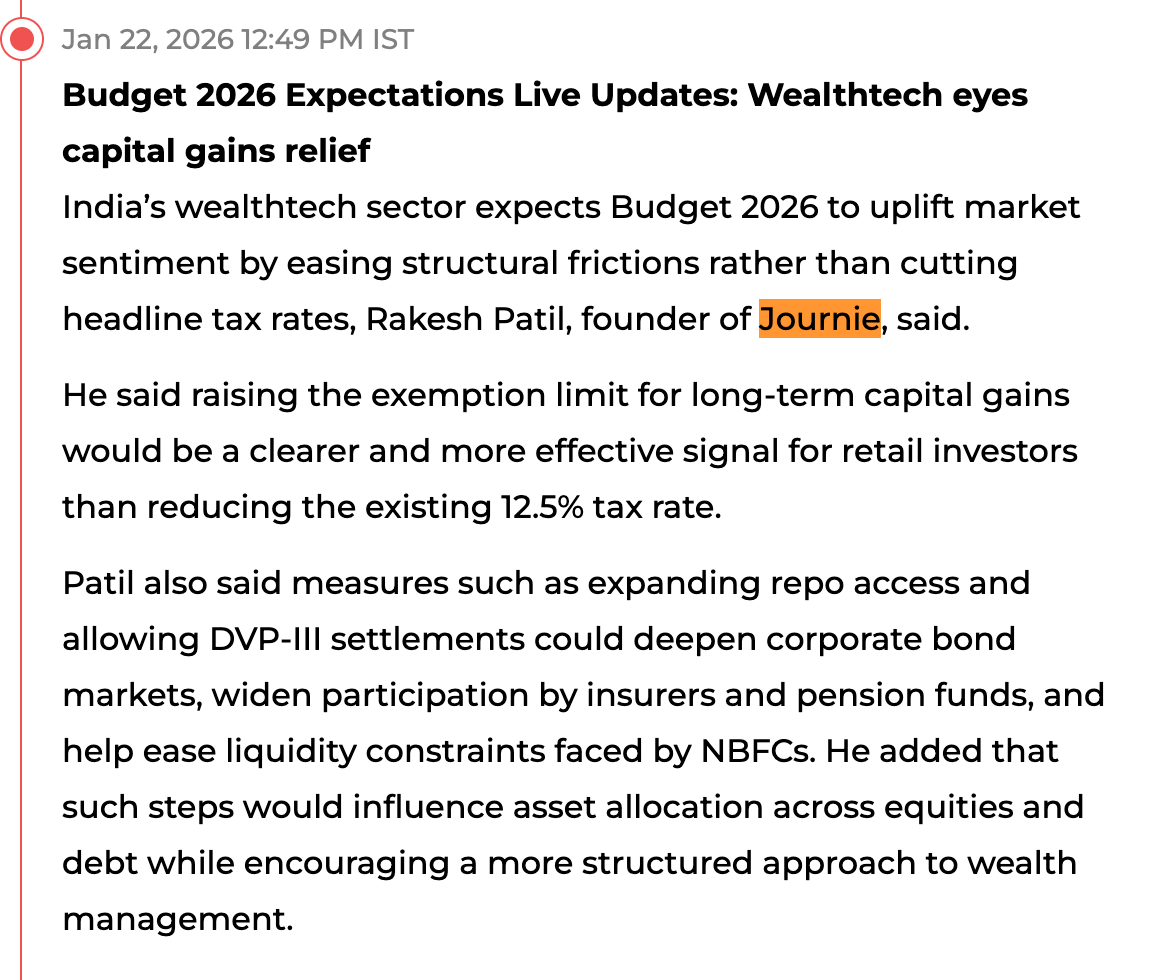
Budget 2026 Expectations: Wealthtech eyes capital gains relief

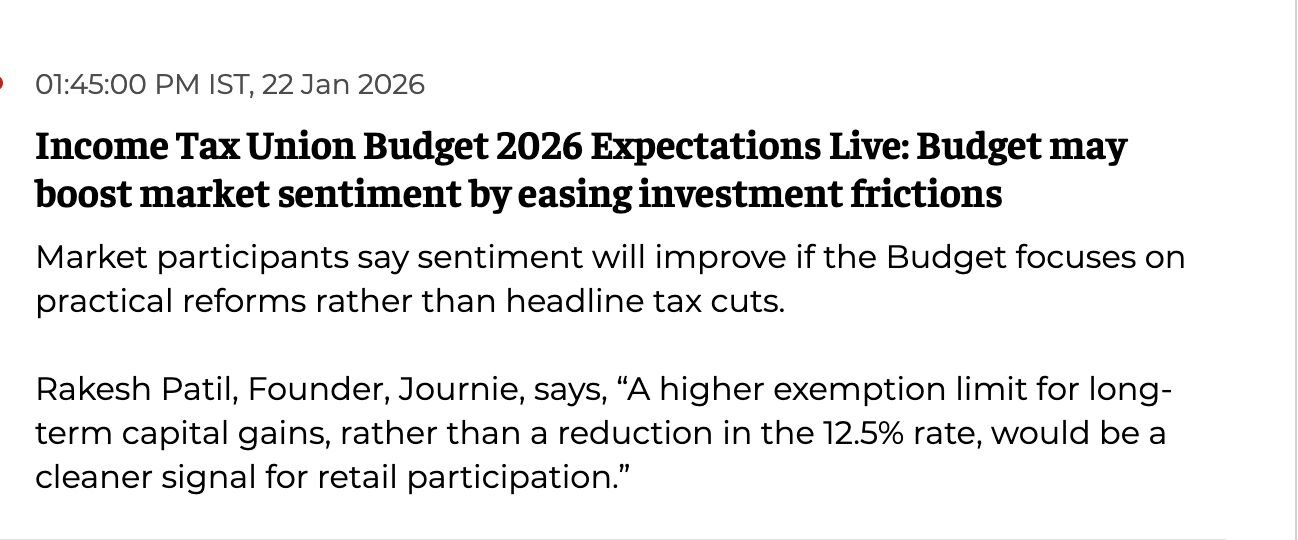
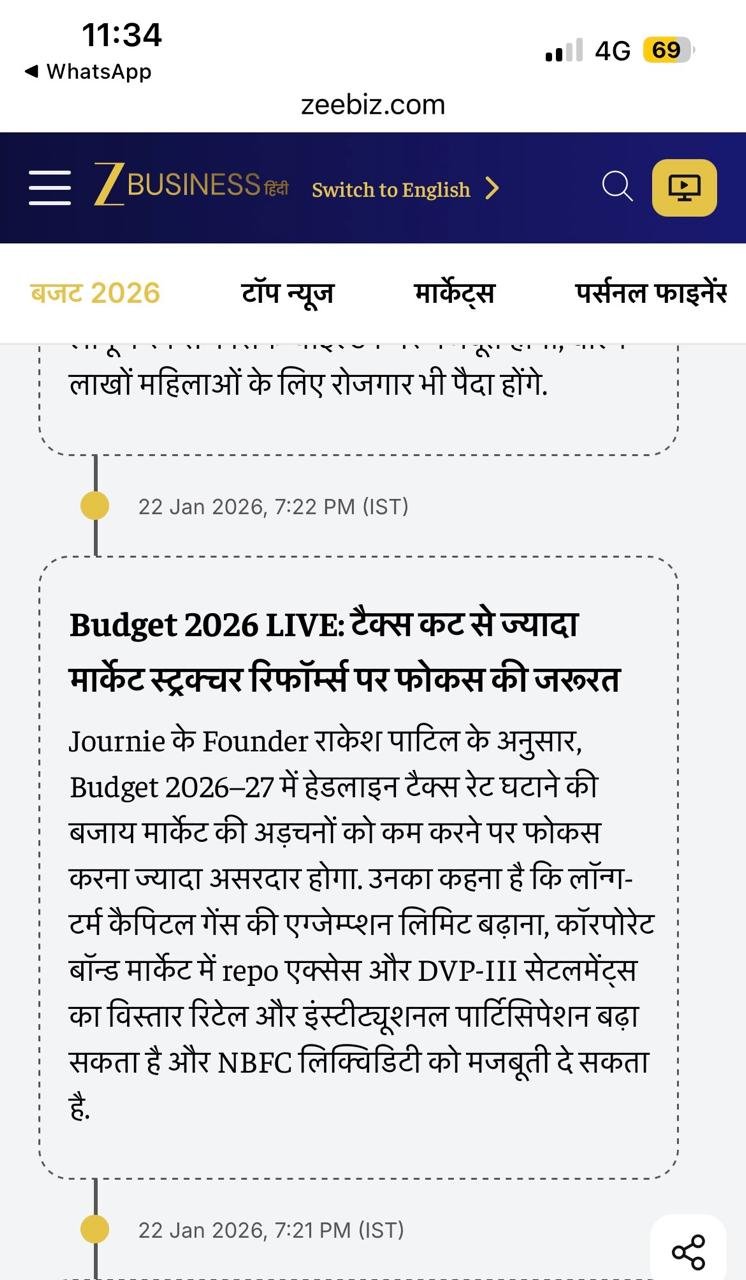
Journie’s pre-Budget perspectives were featured by The Economic TimesCNBC TV18, and Zee Business, highlighting the need for structural reforms that improve capital efficiency, deepen liquidity, and strengthen long-term investor confidence.


Startup India: A Decade That Reshaped Indian Entrepreneurship (2016–2026)

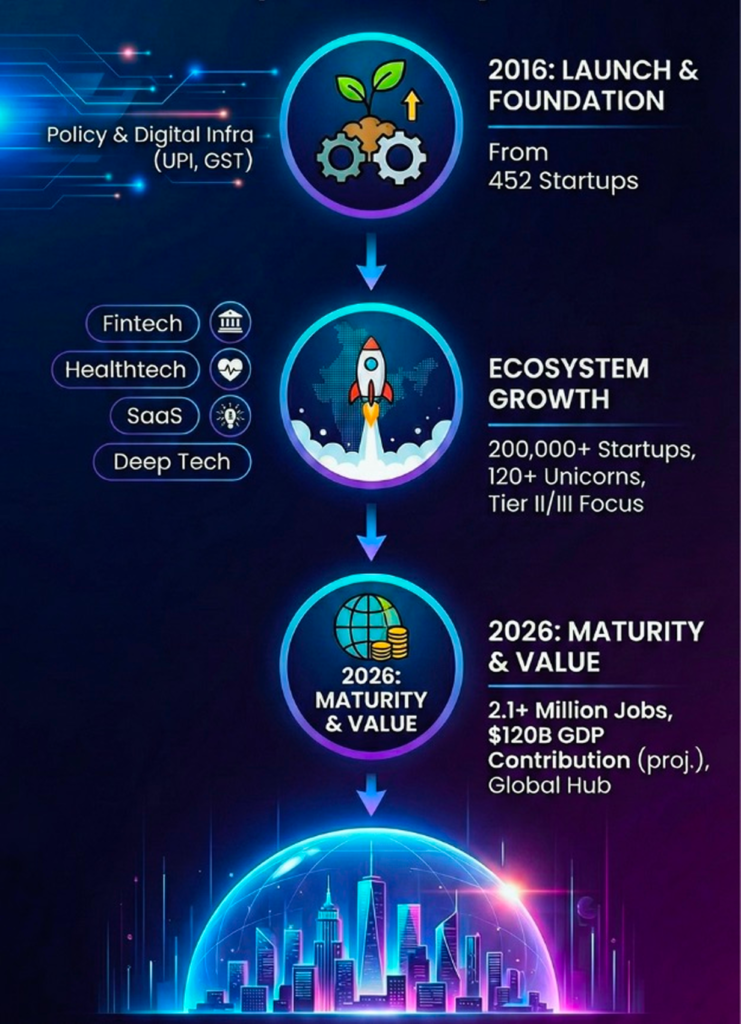
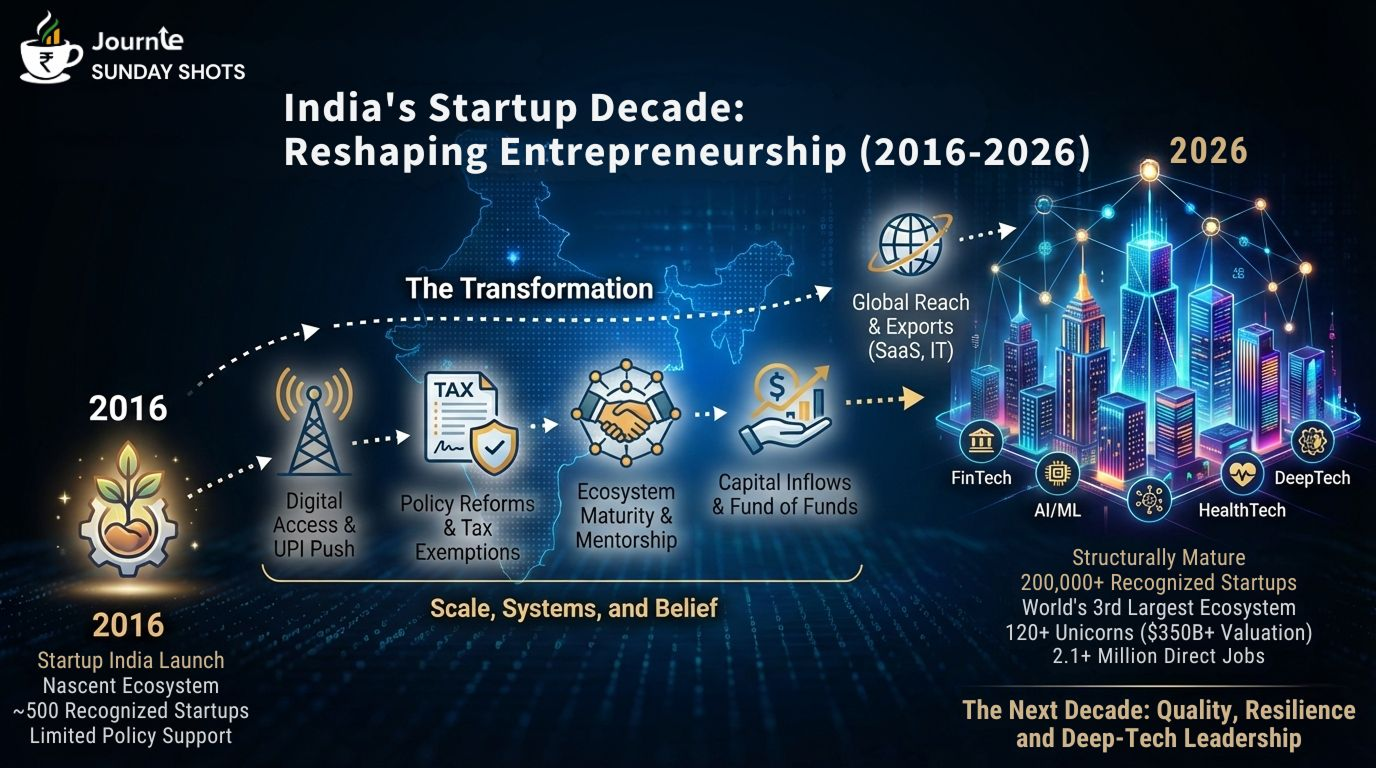
On January 16, 2016, the Government of India launched Startup India with a clear and ambitious mandate: to formalize entrepreneurship, catalyze innovation, and build a robust startup ecosystem.

A decade later, as National Startup Day 2026 marks this milestone, India’s startup story stands at a meaningful inflection point — from fragmented enterprise creation to one of the largest and structurally mature startup ecosystems in the world.

This is not just a story of scale. It is a story of systems, belief, and economic intent.

Early Foundations: Before Startups Had a Name

India’s startup story did not begin in 2016.

Its roots stretch back decades, shaped by technology, liberalization, and infrastructure.

In 1968, Tata Consultancy Services (TCS) was founded, emerging as one of India’s earliest pioneers in computer services. Long before “startup” entered the mainstream lexicon, TCS demonstrated that technology-led enterprises could be built, scaled, and exported from India.

The next inflection point came in 1991, when economic liberalization unlocked private enterprise. It enabled the growth of domestic financial institutions, expanded competitive markets, and allowed Indian technology firms to operate in a more globalized environment.

Subsequent infrastructure shifts compounded this momentum. The broadband push in the early 2000s expanded digital access, while the launch of UPI in 2016 dramatically accelerated innovation in fintech, e-commerce, and platform-led businesses.

Startup India did not invent entrepreneurship. It organized it, accelerated it, and gave it institutional form.

From Nascent Beginnings to an Ecosystem

By 2016, despite decades of entrepreneurial activity, India’s startup landscape remained embryonic.

Just 452 startups were officially recognized by the Department for Promotion of Industry and Internal Trade (DPIIT). Policy support was fragmented, access to early capital limited, and regulatory frameworks were largely designed for incumbents rather than innovators.

Startup India sought to change this foundation.

What Shifted

  • Simplified compliance and self-certification
  • Three-year tax exemptions for eligible startups
  • Faster IP and patent processing
  • Structured mentorship platforms such as MAARG
  • Seed funding and credit support mechanisms

Startup India’s most important contribution wasn’t capital. It was coherence.

Entrepreneurship finally had a lifecycle framework.

Scale That Redefined the Map

Over the next decade, the ecosystem expanded rapidly, and unevenly in all the right ways.

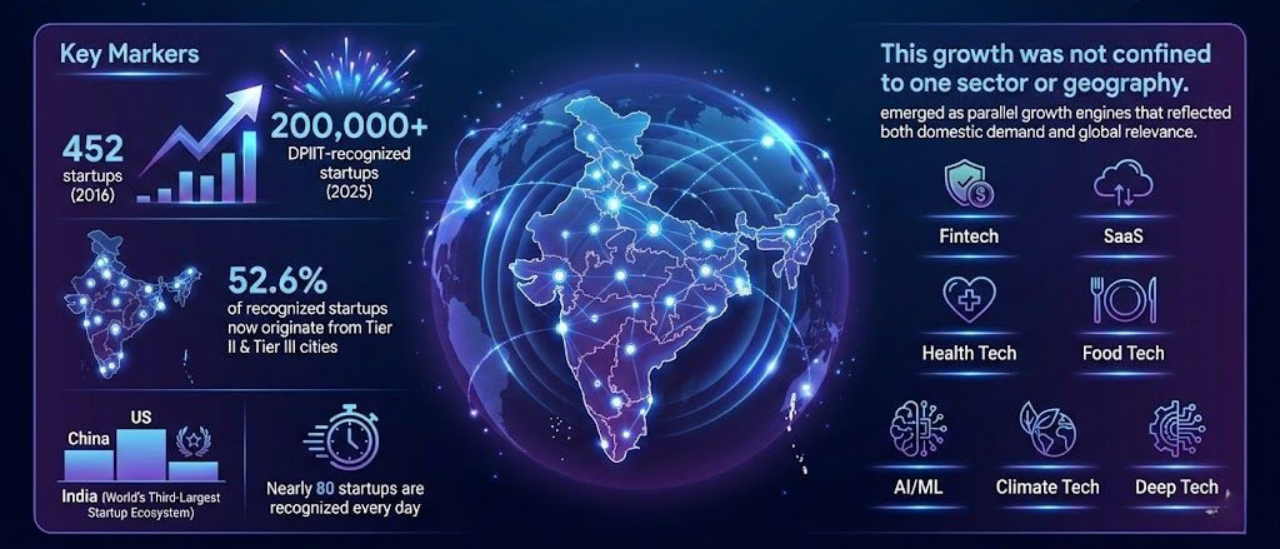
Key Markers

  • 452 startups (2016) → 200,000+ DPIIT-recognized startups (2025)
  • 52.6% of recognized startups now originate from Tier II & Tier III cities
  • India consistently ranks as the world’s third-largest startup ecosystem, after the US and China
  • Nearly 80 startups are recognized every day

This growth was not confined to one sector or geography.

Fintech, SaaS, health tech, food tech, AI/ML, climate tech, and deep tech emerged as parallel growth engines that reflected both domestic demand and global relevance.

Unicorns: From Exceptions to Outcomes

One of the most visible signals of ecosystem maturity has been the rise of unicorns. The startups valued at over $1 billion.

Unicorn Snapshot

  • 120+ unicorns as of January 2026.
  • Combined valuations exceeding $350 billion.
  • Presence across fintech, enterprise software, mobility, e-commerce, and consumer technology

Notably, India’s first unicorn pre-dated Startup India.

In 2011, InMobi, a global mobile advertising platform, crossed the $1-billion valuation mark, five years before the policy launch.

Startup India didn’t create ambition. It ensured ambition would no longer remain an exception.

Capital: From Abundance to Discipline

While Startup India cannot claim credit for all capital inflows, it played a decisive signaling role by reassuring domestic and global investors that entrepreneurship in India was institutionally supported.

A ₹10,000-crore Fund of Funds, managed through SIDBI, catalyzed over ₹90,000 crore in downstream investments — illustrating how targeted public capital can unlock private participation.

By 2025, India also emerged as one of the world’s most active IPO markets, with 35+ startup and VC-backed listings, alongside $135 billion FDI commitments from global tech giants

As global liquidity tightened, the ecosystem entered a correction phase.

This was not regression. It was maturation. Growth-at-any-cost gave way to capital efficiency, governance discipline, and clearer paths to profitability and exits.

Jobs and the Real Economy

Beyond valuations and funding rounds, startups have begun to demonstrate tangible economic impact.

Employment Impact

  • 2.1+ million direct jobs created by DPIIT-recognized startups as of January 2026, spanning IT services, healthcare, and commercial services
  • This translates to an average of ~11 jobs per startup

These figures exclude indirect employment across supply chains, platform work, and professional services, effects that are real but harder to quantify.

GDP Linkages

While precise attribution remains complex, startups are now a measurable contributor to India’s GDP, not merely an innovation layer.

In 2023, startups contributed an estimated ~$35 billion, or roughly 1–1.2% of GDP. This is  projected to rise to ~$120 billion by 2030 (around 1.5–2% of GDP), driven by scale, formalization, and productivity gains.

This contribution is reflected through:

  • Accelerated formalization of informal sectors
  • Productivity improvements via digital adoption
  • Globally competitive export businesses, particularly in SaaS and IT services

A Necessary Reality Check

The decade was not friction-free.

  • 6,000+ startups shut down in 2025 alone
  • Early-stage funding tightened sharply after the boom years
  • Many ventures struggled with unit economics and durable business models

Every serious ecosystem needs a winter. India’s separated builders from storytellers.

Failure at scale is not weakness. It is market evolution.

Beyond the Numbers: Structural Shifts

Several quieter but consequential shifts defined this decade:

1. Democratization of Entrepreneurship

Startup formation expanded far beyond Bengaluru, Mumbai, and Delhi, with sustained momentum from smaller cities and emerging state ecosystems.

2. Sectoral Breadth

While fintech and software lead, deep tech, health tech, climate solutions, and food processing are gaining traction.

3. Inclusion

The number of women founders and directors has steadily increased, reshaping leadership demographics.

4. Policy–Private Capital Synergy

Public frameworks reduced friction; private capital introduced discipline, governance, and global benchmarks.

The Next Decade: From Scale to Strength

If the first decade was about scale, the next must be about quality and resilience. India is targeting 280 unicorns, 50 million jobs, and deep-tech leadership in AI, climate, defence, and space through Startup India’s new iteration.

Priorities are clear:

  • Profitability over valuation milestones
  • Reliable exit pathways via IPOs and acquisitions
  • Innovation that addresses healthcare, climate, and agricultural productivity

Looking Ahead: From Momentum to Maturity

Startup India’s first decade has been transformational in terms of scale, ecosystem maturation, and global positioning. India today:

  • Is one of the world’s largest startup ecosystems
  • Has hundreds of thousands of recognized startups
  • Hosts 100+ unicorns with global valuations and impact
  • Has attracted meaningful capital and built credible exit pathways

But this is a checkpoint, not the destination.

The real value will come from sustainable businesses that  create jobs, exports, solutions to core problems, and long-term economic resilience.

That’s the lens India needs for the next decade: less vanity, more value.

Until Next Sunday!

Disclaimer: This update is for informational purposes only. Please consult a SEBI-registered advisor before investing.

Elevate the Way You Manage Your Wealth

For a trusted wealth experience—powered by people and technology, crafted around you.

Join the Journie

Subscribe to Journie Shots — thoughtful, well-curated insights and market stories delivered every Sunday.