
The Business Behind the Blast: Inside India’s ₹6,000+ Crore Firecracker Economy
Every Diwali night, India’s sky lights up with vibrant colours and joyous explosions. But behind those shimmering bursts lies a story of enterprise, craftsmanship, and legacy.
As we return from the festive break — refreshed, recharged, and perhaps still surrounded by a hint of sparkle — this week’s Sunday Shots takes you through an industry lane that powers that magic.
An industry that fuses chemistry, craft, and capitalism in equal measure.
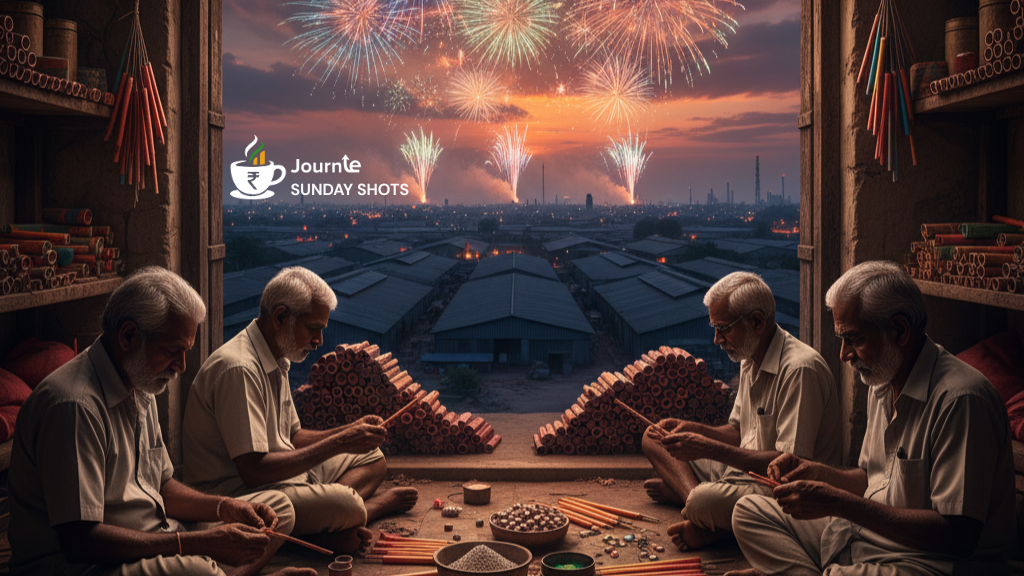
Welcome to Sivakasi — a small town in Tamil Nadu that’s become the beating heart of India’s fireworks industry.
The place that lights up India’s brightest festival, and in the process, fuels a ₹6,000+ crore economy.
A Town That Built a Festival
Sivakasi wasn’t always about fireworks.
In the early 1900s, it was known for matchsticks and small-scale printing. Over time, its dry climate, abundant labour, and enterprising families sparked a change that transformed everything.
What began as a handful of workshops gradually evolved into a vast cluster of manufacturing units, printing houses, packaging sheds, and supply chains — all tuned to the rhythm of one festival: Diwali.
Today, the town stands as a powerful industrial hub, producing over 90% of India’s fireworks and employing nearly 8 lakh people, directly and indirectly.
A town once known for matches now powers the sky.
For generations, its families have turned sparks into livelihoods — and livelihoods into legacy.
Lighting Up India’s Balance Sheet
India’s fireworks industry today is more than just festive sparkle — it’s a meaningful contributor to India’s manufacturing and trade story.
Valued between ₹6,000–7,000 crore, the industry fuels an ecosystem that goes well beyond Diwali sales, spanning chemical production, packaging, printing, logistics, and rural employment.
Each year, thousands of micro and small enterprises in and around Sivakasi add to India’s MSME output, supporting local economies across Tamil Nadu.
While the business peaks for a few months, its impact lingers — in jobs, taxes, and trade flows.
For many in southern Tamil Nadu, fireworks aren’t just a festival business; they’re a year-round livelihood cycle that sustains an entire industrial belt.
The Standard of the Spark
At the heart of this story stands one of India’s most iconic firecracker manufacturers — Standard Fire Works Private Limited.
Founded in 1977, and now led by the third generation of the founding family, the company illustrates how tradition and discipline can combine.
Over nearly five decades, it has transformed festive passion into a well-run enterprise.
In FY2024, Standard reported ₹224 crore in revenue with a profit margin of ~24%. The management cited a return on capital employed (ROCE) of around 16%, reflecting resilience in a tricky, seasonal business.
Its consistency stands out in a market known for volatility.
For every burst of colour in the sky, there’s an equation of chemistry, compliance, and capital discipline behind it.
The Fragile Side of the Fireworks
Beneath the Diwali glow lies a complex web of challenges — from regulation and safety to seasonality and scale.
Each regulatory shift, whether in bursting windows, chemical restrictions, or noise limits, changes how manufacturers plan production, manage inventory, and control costs.
Safety remains a pressing concern. Accidents in unlicensed units continue to make headlines, harming not just workers but also the reputation of the entire Sivakasi cluster.
For compliant players, one mishap anywhere in the region can invite blanket scrutiny and temporary shutdowns.
Then there’s the economic volatility — raw-material inflation, compressed production cycles, and dependence on festive demand make margins fragile.
Add to that fragmentation and counterfeits, and even the most disciplined manufacturers struggle with price pressure and perception challenges.
It’s an industry that shines bright, but often walks a thin line between compliance, competition, and consequence.
Balancing Fire and Frameworks
Over the years, India’s fireworks industry has been steadily brought under a more formal and safer structure.
It operates under the Explosives Act (1884) and Explosives Rules (2008), regulated by the Petroleum and Explosives Safety Organisation (PESO).
In recent years, environmental regulation has also reshaped the sector, with the Supreme Court mandating the use of “green crackers” that emit less smoke and noise.
For manufacturers, this has meant reformulating chemical compositions, securing certifications from NEERI, and investing in safer, mechanised production lines.
Regulation, once seen as restriction, is now viewed as a pathway to resilience — pushing the industry toward better practices, safer processes, and cleaner innovation.
The Future is Green — and Global
Despite tighter norms and rising scrutiny, India’s fireworks industry is adapting fast — finding growth in innovation, sustainability, and global reach.
Leading companies like Standard Fire Works, Kaliswari, and Vinayaka Fireworks are transitioning to eco-friendly formulations, introducing QR-coded traceability to curb counterfeits, and aligning production with green cracker certifications from CSIR and NEERI.
At the same time, the industry is looking beyond India’s skies — aiming to challenge China’s ₹26,000 crore dominance in global fireworks exports.
Eco-conscious consumers in the US, Europe, and the Middle East are increasingly open to alternatives, and Indian manufacturers are positioning themselves for that opportunity.
But scaling this ambition isn’t without challenges. From shipping bottlenecks and certification hurdles to the need for a uniform export framework, the sector still awaits stronger policy support.
If nurtured with the right backing, Sivakasi’s sparks could one day illuminate India’s export portfolio — not just its festivals.
And perhaps that’s the real spark here — transformation born from tradition.
As homes across India glow with diyas and fireworks, remember the quieter light — the one in Sivakasi’s factories , where skill meets science, and where every spark carries decades of craft and courage.
An industry that began with hand-pulled matches now builds global-grade pyrotechnics.
And behind every flash of light in the sky lies a story of Indian entrepreneurship — disciplined, generational, and deeply human.
At Journie, we believe every spark in India’s economy tells a story — of resilience, reinvention, and purpose.Until next Sunday, here’s to the sparks that outlast the celebration — steady, bright, and full of purpose.
Disclaimer: This update is for informational purposes only. Please consult a SEBI-registered advisor before investing.