
From Geopolitics to the Gas Stove: The Economics of the Hormuz Blockade

Two weeks ago, we explored the broader economics of war — how conflicts reshape supply chains and ripple through inflation and markets.

This week, those linkages are no longer theoretical.

Over the past few days, something unusual began unfolding across parts of India’s energy supply chain.

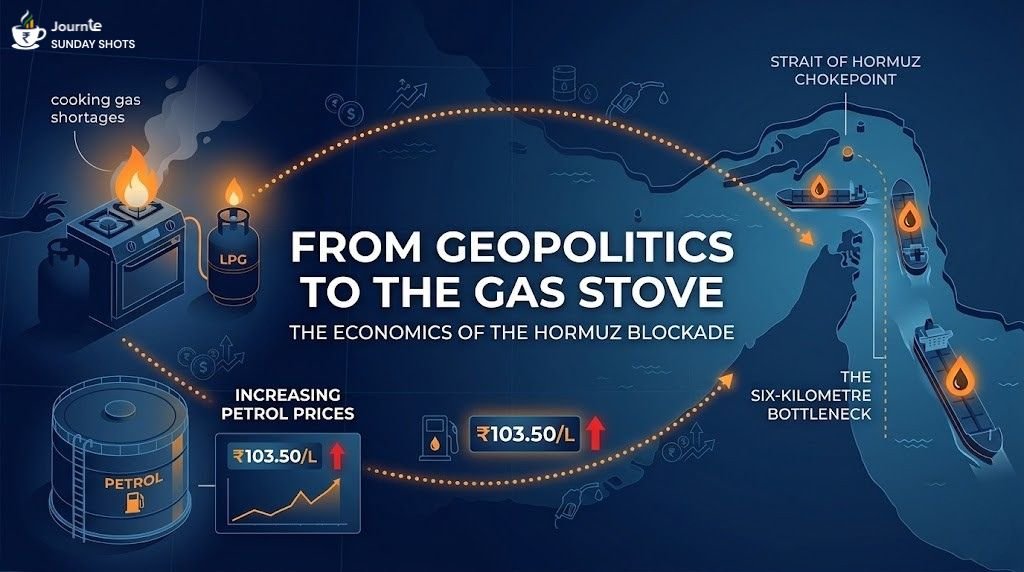
Restaurants in several cities reported difficulty sourcing commercial LPG cylinders. Households rushed to buy induction stoves amid whispers of cooking gas shortages. Energy distributors moved quickly to prioritize domestic supply as tensions in West Asia escalated.

At first glance, these may appear like isolated supply disruptions. But they tell something deeper about how the global energy system actually works.

Because India’s energy security, like much of the world’s, depends on supply chains that stretch thousands of kilometers across oceans.

And at the centre of those supply chains lies one narrow stretch of water.

The Six-Kilometre Bottleneck

If global energy markets had a heartbeat, it would probably be heard here.

The Strait of Hormuz connects the Persian Gulf to the Arabian Sea. At its narrowest point, the corridor is about 33 kilometres wide.

But the space used by the world’s oil tankers is far smaller. International maritime rules divide the strait into two shipping lanes — each about three kilometres wide, separated by a safety buffer. Which means most of the world’s energy flows through an effective corridor of just six kilometres.

Nearly one-fifth of global oil consumption passes through this bottleneck every day.

Around 20 million barrels of crude oil and petroleum products move through it daily. The same route also carries a large share of global LNG exports from Qatar.

In the architecture of global trade, Hormuz is not just important. It is irreplaceable.

A Gateway Long Before Oil

Long before oil tankers filled these waters, the Strait of Hormuz was already one of the most valuable trade gateways in the world.

In the medieval period, the rulers of the Kingdom of Hormuz made an unusual decision. They shifted their capital to a small island in the middle of the strait.

The island had almost no fresh water and virtually no agriculture. Yet it soon became one of the richest ports in the region.

Why? Because every merchant ship moving between India, Persia, Arabia, and East Africa had to pass through this narrow corridor.

The rulers simply taxed the traffic.

By the 1400s, Hormuz had become a thriving commercial hub trading silk, spices, pearls, and Persian horses. A Portuguese traveller once described it as “a great emporium of the world.”

Even then, the power of the strait was clear. Whoever controlled it controlled trade.

When Empires Fought for the Strait

Its strategic value soon attracted empires.

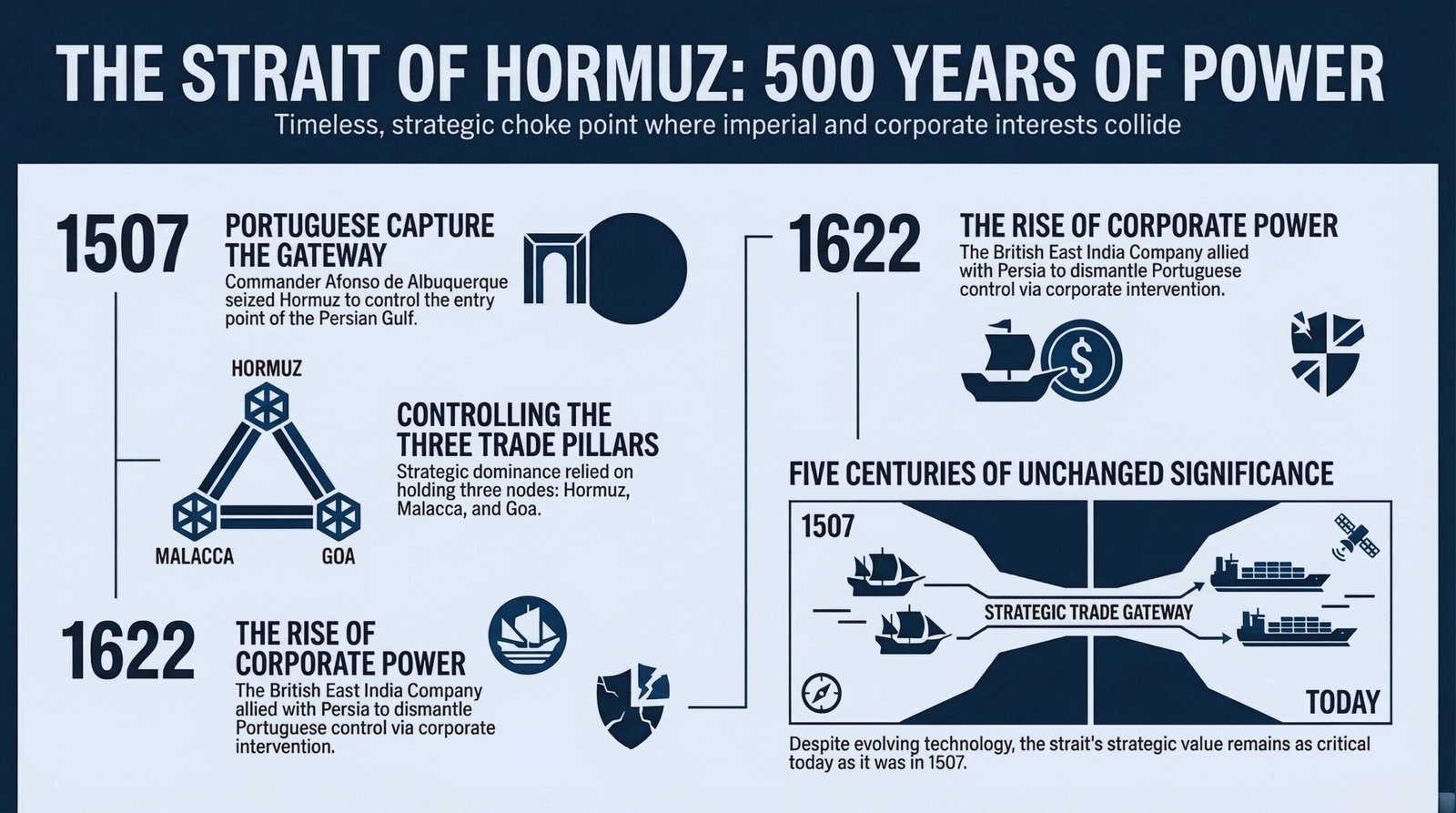
In 1507, the Portuguese commander Afonso de Albuquerque captured Hormuz and built a fortress overlooking the shipping lanes.

Portugal’s strategy was simple: control the key gateways of Asian trade.

Hormuz controlled access to the Persian Gulf. Malacca controlled Southeast Asian trade routes. Goa became the administrative capital of Portugal’s Indian Ocean empire.

For more than a century, ships entering the Gulf effectively paid tribute to the Portuguese crown.

But in 1622, the Persian Empire formed an unlikely alliance with the British East India Company to reclaim the strait. Together they expelled the Portuguese.

It was one of the earliest examples of corporate power shaping global trade routes.

Five centuries later, the ships are different. But the strategic importance of the strait remains exactly the same.

The Illusion of Alternatives

Whenever tensions rise in the Gulf, a simple question emerges: Why not bypass the strait?

The answer lies in the sheer scale of global energy flows.

Oil moves through Hormuz at volumes that pipelines simply cannot replace.

Saudi Arabia’s East-West Pipeline and the UAE’s Habshan–Fujairah pipeline do bypass the strait. But even at maximum capacity, together they can carry less than half of the oil that normally flows through Hormuz.

Countries like Iraq and Kuwait have almost no meaningful bypass infrastructure at all. Geography has effectively locked the global energy system into this narrow corridor.

The Logistics of Scale

Sometimes the best way to understand scale is through a simple comparison.

A typical Very Large Crude Carrier (VLCC) can transport about 2 million barrels of oil in a single voyage.

Now consider air cargo.

A massive aircraft like a Boeing 747 can carry the equivalent of roughly 700 barrels of crude oil by weight.

To replace the cargo of just one oil tanker, you would need nearly 3,000 cargo flights. And that is only for a single shipment.

Shipping crude by sea costs only a few dollars per barrel. Moving it by air would multiply the cost many times over.

In global energy logistics, the sea is not just the cheapest route. It is the only viable one.

When Risk Gets Priced

Energy markets are extremely sensitive to risk. They do not wait for supply to stop. They react the moment the probability of disruption increases.

Over the past week, tensions in the Gulf have started showing up in real ways.

Shipping costs have begun to rise. Insurance premiums for vessels passing through Hormuz have increased. Some operators are delaying or rerouting shipments, even at higher costs.

Oil prices have turned volatile — not because supply has stopped, but because uncertainty has increased.

And that shift is already showing up in India.

Oil marketing companies have raised prices of premium petrol variants by ₹2–3 per litre, signaling early adjustments to global conditions. Globally the gasoline prices have increased anything between 5%-25% in different nations

This is how energy markets function.

Risk shows up in logistics first. Then in prices. And eventually in everyday consumption.

Why India Is Watching the Water

For India, the Strait of Hormuz is not just a distant geopolitical flashpoint. It is deeply connected to our economic stability.

India imports more than 85% of its crude oil, with a large share sourced from producers in the Gulf. A significant portion of these shipments travels through Hormuz before reaching Indian ports.

When tensions escalate in this region, the effects show up quickly: Higher oil prices. Pressure on inflation. Currency volatility. Rising import costs.

Even small movements in energy prices can ripple through the broader economy. Which is why policymakers and markets in India watch the Gulf so closely.

The World’s Most Important Chokepoint

In the vast map of global trade routes, the Strait of Hormuz looks small. Yet every day, a significant share of the world’s energy passes through this single gateway.

For decades, global systems have been built around one assumption — that this route remains open. Most of the time, it does. But moments like these reveals how concentrated the system really is.

A single chokepoint. A narrow corridor of water. A supply chain that stretches from the Gulf to gas stoves and fuel pumps across the world.

Which is why, when tensions rise in the region, markets aren’t just watching the conflict. They’re watching the strait.

Because sometimes, the global economy moves through a corridor barely six kilometres wide.

Until next Sunday!

Disclaimer: This update is for informational purposes only. Please consult a SEBI-registered advisor before investing.

Enjoyed this week’s Sunday Shots? Share it across WhatsApp, LinkedIn, or X — and invite someone else into the conversation.
Subscribe to Sunday Shots for a fresh perspective delivered every week.

Recent Blogs

Lorem ipsum dolor sit amet, consectetur adipiscing elit. Ut elit tellus, luctus nec ullamcorper mattis, pulvinar dapibus leo.

Subscribe to Journie Shots — thoughtful, well-curated insights and market stories delivered every Sunday.