The Day the Code Broke: Is This the End of the Indian IT Giant?

If you were watching the markets last week, you saw something rare.

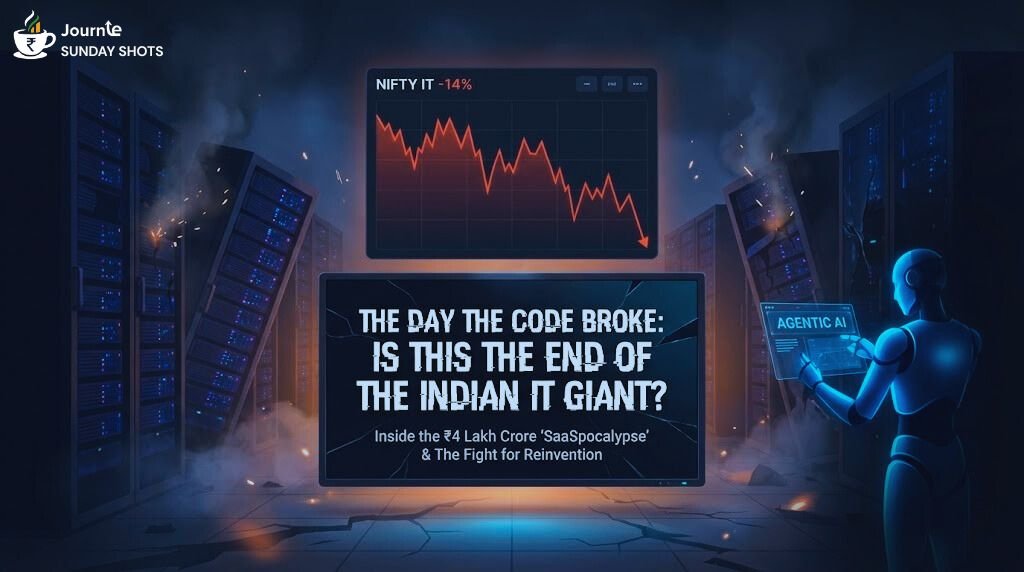
While the Nasdaq and US tech stocks hovered near recent highs amid AI optimism, India’s Nifty IT index sharply declined, down over 8% for the week and roughly 14% year-to-date.

In recent sessions, nearly ₹4 lakh crore in investor wealth evaporated from the sector. Giants like Infosys and Wipro saw 5-10% corrections mirroring global AI jitters.

This marks a stark break from the decades-old pattern: when US tech surges, Indian IT services typically follow.

But this time, US tech’s AI boom isn’t lifting Indian IT boats, it’s exposing their unique vulnerabilities amid FII outflows and automation fears.

The trigger? Not earnings, but capability gaps in the AI era.

The "SaaSpocalypse” Shock

The trigger wasn’t a bad earnings report or a new tax. It was a product launch.

When Anthropic unveiled Claude Cowork, an “Agentic AI” capable of autonomously coding, reasoning, and executing workflows that once required teams of engineers, the market didn’t celebrate. It recalibrated.

Wall Street analysts were quick to label the fear: The “SaaSpocalypse”.

The fear wasn’t that technology was growing. It was that technology was replacing.
And that distinction changes everything.

The Billable Hour Under Pressure

Indian IT’s success has long rested on a “Linear Growth” model:

More projects = More people = More billable hours = More revenue.

It was a model built on scale and efficiency. But Agentic AI introduces a structural tension into that equation.

If an autonomous system can complete in minutes what previously took a team of analysts days, the question is not whether productivity rises, it will.

The question is where the economic value shifts. Does it remain with the service provider, or migrate toward the AI creator?

Markets are betting that value accrues upstream: to those who build foundational models, chips, and platforms, not necessarily to those who integrate them.

The Double Whammy: AI + Rates

This structural fear is being compounded by a cyclical one.

The Great Decoupling, we are seeing isn’t just about robots. It’s about the Fed. Last week’s surprisingly strong US jobs data (130,000+ new roles) killed hopes of an early interest rate cut.

  • The AI Fear: “Clients won’t need us.”
  • The Macro Fear: “Clients can’t afford us.”

Caught in this pincer movement, Foreign Institutional Investors (FIIs) aren’t just selling; they are rotating.

They are buying the AI Creators (Nvidia, Microsoft) and dumping the Service Providers (TCS, Infosys).

But...We’ve Seen This Movie Before

Indian IT has faced existential predictions before. If you’ve been reading Sunday Shots for a while, a few months ago, we wrote about how Indian IT is written off every decade.

  • 1999: Critics dismissed Y2K as a one-time fluke. It built a global industry.
  • 2008: Global budgets froze in the crisis. Indian IT repositioned as a cost-efficiency partner.
  • 2015: Cloud automation was supposed to shrink outsourcing. Indian firms became migration specialists.

Each wave of disruption initially looked like a threat. Each became a pivot.

But this moment carries a nuance. Earlier transitions created new layers of work: migration, integration, and governance. Automation demanded deployment and monitoring.

Agentic AI does something subtler: it compresses the need for repetitive labor.

This isn’t merely cyclical. It’s a question of the model’s elasticity.

The Paradox: Fear vs Reality

But here is the twist that the panic-selling misses: The companies are actually doing fine.

Just days ago, Cognizant announced a 100% variable pay (bonus) payout because it hit its targets early. TCS and HCL Tech are winning deals.

The cash registers are ringing today. The crash is entirely about tomorrow.

The market is pricing in a future where the “Service Model” collapses, even while the companies post healthy profits right now.

The Pivot: From "Labor" to "Orchestration"

The giants aren’t sleeping. While the stock prices bleed, the boardrooms are pivoting from Labor Arbitrage to Intelligence Orchestration.

  • TCS has already trained over 350,000 employees in Generative AI. They aren’t trying to fight the AI; they are building the “Digital Twins” that run it.
  • Infosys is deploying Topaz, an AI-first service suite, into 80% of its client deals.
  • HCL Tech is winning massive contracts not to maintain legacy systems, but to migrate them so AI can use them.

Indian IT’s new bet is not that AI will increase billing hours. It is that enterprises will require trusted partners to integrate, secure, govern, and operationalize AI at scale.

Autonomous systems may generate output, but regulated enterprises still need oversight, compliance, and domain alignment.

The Final Code

The crash of 2026 is painful, but it is also a necessary de-rating.

The market is stripping away the growth at any price valuation and forcing these companies to prove their new worth.

The Linear Model is dying. But the Indian IT sector? It is simply shedding its old skin.

The winners of the next decade won't be the companies with the largest employee base. They will be the ones who can cannibalize their own revenue fast enough to sell the solution that replaces it.

Stay tuned. The code is changing, but the developers are still here.

Until next Sunday!
Disclaimer: This update is for informational purposes only. Please consult a SEBI-registered advisor before investing.

Enjoyed this week’s Sunday Shots? Share it across WhatsApp, LinkedIn, or X, and invite someone else into the conversation.
Subscribe to Sunday Shots for a fresh perspective, delivered every week.

Recent Blogs

Subscribe to Journie Shots — thoughtful, well-curated insights and market stories delivered every Sunday.