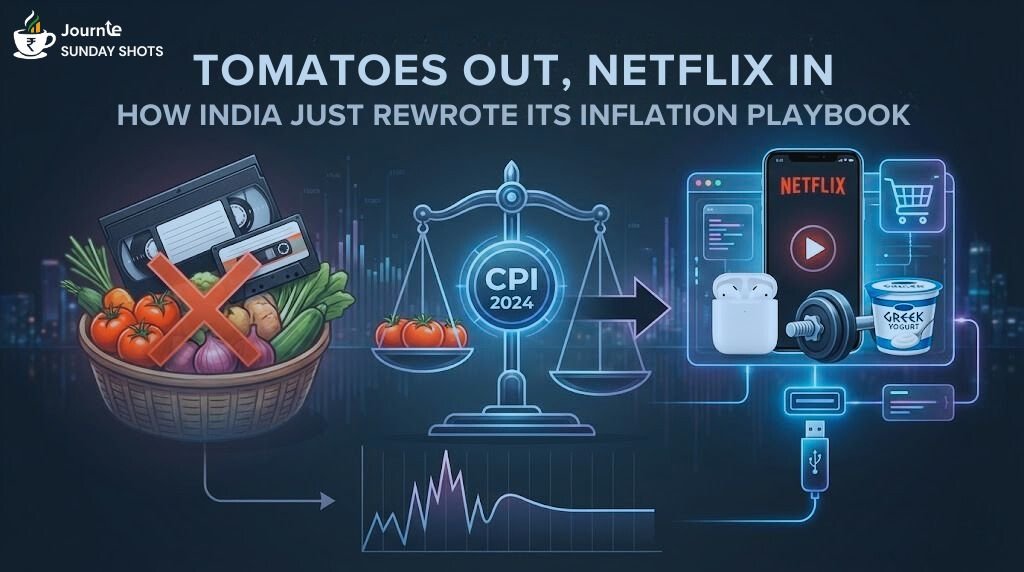

Tomatoes Out, Netflix In: How India Just Rewrote Its Inflation Playbook

How India Just Rewrote Its Inflation Playbook

Every year, we are told the official inflation rate, and on paper, it usually doesn’t look that high. Yet when you pay your bills, renew subscriptions, refill groceries, or renegotiate rent, it often feels like your wallet is getting lighter much faster than the data suggests.

So, if you’ve felt a disconnect between the official inflation numbers and your actual monthly expenses over the last few years, you weren’t wrong.

Until last month, India was measuring a 2026 economy using a 2012 measuring stick. That officially changed on February 12, 2026, when the Ministry of Statistics completely overhauled the Consumer Price Index (CPI), shifting the base year to 2024.

This isn’t just a statistical update; it is a fundamental rewiring of how the Reserve Bank of India (RBI) views the economy, sets interest rates, and ultimately, how your investments perform.

More importantly, it officially acknowledges the economic transition of New India, a shift from subsistence-heavy spending toward diversified, digital, and discretionary consumption.

What is CPI, and Why Should You Care?

Think of the Consumer Price Index (CPI) just like the Nifty 50. But instead of tracking 50 large companies, it tracks a basket of items that a typical Indian household buys—food, rent, transport, healthcare, and education.

Each item gets a weight based on how much we spend on it. When the prices in this basket rise, the CPI rises. That is your official inflation number.

The RBI uses this exact number to decide interest rates. So, when the formula to calculate the CPI changes, everything downstream changes too.

The Basket Surgery: Retiring the VCR

The old CPI was built on 2012 consumption patterns. Tracking VCR and DVD players in 2025 while ignoring OTT subscriptions that millions of households pay for every month was, frankly, absurd. We were measuring an India that no longer exists.

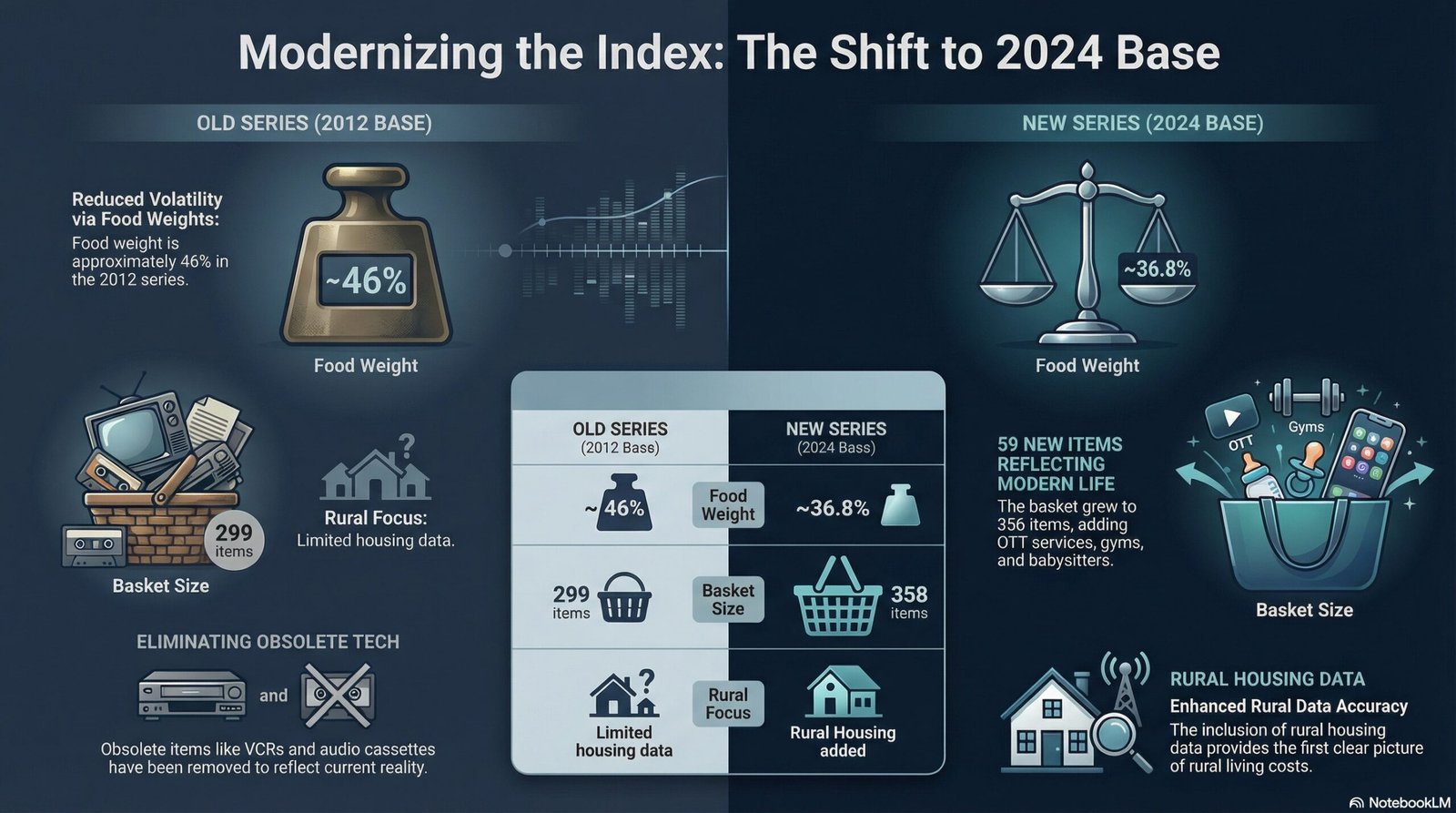
To fix this obsolescence, the government expanded the tracked items from 299 to 358 to reflect reality.

  • What’s Out: VCRs, DVD players, tape recorders, audio cassettes, second-hand clothing, and coir rope.
  • What’s In: OTT streaming subscriptions (Netflix, Prime), babysitters, gym equipment, value-added dairy (like Greek yogurt), smartphones, airpods, pen-drives and cleaner fuels (CNG/PNG).

Crucially, the methodology entered the 21st century. Instead of just paper-based surveys in local markets, officers are now using tablets to collect data.

For the first time, prices are being pulled directly from major e-commerce platforms across cities. If you buy it on Amazon, Flipkart, or Blinkit, it now counts toward the national inflation print.

Engel’s Law and the Great Rebalancing

There is a well-established economic principle called Engel’s Law: as household incomes rise, the percentage of income spent on food declines. Even if families spend more money on food in absolute terms, it occupies a smaller slice of their total consumption pie.

Under the old 2012 series, Food & Beverages made up a massive 45.86% of the CPI. This created a massive, misleading signal. A bad monsoon or a seasonal spike in tomato and onion prices would violently swing headline inflation.

But the RBI cannot control food prices with interest rates. It cannot make onions cheaper by raising the repo rate. Yet, these food-driven spikes repeatedly forced the central bank into difficult, hawkish positions.

The new CPI fixes

The new CPI fixes this distortion:

  • The Food Weight Drop: Food now accounts for 75%. Food price volatility will no longer hijack the headline number as violently.
  • The Housing Surge: The weight of Housing has jumped from 10.07% to 67%. This is a combined figure, as the increase is partly due to the first-time inclusion of Rural House Rent, which is a massive structural shift for the index.
  • The Global Standard: India adopted the UN’s COICOP 2018 framework, expanding from 6 broad groups to 12 divisions. Information and Communication now has its own dedicated weight, proving that telecom tariffs and data packs are now as essential as utilities.

In short, urban rents, telecom bills, and utility costs are now the real drivers of inflation, rather than seasonal vegetable spikes.

The "Apples-to-Oranges" Print

For the markets, predictability is everything. The first inflation print under this new series came in at a surprisingly cool 2.75% for January 2026.

You might see headlines comparing this to December 2025’s print of 1.33% (under the old math) and assuming inflation doubled. It didn’t.

Applying new weights to the exact same prices gives you a totally different number.

The government has released a linking factor to help economists back-test the data, but practically speaking, we are starting from a brand-new baseline.

The Downstream Ripple Effect

The CPI is the single most important number in the country. It influences borrowing costs, bond yields, wage indexation, and capital allocation decisions.

  • The RBI’s Next Move: With food-driven distortions minimized, RBI has a cleaner and more stable signal of underlying demand. A less volatile CPI strengthens the case for policy to respond to sustained demand trends rather than seasonal food spikes.
  • Real Returns: With inflation at 2.75%, fixed deposits and debt instruments now offer a stronger real return cushion.
  • Government Wages: The Dearness Allowance (DA) for nearly 50 lakh central government employees and 69 lakh pensioners is CPI-linked. Their future hikes will now represent actual, modern inflation.

The Capital Markets Angle

A less volatile CPI translates to a more predictable interest rate environment. A smoother inflation series compresses volatility premiums in debt and bond markets and stabilizes duration expectations.

For equities, a stable rate environment historically provides a strong foundation for sectors like real estate, auto, and consumer discretionary.

For foreign investors, it signals statistical credibility and structural maturity.

The government finally updated its economic software to match how we actually spend. Now, it’s time to ensure your portfolio is calibrated to the same reality.

The Lens Has Changed

Inflation has not disappeared. Tomatoes will still rise. Rent will still creep up. School fees will still inch higher.

But the way these forces aggregate into the headline number has changed. And that matters. Because capital flows react not just to inflation, but to the stability of inflation.

For over a decade, India’s macro story often felt noisy. Now, it may feel steadier. Whether that steadiness reflects economic evolution or statistical smoothing will reveal itself over time.

But one thing is clear: The ruler has changed.

India hasn’t rewritten its inflation story. It has simply changed the way we read it. And sometimes, the lens matters as much as the data.

Until next Sunday!

Disclaimer: This update is for informational purposes only. Please consult a SEBI-registered advisor before investing.

Enjoyed this week’s Sunday Shots? Share it across WhatsApp, LinkedIn, or X — and invite someone else into the conversation.
Subscribe to Sunday Shots for a fresh perspective delivered every week.

Recent Blogs

Lorem ipsum dolor sit amet, consectetur adipiscing elit. Ut elit tellus, luctus nec ullamcorper mattis, pulvinar dapibus leo.

Subscribe to Journie Shots — thoughtful, well-curated insights and market stories delivered every Sunday.