

The Rupee’s Journey: When 90 Became a Milestone
There are moments in a market cycle when a number stops being a statistic and becomes a story.
Last week, 90 became that number.
For the first time in history, the Indian rupee slipped past ₹90 per US dollar — a moment that felt dramatic for households, symbolic for policymakers, and almost inevitable for markets watching the slow drift through 2025.
This edition breaks down: why we reached this point, why the RBI isn’t panicking, and what this milestone really means for India’s economy and investors.
The Background: How We Reached 90
Through most of 2024, the rupee drifted lower but stayed inside a comfortable range, supported by stable growth and strong FX reserves. In 2025 the script changed. A series of global and domestic pressures slowly built up pressure.
- A widening trade deficit: India’s import appetite — crude, electronics, gold, capital goods; kept rising even as exports softened. Each month of deficit added pressure: more dollars went out; more rupees chased them.
- The global dollar wave: Geopolitical tensions and slowing growth across Europe and China drove global investors into the US dollar. When the dollar surges, most emerging market currencies tend to bend. The rupee did too.
- Foreign outflows: Foreign investors trimmed equity and debt exposure as US yields remained attractive. Outflows amplified pressure on the currency.
- A widening trade deficit: India’s import appetite — crude, electronics, gold, capital goods; kept rising even as exports softened. Each month of deficit added pressure: more dollars went out; more rupees chased them.
By early December, the rupee finally slipped past 90—a psychological line that made years of slow depreciation suddenly feel like a headline.
The Plot Thickens: Why the Rupee Fell Further
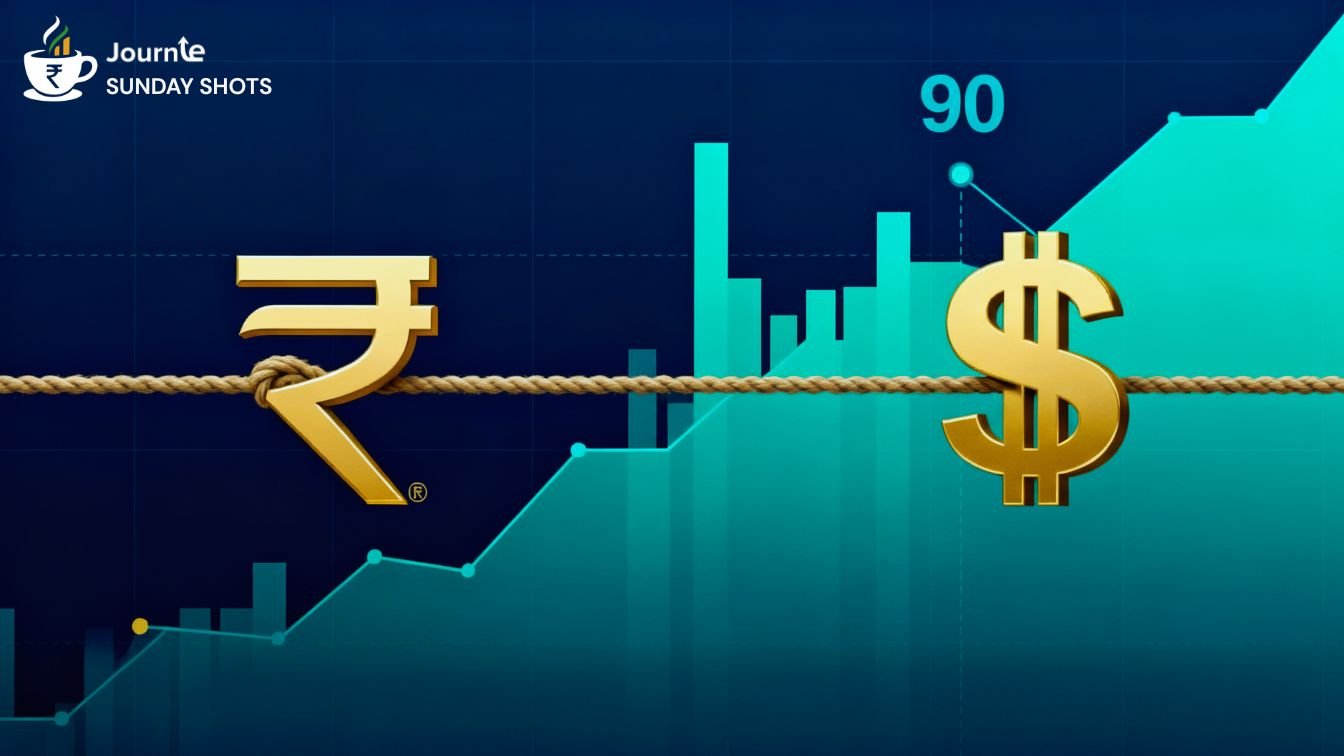
Imagine a tug-of-war. On one side: global trade tensions, US tariffs, a surging dollar. On the other: India’s growth story and RBI’s credibility. The rope in the middle is the rupee, pulled hard from both ends.
And this wasn’t an overnight shock; it’s the culmination of a 2025 depreciation trend driven by a perfect storm:
- Global trade tensions: Steep US tariffs on several categories of imports, and uncertainty around the India–US trade arrangement, weighed on exports and investor sentiment.
- Higher import bill, same export base: Oil stayed expensive in rupee terms, and the domestic appetite for electronics and capital goods barely cooled, so the import bill remained elevated even as the rupee weakened.
- Positioning and psychology: As 90 approached, importers rushed to hedge and buy dollars, while exporters delayed conversions, expecting better rates. This created a self-reinforcing squeeze.
- Global trade tensions: Steep US tariffs on several categories of imports, and uncertainty around the India–US trade arrangement, weighed on exports and investor sentiment.
In other words, fundamentals started the move; positioning and sentiment finished it.
The RBI’s Strategy: Letting the Rupee Find Its Level
Here’s where the story gets interesting.
Instead of dramatically defending a line in the sand, the RBI has chosen to manage the pace of the move, not the destination.
- Supporting Exporters: A weaker rupee makes Indian goods and services more competitive abroad — especially in IT, pharma, textiles, auto components and gems & jewellery. For an economy working to diversify exports and deepen manufacturing, this is not a trivial benefit.
- Prioritizing Growth: With headline inflation trending comfortably below the upper band and growth forecasts upgraded to around 3% for FY26, the Monetary Policy Committee felt it had room to cut the repo rate by 25 bps to 5.25%.
The message: Do not sacrifice growth just to keep the rupee at a nice round number. - Managing volatility, not level: RBI officials have signalled they will calm disorderly moves but won’t peg the currency to a specific value.
This is the classic managed float approach: intervene when markets misbehave, but let fundamentals and flows decide the underlying trend.
- Supporting Exporters: A weaker rupee makes Indian goods and services more competitive abroad — especially in IT, pharma, textiles, auto components and gems & jewellery. For an economy working to diversify exports and deepen manufacturing, this is not a trivial benefit.
Behind the scenes, tools like FX swaps and Open Market Operations keep rupee and dollar liquidity smooth even as the spot rate adjusts.
What This Means for the Economy
This entire episode is a story of balance—not crisis. The rupee’s fall has winners, losers and trade‑offs:
- Importers & inflation: Oil, chemicals, machinery, electronics and other inputs become costlier in rupees, and these higher costs can gradually filter into fuel, transport, appliances and everyday goods. The government’s subsidy bill on fuel and fertilisers may also rise if global prices stay firm.
- Exporters & growth: Exporters earn more rupees per dollar of revenue, supporting margins and, in some cases, expanding hiring and capex. Sectors with natural dollar revenues — IT services, pharma, speciality chemicals — hold up better, while import-heavy and purely domestic firms feel the squeeze.
- Consumers: Overseas travel, foreign education, luxury imports and tech gadgets become noticeably more expensive in rupee terms. Over time, a sustained weak rupee can subtly shift consumption towards local alternatives where they exist, a boost to domestic producers.
- Financial markets: Dollar-earning companies often outperform in weak-rupee phases, while import-heavy or unhedged borrowers tend to come under pressure. In debt markets, lower policy rates support domestic bonds, but global investors remain vigilant about currency volatility.
- Importers & inflation: Oil, chemicals, machinery, electronics and other inputs become costlier in rupees, and these higher costs can gradually filter into fuel, transport, appliances and everyday goods. The government’s subsidy bill on fuel and fertilisers may also rise if global prices stay firm.
The rupee at 90 isn’t the conclusion of a story; it’s the beginning of a new chapter.
From here, three forces will decide the next chapters: how quickly India can narrow its trade gap, how disciplined global investors remain on India, and how the RBI balances growth with currency and inflation risks.
A credible path on reforms — boosting exports, deepening manufacturing, and reducing energy dependence, will matter more than any single day’s exchange rate print.
These are the levers that will determine whether 90 becomes a temporary checkpoint…or the beginning of a new normal.
Until Next Sunday — Here’s to staying curious, staying calm, and seeing the story behind the headline.

If you enjoy reading Sunday Shots — share it among your friends, family, or even strangers on WhatsApp, LinkedIn, and X.
Good insights travel best through good company.
Disclaimer: This update is for informational purposes only. Please consult a SEBI-registered advisor before investing.