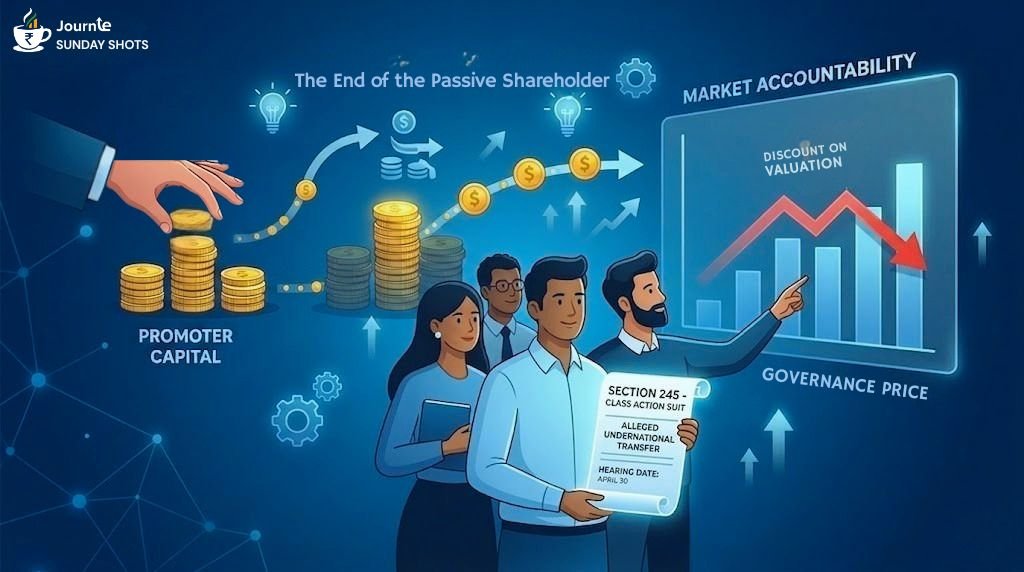
The End of the Passive Shareholder: A Watershed Moment for Indian Corporate Governance
For a long time, there has been an unspoken understanding in Indian markets: You may own shares in a company, you may track its performance, you may even believe in its long-term story—but when it comes to how major decisions are actually made, you are often just along for the ride.
Historically, this wasn’t because investors didn’t notice the shadows being cast by promoters; it was because questioning them rarely changed the outcome.
But something is unfolding right now that is shifting the tectonic plates of Indian corporate governance. It involves a ₹2,500 crore question mark, a sleeping law, and a date—April 30—that marks a new chapter in India’s investing journey.
A Story That Feels Uncomfortably Familiar
Imagine you invest ₹700 with someone you trust. A few years later, you’re told the business didn’t work out and your money is effectively gone. You accept the loss and move on.
Now, imagine discovering later that the business didn’t just survive, it thrived. Its debts were waived, and its value returned.
But instead of that recovery flowing back to you, your stake—once written off as worthless, was transferred to the friend’s personal trust at an 85% discount.
The Anatomy of the Disappearing Value
Over the past decade, a variation of this exact scenario played out in the public markets. To understand why shareholders are finally pushing back, you have to look at the mechanics of how the value was moved.
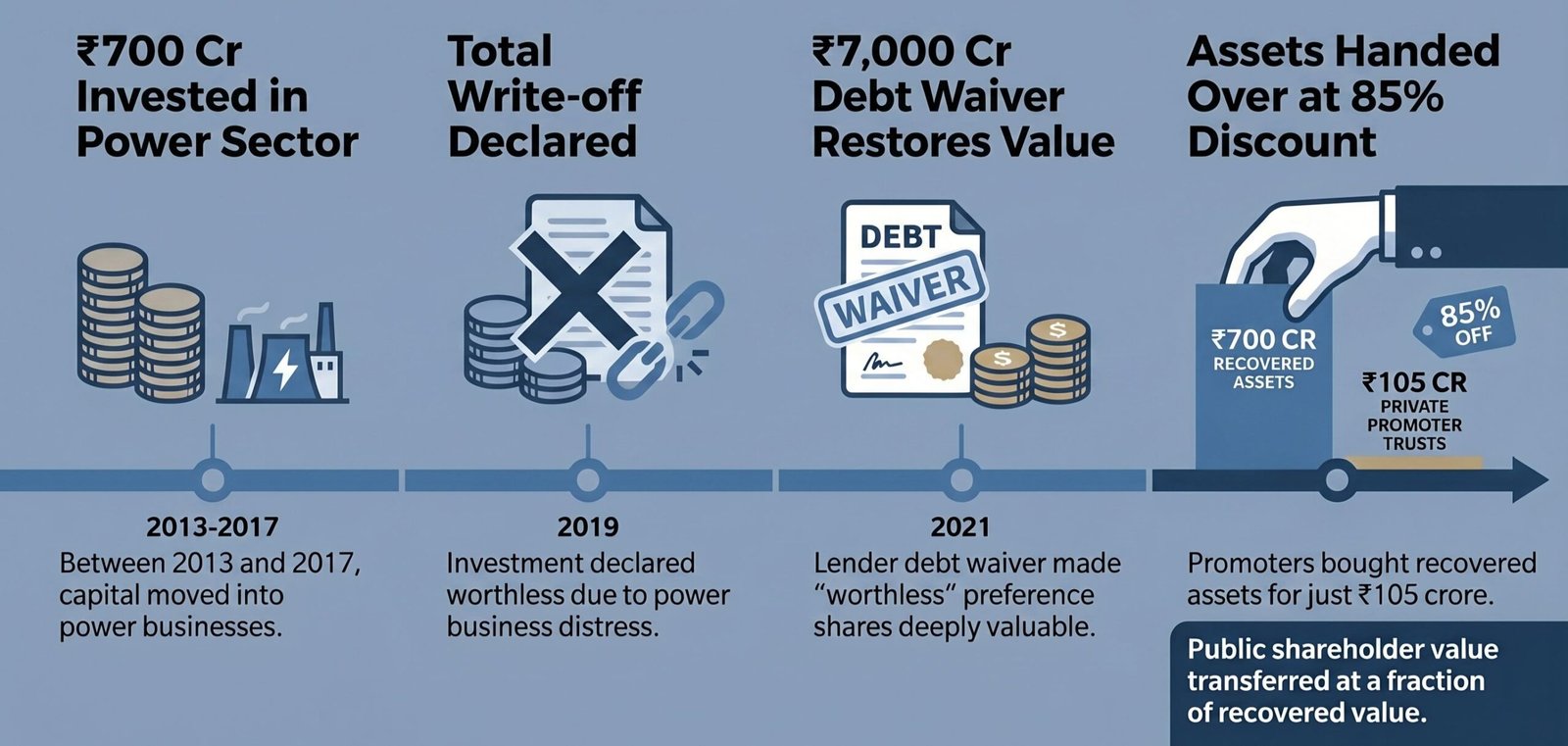
The Setup: Between 2013 and 2017, a major listed packaging company invested roughly ₹700 crore into its broader group’s power businesses using preference shares.
The Distress: By 2019, the company wrote off the entire investment. The message to the public shareholders was clear: The power business is in distress, and your money is gone. Ordinarily, that would have been the end of the story.
The Recovery: But in 2021, a plot twist arrived. Those same power companies received a massive debt waiver of nearly ₹7,000 crore from lenders. Overnight, their financial position improved drastically, and the “worthless” preference shares became deeply valuable again.
The Transfer: At that point, one would expect a reversal in the narrative—a recognition that shareholder capital was saved. Instead, the promoters sold these newly valuable assets to their own private family trusts at an 85% discount. Roughly ₹700 crore in assets were silently handed over for just about ₹105 crore.
The most glaring part? The listed company was sitting on over ₹1,200 crore in cash at the time.
There was no financial urgency. No capital constraints forcing a fire sale. Just a decision where the value was moved from the public pocket to a private one.

When the Dormant "Superpower" Woke Up
A group of shareholders chose not to just accept or simply exit. Instead, they came together and invoked a provision that had existed in Indian law for years but had rarely been used in any meaningful way.
Section 245—the Class Action Suit: A class action mechanism that allows shareholders to collectively seek accountability.
Introduced in 2013, this framework was meant to empower investors. In practice, it remained largely dormant—complex, untested, and often seen as impractical.
Until now.
This time, the case was filed. It was admitted. Attempts to dismiss it did not succeed. And the country’s market regulator also stepped in, adding another layer of scrutiny.
For the first time, the mechanism is not just theoretical—it is being actively tested.
A Larger Question Beneath the Surface
At its core, this case is not just about one company or one set of transactions. It brings into focus a deeper question: Who does a listed company ultimately serve?
Is it an extension of the promoters who built it, or is it an institution accountable to every person who has capital at stake?
For a long time, the answer existed somewhere in between, shaped more by implicit trust than explicit enforcement. But as our markets deepen, that balance is inevitably evolving.
Why This Moment Matters
An upcoming hearing later this month is unlikely to be the final word on the matter. Legal processes of this nature tend to unfold over time.
But this moment is significant for a different reason. It represents a shift from passive acceptance to active participation.
For years, the default response available to minority shareholders was simple—if you were uncomfortable, you exited.
Markets absorbed governance concerns through valuation discounts, not through enforcement. Now, that default response is being challenged in real-time.
A Shift That Markets Eventually Price In
In more developed markets, shareholder litigation is not uncommon. It plays a role in shaping corporate behaviour, influencing board decisions, and reinforcing accountability.
India has traditionally relied more on promoter credibility and regulatory oversight than on shareholder-led action.
But as markets deepen and capital becomes more discerning, this balance tends to evolve.
Because ultimately, markets do not just price earnings. They price the reliability of those earnings. And that reliability is inseparable from governance.
Something meaningful has already changed. The assumption that minority shareholders will remain passive participants is beginning to weaken.
For years, the only real right a minority shareholder had was the right to sell and leave. What we are seeing now is the emergence of an alternative path—where investors do not just price in risk, but actively question it.
As this case unfolds, one thing is becoming clearer: the journey of investing in India is no longer just about returns. It is also about rights.
See you next Sunday, for another Shot of insights.
Disclaimer: This update is for informational purposes only. Please consult a SEBI-registered advisor before investing.
Enjoyed this week’s Sunday Shots? Share it across WhatsApp, LinkedIn, or X — and invite someone else into the conversation.
Subscribe to Sunday Shots for a fresh perspective delivered every week.
Lorem ipsum dolor sit amet, consectetur adipiscing elit. Ut elit tellus, luctus nec ullamcorper mattis, pulvinar dapibus leo.