Oil, Ice & The Golden Dome: The Strategy Behind the Headlines

If you thought 2025 was volatile, welcome to January 2026.

This week, the world didn’t merely shift direction; it was forcibly rearranged. From the streets of Caracas to the ice sheets of Greenland, seemingly disconnected headlines revealed a cohesive pattern, a calculated strategy: a synchronized push to secure resources, routes, and leverage.

Markets, as they always do, reacted to the uncertainty before the narrative fully formed.

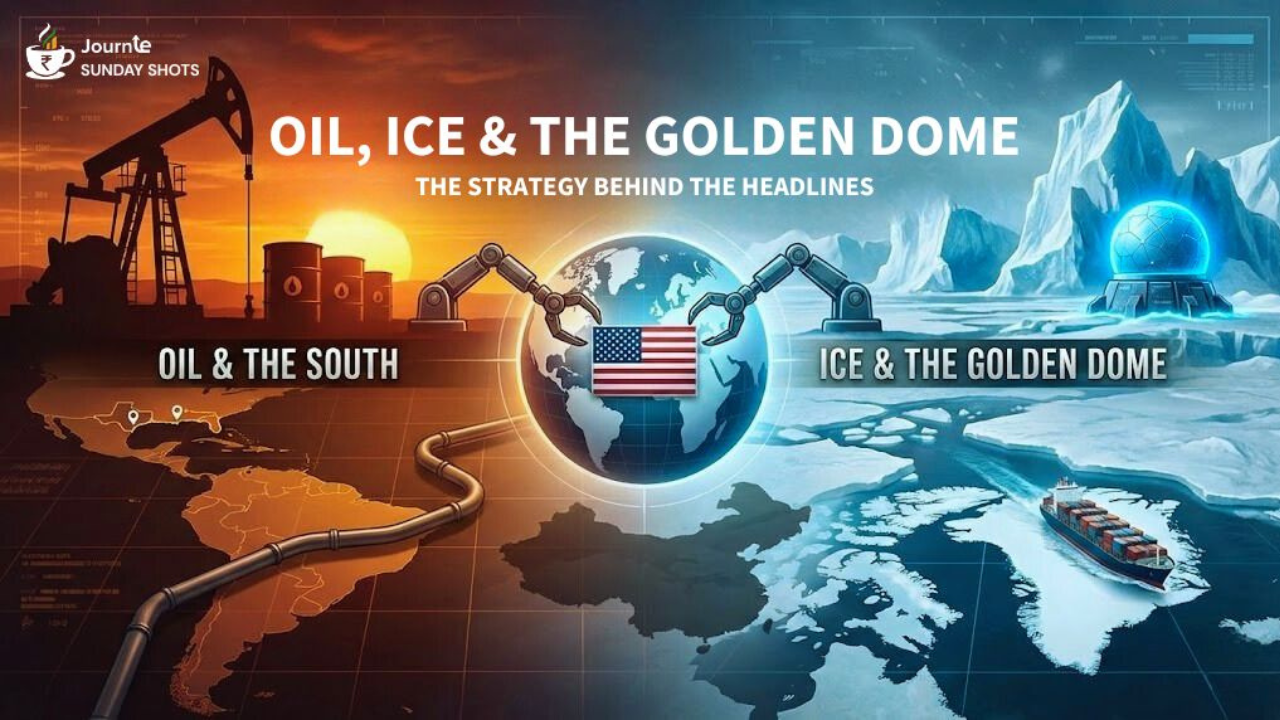
What we are witnessing is not chaos. It is Resource Realism — the most aggressive redrawing of the global resource map since the Cold War. The United States has launched a strategic pincer movement: one arm reaching South for the energy of the past (Oil), and one arm reaching North for the energy of the future (Uranium & Logistics).

And the target in both crosshairs? China.

Today, we dive deep into this new doctrine, the Venezuela-Greenland connection, and how the forces are rewriting the rules of the global market.

Chapter 1: The Southern Front: Black Gold and Broken Restraint

Venezuela has always been a crisis story. What changed this month is why it matters again.

On January 3rd, the status quo was shattered. The US intervention that effectively displaced the top leadership wasn’t just a military operation; it was a resource correction.

The Context: The country holds roughly 303 billion barrels of proven oil reserves, the largest in the world. Yet for 15 years, Venezuela served as China’s gas station. Beijing loaned Caracas over $60 billion, and in return, oil flowed East to pay off debts rather than North to the market.

The Pivot: Instead of a messy ideological regime change, Washington prioritized continuity. By securing the flow, the US achieves two strategic goals:

  1. Physics:Venezuelan heavy crude is chemically perfect for US Gulf Coast refineries.
  2. Geopolitics:It severs China’s energy lifeline in the Western Hemisphere. The “Bank of Beijing” has been significantly weakened.

This wasn’t about exporting democracy. It was about controlling the tap.

Notably, oil prices didn’t spike. A signal that markets expect supply to be managed. But a long-standing geopolitical restraint has been crossed. And when restraint breaks once, risk gets repriced everywhere.

Chapter 2: The Northern Front: Ice, Infrastructure, and the Golden Dome

While the dust settled in Caracas, the strategic focus shifted North, to Greenland.

What sounded like a joke in 2019 is treated as a strategic flashpoint in 2026. The reason isn’t real estate; it is three converging realities.

  1. The New Mediterranean:Melting ice is unlocking the Northwest Passage, a shipping lane that cuts Asia–Europe transit times by 40%. The Arctic is becoming the world’s most critical new logistics corridor, and Greenland is the toll booth.
  2. The Mineral Bank:Greenland hosts massive deposits of uranium and rare earth elements. Control here isn’t just about mining; it’s about breaking China’s monopolyon the critical inputs for EVs, semiconductors, and advanced defense systems.
  3. The Golden Dome:The US has linked this territory to a proposed $175B missile defense shield. Geography makes Greenland the only viable location for sensors needed to intercept hypersonic threats over the pole.

In simple terms: Greenland is not land. It is infrastructure.

When Europe pushed back on territorial discussions, the US weaponized trade.

The threat? A 10% tariff on major European economies starting February 1st, escalating to 25% by June if a deal isn’t reached. Tariffs are no longer about trade imbalances; they are leverage tied to strategic outcomes.

That was the moment markets flinched.

Chapter 3: The Silent Protagonist: China’s Shadow

China did not need to issue a single statement to be central to this story. Its footprints are visible on both fronts.

The Sequence:

  • In the South:Venezuelan oil had been a pillar of Beijing’s energy security, secured by over $60 billion in loans. That tap has been materially disrupted.
  • In the North:Chinese firms like Shenghe Resources have spent years attempting to unlock Greenland’s rare earth deposits, while Beijing formally declared itself a “Near-Arctic State” to build a “Polar Silk Road” through the melting ice. That path is now blocked.

From Washington’s perspective, these were not isolated commercial deals. They were structural threats.

Seen together, the strategy becomes clear. The US is executing a containment maneuver: secure the energy of yesterday (Oil), and deny control over the resources and routes of tomorrow (Rare Earths & Arctic Shipping).

This is not a quarterly trade dispute. It is decade-long positioning.

Chapter 4. The Market Repricing: Why India Felt It

Global markets didn’t panic last week. They stepped back.

The warning signs didn’t arrive in one burst, they accumulated. By Tuesday (Jan 20), the repricing became visible. Indian markets fell over 1% in a single session, with the Sensex shedding more than 1,000 points, echoing rising global anxiety.

Despite a muted recovery later in the week, markets closed with investors carrying unresolved risk into the weekend.

This wasn’t a routine correction. It was a repricing of risk.

When geopolitics, trade policy, commodities, and currencies begin moving together, correlations rise, and risk appetite falls.

And India? The response was rational.

  • The Gold Signal:Gold moved first, climbing to record levels (crossing ₹1.45 lakh per 10g). Not because inflation resurfaced, but because policy uncertainty did.
  • Trade War Contagion:Tariff threats against the EU raise the risk of slower European growth. Europe is a major client for Indian IT services and textiles. If Europe slows, Indian export order books feel it quickly.
  • The FII Pullback:Foreign investors dislike binary outcomes. With the February 1 tariff deadline approaching, FIIs reduced exposure to emerging markets, rotating into safer assets like US Treasuries. This week, FIIs pulled out approximately ₹14,600 Crore from Indian equities.
  • The Domestic Drag:Geopolitics wasn’t acting alone. Softer Q3 results from heavyweight banks and consumption names weakened the market’s internal cushion, amplifying the global shock.
  • Policy Proximity:With the Union Budget weeks away, caution naturally dominated conviction.

The Silver Lining: The "Second-Order" Effect

This week’s decline was not a verdict on India’s long-term story. It was a defensive reaction to shifting rules of engagement.

However, as supply chains diversify and the “China-plus-one” strategy accelerates due to these very tensions, India remains one of the few scalable alternatives. History shows that periods of global volatility often obscure opportunity in the short term, only to reveal it over longer cycles.

Markets may have stepped back this week. But capital, eventually, always looks for a place to step forward again.

The Bottom Line

We are moving from a rules-based world to a resource- and leverage-based one, from a world of Free Trade to a world of Fortress Economics.

The US is aggressively consolidating resources, energy in the South, strategic minerals in the North.

The market is currently repricing risk, which feels like volatility. Understanding the why the shift toward securing resources, removes the panic, and replaces it with perspective.

Until Next Sunday!


Disclaimer: This update is for informational purposes only. Please consult a SEBI-registered advisor before investing.

Recent Blogs

Subscribe to Journie Shots — thoughtful, well-curated insights and market stories delivered every Sunday.