

India–US Trade Reset: The Art of the Deal, Revisited

Ind-US-Trade-Reset-Feature-Image-sunday-shots

In classic finance as in life, markets don’t reward noise; they reward certainty. And over the past week, India found itself not just in the headlines, but at the centre of a subtle but meaningful shift in global trade dynamics.

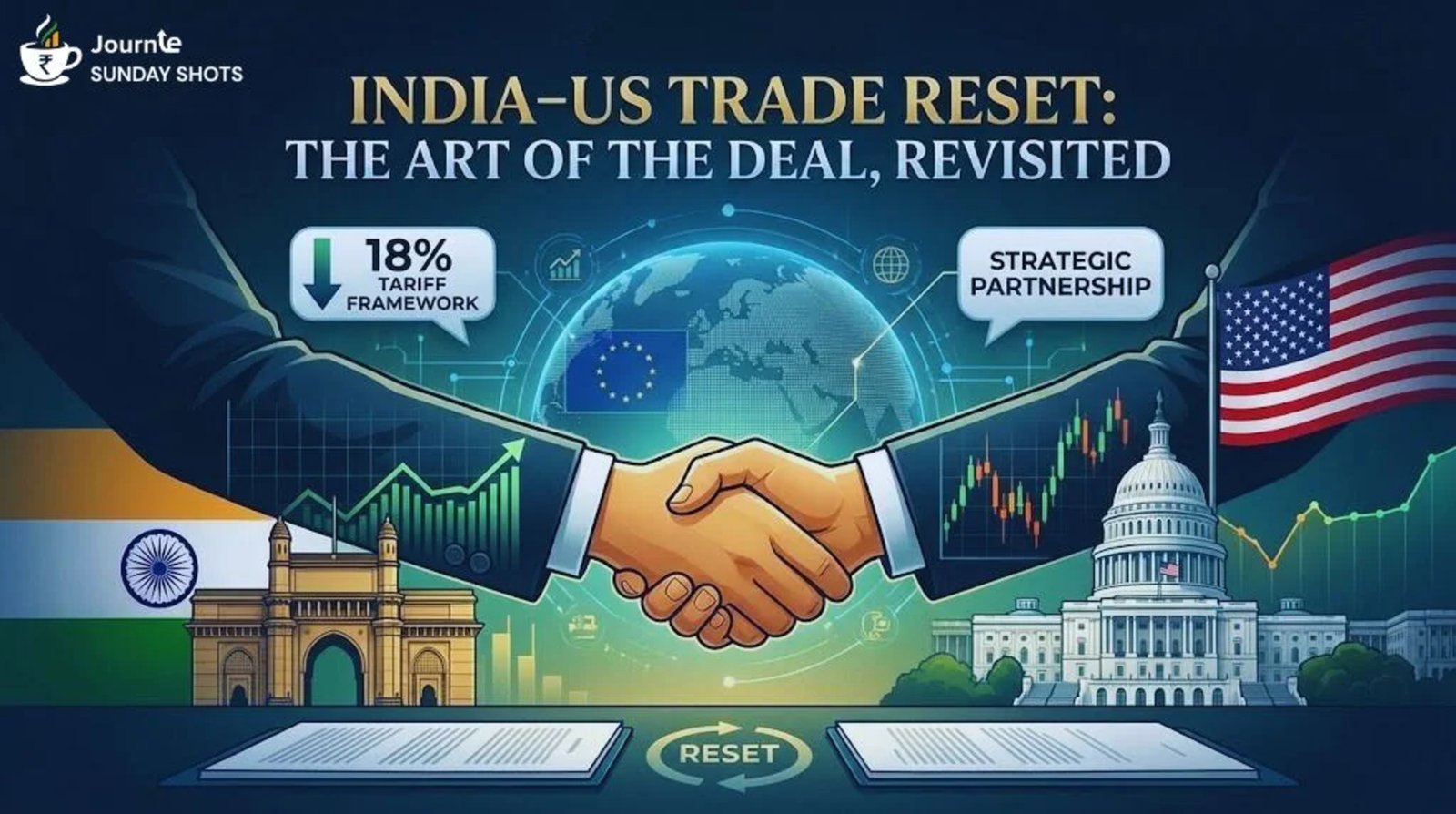
A potential trade agreement between India and the United States, involving an ~18% tariff framework and broader commitments to strengthen economic ties, has become more than a policy bulletin.

It’s a recalibration of trade, trust, and strategic positioning on the world stage, with implications that stretch well beyond headline figures.

Ghosts of the Trade Crisis Past

To fully appreciate this development, we have to rewind.

In August 2025, relations between New Delhi and Washington weren’t frigid; they were tense. A sharp escalation of tariffs had pushed duties on Indian exports into punitive territory, with effective rates nearing 50% once additional levies tied to energy imports were layered in.

This wasn’t just about trade terms. It was geopolitics expressed through tariff rates — a pressure tactic linked to strategic choices around energy sourcing and foreign policy alignment. Indian exporters felt it acutely, especially across labour-intensive sectors from textiles to engineering.

The question wasn’t whether there would be a resolution, it was when, and on what terms.

What’s Been Announced (and What’s Still in Progress)

This week, both sides signalled meaningful progress.

The United States indicated plans to reduce tariffs on Indian goods from 50% tariff towards an ~18% framework, addressing one of the largest overhangs in the bilateral trade relationship. India, in turn, has signalled openness to calibrated tariff reductions on select US imports as part of a broader bilateral agreement.

A formal joint statement and legally binding framework are expected by mid-March 2026, marking the shift from signalling to execution.

Markets responded quickly to the development. Equity indices stabilized, the rupee strengthened, and export-linked segments saw an immediate sentiment lift as policy uncertainty began to clear.

The Context Markets Didn’t Miss

The timing wasn’t incidental.

Just days earlier, the Union Budget had unsettled markets. Higher taxes on trading (STT) and a perception of policy tightening triggered a sharp risk-off reaction.

Against that backdrop, the trade reset acted less like a stimulus, and more like a counterweight. Not reversing the budget’s intent, but restoring confidence that India’s external positioning remained steady, pragmatic, and globally aligned.

Markets didn’t celebrate. They exhaled.

Behind the Scenes: Why Now?

This wasn’t a lightning strike. It was a slow pivot.

Over the last 12–18 months, India has methodically diversified its trade and strategic relationships.

  • A long-pending free trade agreement with the European Union finally crossed the line, giving India a structural hedge against single-partner dependence.
  • New corridors opened with smaller but strategically relevant partners like New Zealand and Oman.
  • Energy sourcing widened with strategic $2.8 billion Uranium supply agreement with Canada (in progress).
  • Even supply-chain engagement with China was approached with calibrated pragmatism, particularly around securing inputs like critical APIs and chips.

The signal to Washington was soft, but unmistakable: India has options.

A prolonged standoff would not have isolated India; it would have risked isolating the US from one of the world’s most consequential growth stories.

Seen in that light, this reset looks less like a concession and more like a recalibration, one aimed at restoring predictability between two large democracies navigating a fragmented global order.

What Changed: The Core Economic Shift

The new framework doesn’t eliminate tariffs. But two shifts matter.

First, the reduction from punitive peaks to a predictable tariff corridor materially improves competitiveness for Indian exporters relative to Asian peers.

Second, and more important — markets dislike uncertainty more than high rates. The removal of a visible policy overhang changes behaviour: order commitments, capital allocation, and risk pricing adjust accordingly.

This is not just about cost economics. It’s about visibility.

Beneficiaries: And the Limits of the Headline Narrative

Immediate sentiment beneficiaries include export-oriented sectors with established US exposure:  textiles and apparel, gems and jewellery, and auto ancillaries.

The math is simple: At an 18% tariff, Indian exporters now hold a clear pricing advantage over competitors in China (~34%), Vietnam (~20%) or Bangladesh (20%). For the first time in years, the tariff differential works for India, not against it.

Crucially, the official text explicitly mentions a “preferential tariff rate quota for automotive parts”—a massive, documented win for the auto ancillary sector.

Medium-term beneficiaries are broader capital flows. As uncertainty fades, foreign allocations tend to stabilize, often before fundamentals visibly improve.

Still unclear are the details that will ultimately matter most:

  • Product-specific tariff schedules
  • Rules of origin and compliance costs
  • Sector-level access and exclusions

These will define real trade flows, not the early market reaction.

Fine Print vs Public Posturing

As with most trade negotiations today, public claims have run ahead of policy text.

The quoted $500 billion figure is real, but nuanced. The document confirms India’s “intent to purchase” this amount over the next 5 years. It is not an immediate commitment, but a long-term potential procurement list focused on Energy, Aircraft (Boeing), Precious Metals, and Technology Products (specifically GPUs).

Similarly, on Russian oil, the MEA’s rebuttal was swift but nuanced: “Energy security for 1.4 billion people is the supreme priority.” Purchases will follow commercial viability and price, not just political pressure.

The timeline reveals a diplomatic win for New Delhi: The US will cut tariffs to 18% first (via Executive Order expected within days), while India’s corresponding tariff reductions will only kick in after the formal legal pact is signed in mid-March.

The sequencing favours early confidence, while concessions remain conditional on legal closure.

What to Watch Next

From here, outcomes will hinge on execution. Three signposts matter:

  • The Domestic Fortress: While Commerce Minister Piyush Goyal confirmed that Dairy and Staple Crops are protected, the document reveals specific openings. The document points toward selective openings in premium agricultural categories, including tree nuts, select fruits, and ethanol-linked products.
  • The Legal Text: Expected by mid-March, which will determine the exact duty cuts.
  • Implementation Timelines: Because trade impact arrives through phases, not press releases.

This is where credibility is earned.

The Takeaway: A Strategic Reset

This potential India–US agreement isn’t a simple tariff rollback. It’s a strategic reset.

It’s about reducing one of the largest blocks of policy risk India has faced in global commerce. A move from friction toward managed partnership, reflecting a broader realignment of trade, energy security, and geopolitics.

The markets reacted with measured relief. Execution now matters more than the announcement.

And whether this becomes durable economic architecture, or just another chapter in global recalibration, will be decided over time.

Until Next Sunday!


Disclaimer: This update is for informational purposes only. Please consult a SEBI-registered advisor before investing.

Recent Blogs

Subscribe to Journie Shots — thoughtful, well-curated insights and market stories delivered every Sunday.