


The Weight of the Curve and the Clock

There is a specific kind of silence in the debt markets right now that isn’t really silence at all.

If you look at the headline numbers, everything seems orderly. But if you sit at a treasury desk, you can feel a subtle, grinding pressure. We are looking at a market where short-term liquidity has finally returned, yet long-term yields flatly refuse to budge.

It’s the story of two ends of the curve responding to very different forces, and the duration decisions that sit in between.

The Ghost of December

To understand the tension we are feeling in early March, we have to look back at the winter we just exited. Late last year, the short-term market broke character.

Commercial Paper (CP) rates — usually the predictable, boring workhorses of corporate funding, spiked sharply.

By late December, 3-6-month CP rates had moved into the 8.25%–8.60% range, with spreads widening to nearly 100–120 basis points over comparable T-Bills. For a market used to surplus liquidity, that was a clear signal of funding stress.

Some part of this is always discounted to the year liquidity jitters, but this time the spread shot up was much higher. It was a liquidity flash-freeze. Subdued government spending met massive tax outflows, and suddenly, the abundant liquidity we had all gotten used to vanished.

The Two-Lakh Crore Stabilization

The situation got so tight that the RBI had to step in decisively.

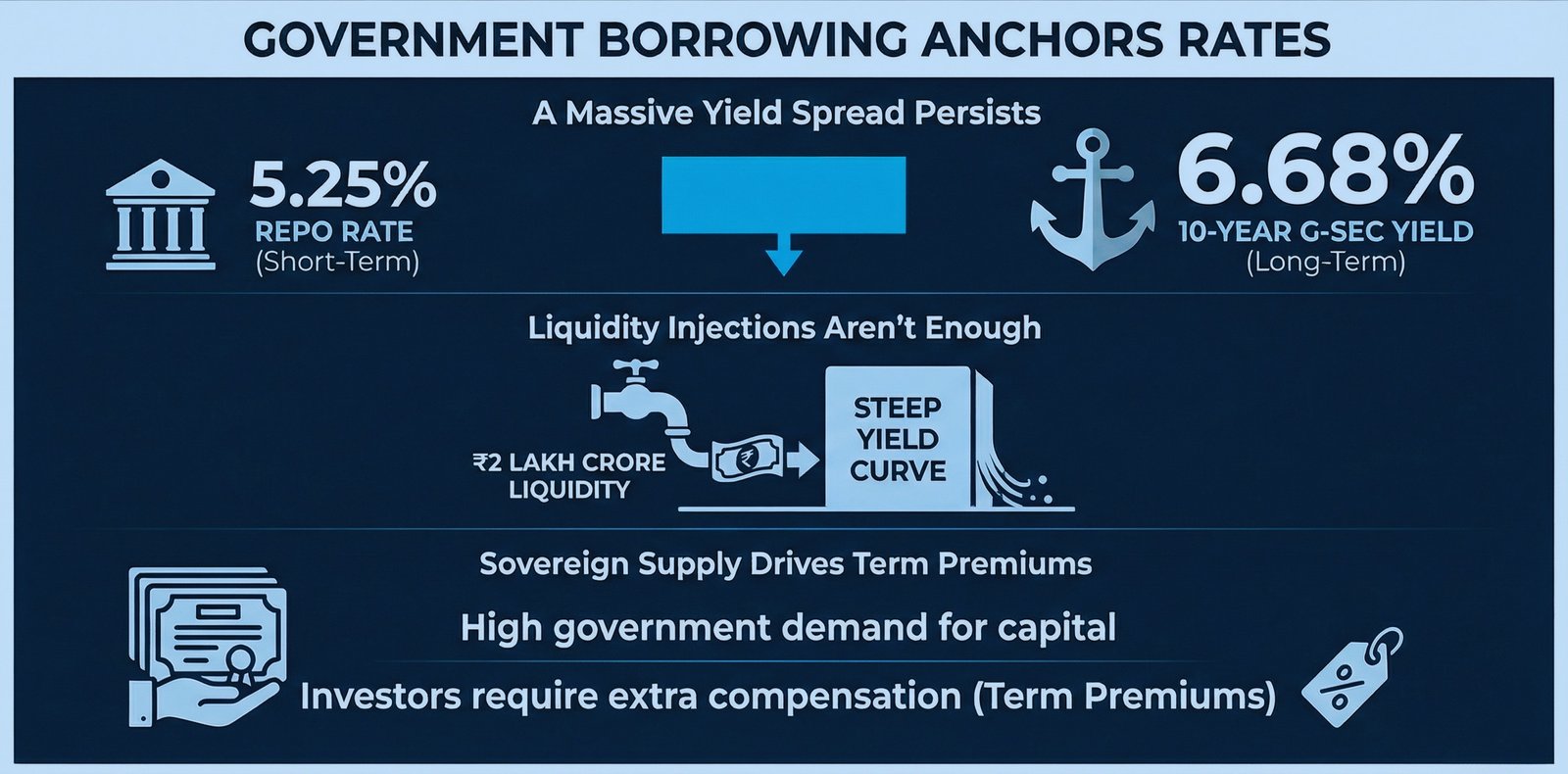
Between late January and early February, the central bank injected a staggering ₹2 lakh crore into the banking system. They used everything in the toolkit: a massive $10 billion Forex swap, ₹1 lakh crore in Open Market Operations (OMOs), and targeted Variable Rate Repo (VRR) auctions.

It worked. As of this month, system liquidity has eased and is back in a comfortable surplus, averaging around ₹70,000 crore per day. The short end of the market can finally breathe again.

But here is where the story gets really interesting.

The Heavy Anchor at the Long End

The RBI successfully extinguished the fire at the short end of the curve. You would expect the rest of the market to relax, right?

Instead, the long end did not respond proportionately.

Today, the benchmark repo rate sits at 5.25%, broadly steady through this phase. Yet, the benchmark 10-year G-Sec yield is stubbornly anchored around 6.68%. That is a massive spread. The long end is sitting at levels we haven’t seen since before the last tightening cycle, especially after a 125bps rate cut in less than a year.

Why is the long end so heavy despite a ₹2 lakh crore liquidity injection? It comes down to basic supply and demand.

The government’s borrowing calendar is massive. When sovereign supply (meaning the states and centre wants to borrow more form the market) is this fundamentally high, the term premium (the extra compensation investors demand for locking their money away for years) simply refuses to compress.

The curve remains noticeably steep, even when central bank liquidity is sloshing around the system.

The Illusion of Easy Carry

This creates an appealing, if frustrating, environment for anyone managing capital. You have a newly liquid short-end where rates remain elevated, and a heavy sovereign supply keeping long yields sticky.

On paper, it looks attractive. Short spreads offer carry. The mid-curve suggests roll-down.
But credit markets rarely offer free yield.

This is not a regime of easy carry. It is a regime of selective carry.

Picking Your Exposure: Rollover vs. Duration

When you park your capital in the short end, you face rollover risk. Yes, liquidity is in surplus today, at least on paper. But as December proved, liquidity cycles don’t move in straight lines. When it’s time to reinvest, the taps might be shut and funding costs could be entirely different.

Conversely, extending your maturity introduces severe duration risk. Long-term bonds are riskier, and because supply from both the states and the Centre is so high, there are fewer takers. If you extend, you are betting that the heavy supply pressure will eventually ease without eroding your capital in the meantime.

The Clock and the Basis Point

Yield alone is a lagging indicator. Spreads always widen before the broader risk reprices.

In an environment like this, simple portfolio questions suddenly become real risk decisions:

  • Are your allocations actually aligned with when the cash is needed?
  • Are those attractive short-term funding costs accurately reflecting the real pricing risk?
  • Is extending your maturity costing you more in hidden volatility than you are gaining in yield?

The curve is not distressed. It is calibrated. And calibrated markets require discipline.

Finding the Right Bucket

The real task for a treasury team today isn’t to constantly hunt for the highest-yielding bucket. It is to make sure you are standing in the right bucket when the next risk repricing happens.

Markets are not compensating us for taking on duration today, but visible carry without invisible duration risk is exceptionally rare.

Static yield chasing works perfectly—right up until the moment policy action, sovereign supply pressure, and bank funding conditions intersect. Because when the curve steepens, timing matters as much as price.

The question is: does the market's compensation match your clock?

Until next Sunday!

Disclaimer: This update is for informational purposes only. Please consult a SEBI-registered advisor before investing.

Enjoyed this week’s Sunday Shots? Share it across WhatsApp, LinkedIn, or X — and invite someone else into the conversation.
Subscribe to Sunday Shots for a fresh perspective delivered every week.

Recent Blogs

Lorem ipsum dolor sit amet, consectetur adipiscing elit. Ut elit tellus, luctus nec ullamcorper mattis, pulvinar dapibus leo.

Elevate the Way You Manage Your Wealth

For a trusted wealth experience—powered by people and technology, crafted around you.

Join the Journie

Subscribe to Journie Shots — thoughtful, well-curated insights and market stories delivered every Sunday.