
Journie WealthTech Private Limited | AMFI Registered Mutual Fund & SIF Distributor (ARN: 318048)

Beyond Power: India's ₹37,500 Crore Bet on Coal

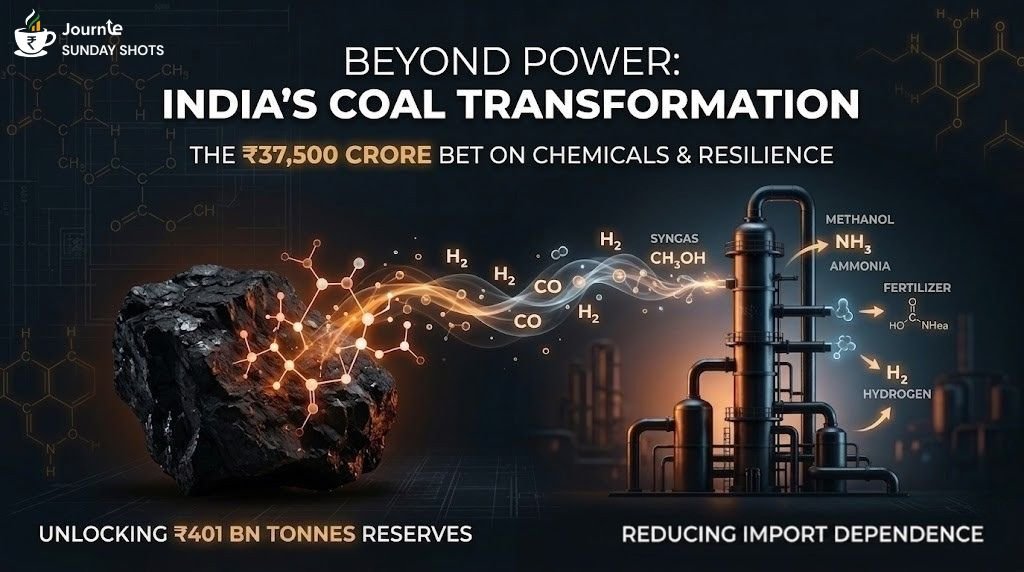
A widescreen infographic for Journie Sunday Shots featuring a large piece of raw black coal on the left radiating glowing molecular structures. The molecules flow as syngas (H2 and CO) into a dark, sleek industrial chemical refinery tower on the right. Text overlays read "Beyond Power: India's Coal Transformation," "The ₹37,500 Crore Bet on Chemicals & Resilience," "Unlocking ₹401 BN Tonnes Reserves," and "Reducing Import Dependence.

Imagine owning a gold mine for decades and using the gold only as paperweights.

The treasure is real. The value is immense. Yet nobody ever pauses to ask whether it might be capable of something greater.

For much of modern history, India’s relationship with coal has looked remarkably similar.

Few resources have shaped the country’s economic journey more profoundly. Coal powered factories, illuminated homes, fueled railways, and became the backbone of India’s industrial rise. It was dependable, abundant, and familiar. Once extracted from the earth, its destiny was almost predetermined: it would be burned.

And that certainty lasted for generations. Until a different question began to emerge.

Not how much coal India could produce. Not how much electricity coal could generate.

But something far more consequential: What if coal was not merely a fuel?

A Country That Never Looked Beyond the Flame

For decades, coal’s value was measured in heat.

The logic was straightforward. Extract it, transport it, burn it, and convert the resulting energy into electricity. The process helped build one of the world’s fastest-growing economies.

Even today, coal remains central to India’s energy system. The country possesses more than 400 billion tonnes of coal reserves, among the largest in the world. Nearly three-fourths of India’s electricity generation continues to depend on it.

Yet there was a hidden assumption beneath this entire model.

Coal was viewed as the final product. Nobody looked at it the way a chemist looks at a molecule or a manufacturer looks at a raw material.

And that assumption may have cost India an opportunity hidden in plain sight.

Then Someone Asked a Different Question

What if coal could be transformed rather than consumed?

The distinction sounds subtle, but it changes everything.

When coal is burned, most of its value disappears as heat.

When coal is gasified, its value begins to multiply.

Instead of setting coal on fire, engineers expose it to oxygen and steam under carefully controlled conditions. What emerges is not smoke or ash, but something known as syngas — a mixture rich in hydrogen and carbon monoxide.

To industry, syngas is far more than a gas. It is a building block.

From it, manufacturers can produce ammonia, methanol, synthetic natural gas, hydrogen, fertilizers, chemicals, and a wide range of industrial feedstocks.

Suddenly, coal stops behaving like fuel and starts behaving like possibility.

And that realization exposed a much larger problem.

The Real Problem Was Never Coal

The irony is striking. India is rich in coal.

Yet it remains heavily dependent on imports for many of the products that coal gasification can produce.

The country imports nearly 90% of its crude oil requirements, more than half of its LNG demand, almost all of its ammonia, and roughly 80–90% of its methanol needs.

Collectively, this dependence translates into an annual import exposure running into lakhs of crores of rupees.

For years, policymakers discussed energy security largely through the lens of oil.

But energy security is not merely about fuel. It is also about fertilizers that support agriculture. It is about chemicals that sustain manufacturing. It is about industrial feedstocks that determine whether factories remain competitive.

Viewed from that perspective, India’s vast coal reserves began to look less like an energy resource and more like an untapped strategic asset.

Naturally, the next question followed. If the opportunity is this large, why not pursue it aggressively?

That Is Precisely Why Delhi Is Betting Big

In 2024, India announced an ₹8,500 crore incentive program to encourage coal gasification projects.

Just two years later, that commitment expanded dramatically.

In May 2026, the government unveiled a ₹37,500 crore incentive scheme, signaling that coal gasification had moved from a promising experiment to a national industrial priority.

The ambition is equally striking.

India aims to gasify 100 million tonnes of coal annually by 2030, transforming a significant portion of its coal output into higher-value industrial products rather than simply burning it for power generation.

Behind the headline figures lies a larger strategic vision.

Every ton of domestically produced methanol is a ton that does not need to be imported. Every unit of ammonia produced within the country strengthens supply chains. Every step toward domestic industrial feedstocks reduces exposure to geopolitical shocks, shipping disruptions, and volatile global commodity markets.

In essence, this is not merely an energy policy. It is an economic resilience strategy.

And there is already a country that demonstrates what such a strategy can achieve.

China Offers a Glimpse of What Is Possible

Long before coal gasification became a major policy discussion in India, China was investing heavily in it.

Over decades, it built a vast coal-to-chemicals ecosystem, converting coal into methanol, ammonia, synthetic fuels, and industrial feedstocks at scale.

The achievement was not merely technological. It was strategic.

By converting domestic coal into industrial inputs, China reduced dependence on imported alternatives while strengthening key manufacturing sectors.

For India, the lesson is not that China’s model should be copied blindly.

The lesson is that countries often discover the true value of a resource only when they stop using it in the most obvious way.

Yet India’s journey comes with its own complexities.

The Future May Not Even Require Digging the Coal Out

One of the most fascinating developments emerged in 2025 when India incorporated Underground Coal Gasification (UCG) provisions into commercial mining agreements for the first time.

The concept sounds almost unbelievable.

Instead of extracting coal from the ground and transporting it to a processing facility, the coal is converted into gas while it remains underground. It is as if the coal seam itself becomes the factory.

If successful, the approach could potentially unlock coal reserves that are difficult or uneconomical to mine through conventional methods, while reducing some of the logistical challenges associated with extraction and transportation.

That possibility is precisely why policymakers and industry observers are paying close attention.

Whether UCG eventually succeeds at scale remains to be seen. But what matters today is what the experiment represents: A fundamental change in mindset.

For generations, India viewed coal as something to be extracted and burned. Now it is beginning to view coal as something to be engineered, transformed, and upgraded.

The Real Revolution Is Not in the Coal

When historians look back at this moment, they may conclude that India's coal revolution was never really about coal.

After all, the reserves were always there. The mines already existed. The resource itself did not suddenly change.

What changed was the question being asked.

For decades, India asked: How much electricity can coal generate?

Today, it is asking: How much value can coal create?

Sometimes revolutions begin with a new technology, sometimes they begin with a new policy and sometimes they begin with something far simpler:

The realization that the true value of a resource is not always found in its most obvious use.

See you next Sunday for another shot of insights!
Disclaimer: This update is for informational purposes only. Please consult a SEBI-registered advisor before investing.

Enjoyed this week’s Sunday Shots? Share it across WhatsApp, LinkedIn, or X — and invite someone else into the conversation.
Subscribe to Sunday Shots for a fresh perspective delivered every week.

Recent Blogs

Lorem ipsum dolor sit amet, consectetur adipiscing elit. Ut elit tellus, luctus nec ullamcorper mattis, pulvinar dapibus leo.

Subscribe to Journie Shots — thoughtful, well-curated insights and market stories delivered every Sunday.