
Journie WealthTech Private Limited | AMFI Registered Mutual Fund & SIF Distributor (ARN: 318048)
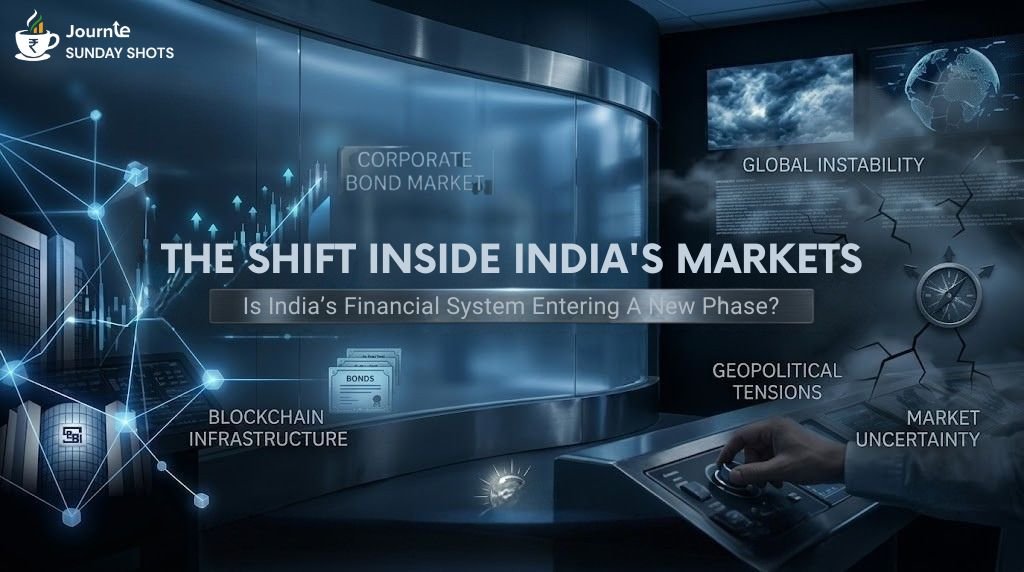
The Shift Inside India’s Markets: Is India’s Financial System Entering A New Phase?
Every few years, India’s financial markets reach moments that feel bigger than daily headlines.
Moments where regulation, technology, geopolitics, and investor sentiment all begin colliding at the same time.
This feels like one of those moments.
Because while most conversations still revolve around stock market highs, interest rates, and inflation, two recent developments are quietly revealing something much larger about where India’s financial system may be headed next.
The first came from SEBI.
India’s market regulator is now exploring stronger disclosure standards for debt markets while also preparing to test tokenized corporate bonds using blockchain infrastructure.
The second came from Kent RO.
One of India’s most recognized consumer brands decided to postpone its IPO plans — not because business was weak, but because rising geopolitical tensions suddenly made market conditions too uncertain.
At first glance, these may look like two unrelated developments. But together, they reveal something important.
India is simultaneously trying to modernize its financial system for the future while navigating a world becoming far more unstable. And that tension may define the next phase of India’s markets.
India Wants Deeper Markets, Not Just Bigger Markets
Over the last two decades, India’s equity markets have evolved rapidly.
Retail participation surged. SIP culture expanded. Digital investing became mainstream. IPO activity exploded.
But one part of India’s financial system still remains relatively underdeveloped compared to large global economies:
The corporate bond market.
And that matters far more than most people realize.
Because mature economies are not only financed only through banks. They are also financed through deep debt markets.
Infrastructure projects. Corporate expansion. Institutional financing. Long-term capital allocation. All of this becomes easier when companies can efficiently raise money through bonds instead of depending excessively on banks.
Because economies that depend too heavily on banks eventually face capital bottlenecks as they scale.
That is exactly where SEBI now appears to be focusing.
Recently, SEBI Chairman Tuhin Kanta Pandey indicated that India may move toward stronger disclosure standards for debt markets — bringing them closer to the transparency levels seen in equities.
At first glance, this sounds technical. But the larger implication is actually simple: Trust. Because capital flows where visibility improves.
The more transparent markets become, the more institutional participation increases. And deeper participation eventually creates stronger, more liquid, and more resilient markets.
India Is Experimenting with Blockchain-Based Bonds
Alongside disclosure reforms, SEBI also announced plans to test tokenized corporate bonds using Distributed Ledger Technology (DLT).
In simple words: India is now experimenting with blockchain infrastructure inside its bond markets.
Not for hype. Not for headlines. But for efficiency.
Today, bond settlements often involve multiple intermediaries, fragmented records, operational friction, and settlement delays. Tokenization attempts to simplify parts of that system through digitally recorded ownership and faster settlement infrastructure.
The broader goal is straightforward: Lower friction, better traceability, Faster execution and deeper liquidity. And this matters because India’s long-term economic ambitions cannot rely only on equity markets.
Large economies require sophisticated debt markets to finance growth efficiently. More importantly, India is no longer waiting for global consensus before experimenting with new financial infrastructure.
Which means this is not just a technology experiment. It is a financial infrastructure story.
Yet building stronger markets is only one side of the equation.
Because no matter how sophisticated financial infrastructure becomes, markets still operate within the realities of the world around them.
And that reality was visible in another development this week.
Kent RO’s IPO Delay Reveals the Other Side Of Markets
But while regulators were discussing the future, another reality was quietly unfolding at the same time.
Kent RO Systems had already received regulatory approval for its IPO. Business remained stable. Demand remained intact. Yet the company still decided to postpone its listing plans.
Why? Because geopolitical tensions and Middle East instability suddenly weakened market sentiment and increased uncertainty. And this reveals something important about modern markets.
Today, even fundamentally strong businesses are vulnerable to events happening far beyond their own industries or borders.
Oil prices rise →Transportation costs increase →Raw material inflation returns →Investor sentiment weakens →Volatility spikes.
And suddenly even IPO timing becomes difficult.
The company chose patience over rushing into uncertain conditions. And that decision reflects a broader shift now visible across global markets.
This is no longer an environment where strong fundamentals alone are enough. Stability itself has become a market variable.
India’s Markets Are Now Operating In Two Timelines
And that may be the most fascinating part of this entire story.
On one side, India is aggressively modernizing: stronger transparency, deeper debt markets, digital financial infrastructure, blockchain experimentation, and broader institutional participation.
But simultaneously, the global environment is becoming more fragmented and unpredictable.
Wars. Energy shocks. Supply-chain disruptions. Geopolitical realignments. Interest-rate uncertainty.
All of these now influence investor behavior and capital flows far more aggressively than before.
Which means India’s markets are now operating in two timelines at once.
One focused on building the future. The other focused on navigating instability in the present.
The real story here is not simply about debt disclosures or one delayed IPO. It is about how financial systems evolve during periods of uncertainty.
Strong markets are not built only through stock rallies or bull runs. They are built through: institutional trust, regulatory credibility, technological efficiency, deep capital markets, and resilience during volatility.
That remains the larger lesson often overlooked in market conversations.
Most people notice rallies and IPOs. Very few notice the financial plumbing underneath an economy being rebuilt in real time.
And that is exactly what India now appears to be doing.
The next phase of India’s markets may not simply be about becoming bigger. It may be about becoming stronger, smarter, and resilient enough for a far more unpredictable world.
See you next Sunday for another shot of insights!

Disclaimer: This update is for informational purposes only. Please consult a SEBI-registered advisor before investing.
Enjoyed this week’s Sunday Shots? Share it across WhatsApp, LinkedIn, or X — and invite someone else into the conversation.
Subscribe to Sunday Shots for a fresh perspective delivered every week.
Lorem ipsum dolor sit amet, consectetur adipiscing elit. Ut elit tellus, luctus nec ullamcorper mattis, pulvinar dapibus leo.