

Journie WealthTech Private Limited | AMFI Registered Mutual Fund & SIF Distributor (ARN: 318048)

The PFC–REC Merger: The Trade-off Behind the Headlines

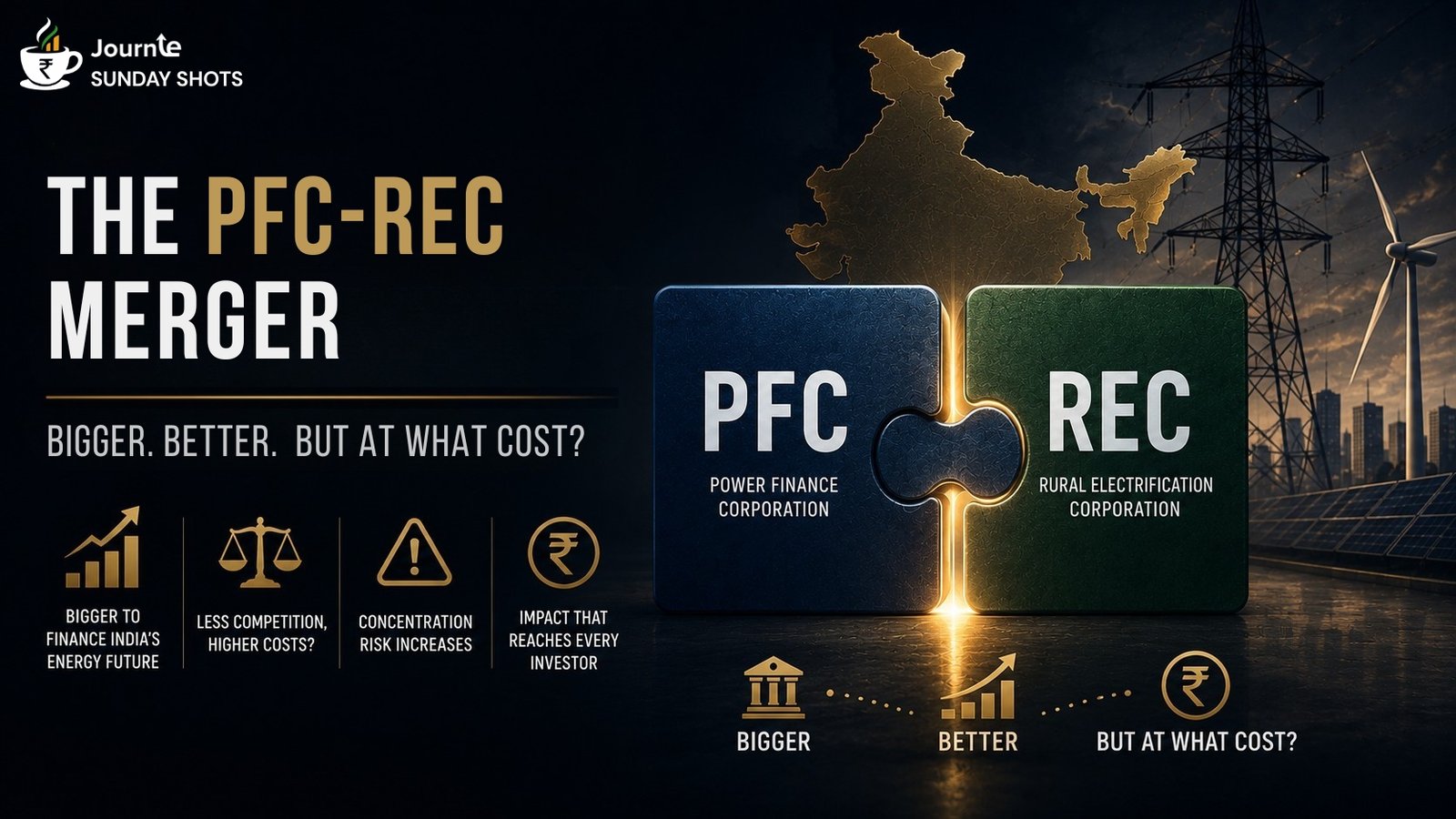
The PFC–REC merger illustrated with two interlocking puzzle pieces representing India's largest power finance institutions against a backdrop of power infrastructure and renewable energy, symbolising the trade-off between scale and competition.

Imagine your neighbourhood has two grocery stores.

Both compete for your business. One offers better prices, the other better service. Because they compete, you benefit.

Now imagine those two stores merge into one.

The new store is larger, more efficient and financially stronger. It can negotiate better with suppliers, operate at lower costs and serve more customers.

But there is one thing missing—competition. And sometimes, losing competition becomes more expensive than gaining scale.

A similar story is unfolding in the institutions that finance India’s power sector.

The proposed merger of Power Finance Corporation (PFC) and REC Ltd. will create India’s largest dedicated power-sector financier, with a combined loan book exceeding ₹11 lakh crore.

The rationale is clear: build a stronger institution capable of financing India’s rapidly growing infrastructure and clean-energy ambitions. 

On paper, it makes perfect sense. But financial markets rarely judge size alone. They judge competition, concentration and risk.

And that is where this merger becomes far more interesting than it first appears.

A Bigger Shift Than Just One Merger

This merger is not happening in isolation. Over the past decade, India has steadily moved towards creating larger financial institutions.

The merger of SBI with its associate banks, the consolidation of public-sector banks, the combination of HDFC Ltd. with HDFC Bank and now the proposed merger of PFC and REC—all point towards the same philosophy.

Build larger institutions that can finance larger ambitions.

For a country investing aggressively in highways, railways, renewable energy, transmission networks, battery storage and digital infrastructure, the logic is easy to understand. Projects of this scale require equally large pools of long-term capital.

Scale, therefore, becomes a strategic advantage. But every advantage comes with a trade-off.

Because while larger institutions become stronger, markets often become less competitive.

From Two Powerhouses to One Giant

For decades, PFC and REC have been the twin pillars of India’s power financing ecosystem.

Together, they have financed thermal power plants, renewable energy projects, transmission lines, state electricity distribution companies (DISCOMs) and several of the country’s largest infrastructure projects.

Government ownership has historically allowed both institutions to raise capital at highly competitive borrowing costs, making them the preferred lenders for India’s expanding power sector.

The merger aims to build on these strengths and this strength is precisely why the proposal is attracting attention.

A larger balance sheet could mobilise capital more efficiently, simplify funding for large multi-state projects and strengthen India’s ability to finance its target of 500 GW of non-fossil fuel electricity capacity by 2030.

Yet something important also changes. The merger doesn’t just create a larger institution – it reshapes the market around it.

When Markets Lose a Player

Until now, state governments, electricity distribution companies and infrastructure developers could negotiate financing terms between PFC and REC.

Even though both were government-owned, they still competed—on pricing, execution, lending terms and customer relationships.

That competition benefited borrowers.

If the merger goes through, that competitive pressure naturally reduces as the number of specialised lenders shrinks.

Borrowers may gradually lose some negotiating leverage if alternative financing options do not expand over time.

Markets will closely watch whether this eventually influences lending spreads.

When Competition Falls, Risk Becomes the New Price

Reduced competition is only one part of the story. The bigger question is how financial markets price concentration.

The merged entity will become one of the country’s largest sector-focused lenders, with significant exposure to a single industry—the power sector.

Government ownership continues to provide confidence.

But investors and credit markets may also pay closer attention to concentration risk. A larger institution often attracts greater regulatory scrutiny, stronger governance expectations and more rigorous risk assessment.

None of these are negatives. In fact, they often make institutions stronger. But they can also influence how markets price the institution’s bonds and future borrowings.

Even small changes matter when lending runs into trillions of rupees.

Why This Matters Beyond the Power Sector

It is easy to assume that this merger concerns only policymakers or institutional investors. In reality, almost every investor is connected to this story.

Equity investors could benefit if the merged institution delivers stronger profitability, lower operating costs and better capital allocation over the long term. At the same time, integrating two large public-sector organisations will require aligning technology, people, processes and governance—something that rarely happens overnight.

Debt mutual fund investors have another perspective. Many corporate bond funds, Banking & PSU Funds and Target Maturity Funds already hold bonds issued by PFC and REC. If investors eventually demand a slightly higher risk premium for concentration, existing bond prices could face temporary pressure, while new investors may benefit from improved yields.

Even SIP investors are indirectly exposed.

Infrastructure funds, PSU funds and diversified equity portfolios all invest in businesses linked to India’s power financing ecosystem.

The long-term success—or failure—of this merger could influence portfolios that millions of Indians already own.

The Bigger Story Is India's Energy Transition

Viewed in isolation, this is a merger. Viewed in context, it is a financing strategy.

India is entering one of the largest infrastructure investment cycles in its history. Clean energy, transmission corridors, battery storage, green hydrogen, modern electricity grids and urban infrastructure will require enormous amounts of patient, long-term capital.

Building a larger financing institution could make funding these ambitions easier.

But there is another question worth asking – Can an economy build larger institutions without gradually reducing competition?

If fewer specialised lenders participate in the market, pricing efficiency may decline. State utilities and infrastructure developers could eventually face stricter lending terms or slightly higher financing costs, which may ultimately influence electricity tariffs and public finances.

Every growing economy eventually faces the same trade-off. Competition encourages efficiency, innovation and better pricing. Scale enables larger investments, stronger balance sheets and faster execution.

The challenge is that you rarely get both in equal measure.

The Real Test Begins After the Headlines

History has shown that announcing a merger is the easy part. Executing one is much harder.

India has witnessed several landmark financial mergers over the past decade. Most eventually created stronger institutions—but only after years of integration, cultural alignment and operational refinement.

The proposed PFC–REC merger will face the same challenge.

Creating India's largest power financier is an achievement. Making it more efficient, more competitive and more valuable than the two institutions it replaces is the real test.

Because in finance, bigger creates headlines. Only better creates lasting value.

See you next Sunday for another shot of insights!

Disclaimer: This update is for informational purposes only. Please consult a SEBI-registered advisor before investing.

Enjoyed this week’s Sunday Shots? Share it across WhatsApp, LinkedIn, or X — and invite someone else into the conversation.
Subscribe to Sunday Shots for a fresh perspective delivered every week.

Recent Blogs

Lorem ipsum dolor sit amet, consectetur adipiscing elit. Ut elit tellus, luctus nec ullamcorper mattis, pulvinar dapibus leo.

Subscribe to Journie Shots — thoughtful, well-curated insights and market stories delivered every Sunday.