
Journie WealthTech Private Limited | AMFI Registered Mutual Fund & SIF Distributor (ARN: 318048)
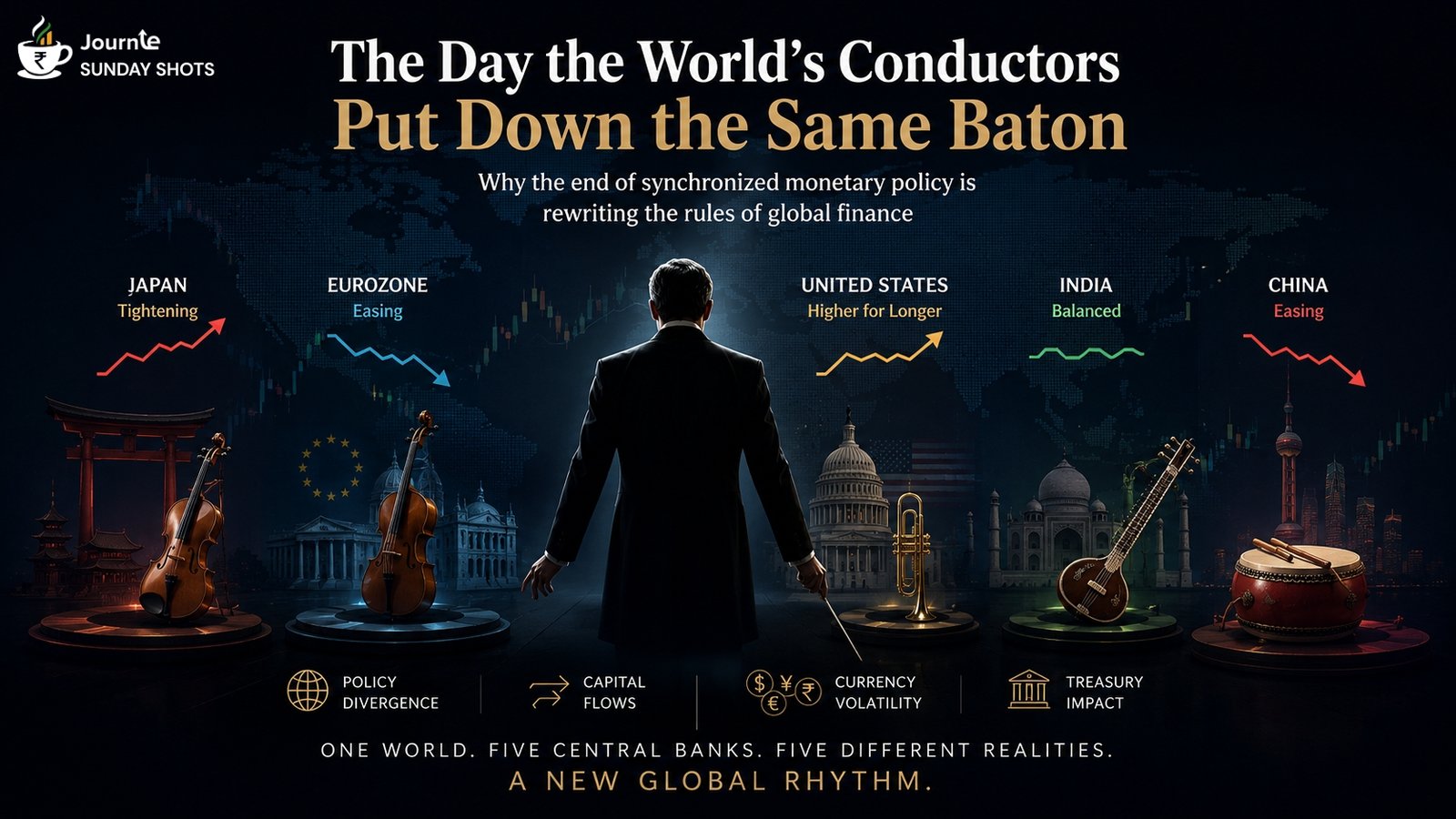
The Day the World's Conductors Put Down the Same Baton
Every time the rupee weakens, the same optimism returns to the markets. Export stocks rally. IT companies gain attention. Pharma businesses come back into focus.
And once again, a familiar belief starts spreading across television debates, WhatsApp forwards, and market conversations: “A weaker rupee is good for India’s exports.”
At first glance, the logic sounds perfectly reasonable.
If the rupee falls against the dollar, Indian goods become cheaper globally. Foreign buyers can purchase more from India at lower relative prices. Exports rise. Economic growth improves.
Simple. Except the modern global economy is no longer that simple.
Because today, exports are not built on currency advantage alone. They are shaped by manufacturing depth, technology, logistics, energy access, production networks, and industrial capability.
And that changes the entire equation for India.
Because while India exports to the world, it also relies heavily on imported inputs underneath. So, when the rupee weakens, export revenues may improve in rupee terms, but production costs rise too.
That contradiction sits at the heart of India’s export story. And it is far more important than most market conversations acknowledge.
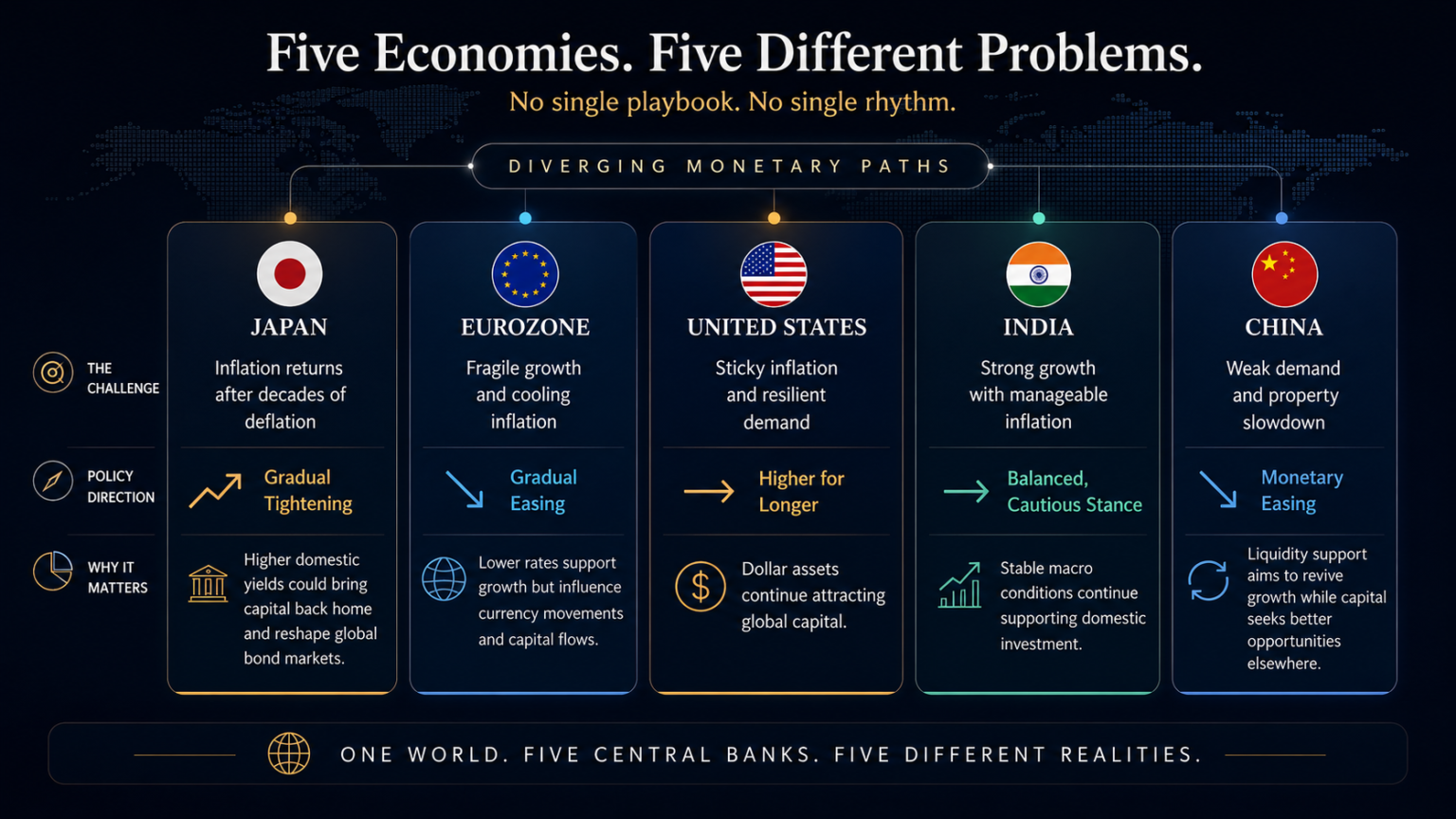
Five Economies. Five Different Problems.
For the first time in years, there is no common monetary playbook.
Every major economy is writing its own chapter. Each central bank is responding to its own economic reality.
Japan is slowly leaving behind decades of ultra-low interest rates. Europe is trying to revive growth.
The United States remains focused on ensuring inflation doesn’t make an unwelcome comeback.
India is balancing growth with price stability. China is trying to stimulate demand.
One world. Five central banks. Five entirely different priorities.
The era of synchronized monetary policy has quietly come to an end.
When Central Banks Disagree, Capital Starts Moving
Money rarely stays where returns are falling. It follows opportunity. Higher interest rates attract capital. Lower rates encourage investors to look elsewhere.
For years, when central banks broadly moved together, these shifts were relatively predictable.
Today, every major policy meeting has the potential to redirect billions of dollars across borders.
Capital doesn’t need a passport. It simply follows incentives. And as those incentives diverge, global money becomes far more selective.
Countries with stable inflation, credible policy frameworks and attractive real yields are likely to attract stronger capital inflows. Those with weaker fundamentals may experience greater volatility.
Policy credibility is becoming just as valuable as economic growth itself.
Currencies Have Found Their Own Voice
Monetary policy is never just about borrowing costs. It also determines where money wants to live.
As interest-rate paths diverge, exchange rates increasingly reflect local economic realities instead of a shared global cycle.
The Japanese yen. The euro. The U.S. dollar. The Chinese yuan. The Indian rupee. They are no longer moving to the same rhythm.
For businesses operating across borders, this changes everything.
A financing decision that looks attractive today can become significantly more expensive if currencies move unexpectedly tomorrow.
Currency risk is no longer a side consideration. It has become a boardroom discussion.
Investing Is Becoming More Geography-Driven
For years, investors diversified across countries while assuming monetary policy would broadly move together.
That assumption no longer holds.
Geography itself has become an investment variable.
Bond markets may outperform in one region while equities lead in another. Currencies can amplify—or completely erase—investment returns.
Countries with stronger policy credibility may attract disproportionate capital even if their growth rates are lower.
The next decade may reward investors who understand why economies are diverging, not just where markets are moving.
The Return of Carry Trades
Different interest rates are also reviving one of finance’s oldest strategies—the carry trade.
Borrow where money is cheap. Invest where yields are higher. When currencies remain stable, the strategy can generate attractive returns.
But currencies rarely stay still forever.
As monetary policies diverge, even small policy surprises can trigger sharp foreign exchange moves, wiping out months of gains overnight.
As Japan gradually raises rates while others move in different directions, carry trades are becoming attractive again—but also far riskier.
The opportunity is returning. So is the volatility.
Treasury Has Become a Strategic Function
Perhaps the biggest transformation isn’t happening on trading floors. It’s happening inside corporate boardrooms.
For years, treasury teams operated in a world where global interest-rate cycles were broadly aligned. Planning was relatively straightforward.
That world no longer exists.
Today’s finance leaders must make decisions across multiple currencies, different borrowing environments and increasingly volatile capital markets.
A financing decision that makes perfect sense in Europe may become significantly more expensive after an unexpected currency move. A borrowing strategy suited for New York may introduce unnecessary foreign exchange risk for operations in Mumbai.
The cheapest source of funding may no longer be the safest. The safest currency may no longer be the cheapest. And the highest yield may not deliver the highest return once currency risk is considered.
Liquidity. Foreign exchange exposure. Refinancing risk. Surplus cash deployment.
These can no longer be managed in isolation.
Treasury management is evolving from a back-office function into a strategic advantage. Because in today’s fragmented monetary world, every financing decision is also a macroeconomic decision.
And legacy systems, disconnected data and spreadsheet-driven treasury are increasingly becoming operational risks.
History rarely announces its turning points. It changes quietly—until one day we realize the rules have already changed.
For more than a decade, markets grew comfortable with central banks moving together. That predictability shaped everything from asset prices to corporate borrowing and investment decisions.
Today, the world is learning a different rhythm..
Japan is normalizing. Europe is easing. America is exercising patience. India is balancing. China is stimulating.
Five major economies. Five different realities. No single conductor.
For years, success came from understanding the global cycle. The next decade will reward those who understand the differences.
Because the world's conductors haven't stopped playing. They've simply stopped following the same baton.
See you next Sunday for another shot of insights!

Disclaimer: This update is for informational purposes only. Please consult a SEBI-registered advisor before investing.
Enjoyed this week’s Sunday Shots? Share it across WhatsApp, LinkedIn, or X — and invite someone else into the conversation.
Subscribe to Sunday Shots for a fresh perspective delivered every week.
Lorem ipsum dolor sit amet, consectetur adipiscing elit. Ut elit tellus, luctus nec ullamcorper mattis, pulvinar dapibus leo.