Journie WealthTech Private Limited | AMFI Registered Mutual Fund & SIF Distributor (ARN: 318048)
The Evolution of Investing: How Factor Investing Became the Third Way
Imagine you’re picking a cricket team.
One selector says, “Pick the biggest stars. They’ve already proved themselves.”
The second disagrees. “Don’t look at fame. Pick players who are in form, perform consistently under pressure, and fit the conditions.”
Neither approach is irrational. They’re simply answering different questions.
For a long time, investing worked in much the same way.
One school believed success came from identifying tomorrow’s winners before everyone else.
Another believed the smartest decision was to stop predicting altogether and simply own the market.
For decades, those were the only two schools of thought. Then a third idea quietly emerged.
Not by asking which company to buy.
Not by asking whether active investing was better than passive investing.
But by asking something much simpler: If we’re already building an index, can we build a better one?
And that question gave birth to one of the fastest-growing ideas in modern investing—factor investing.
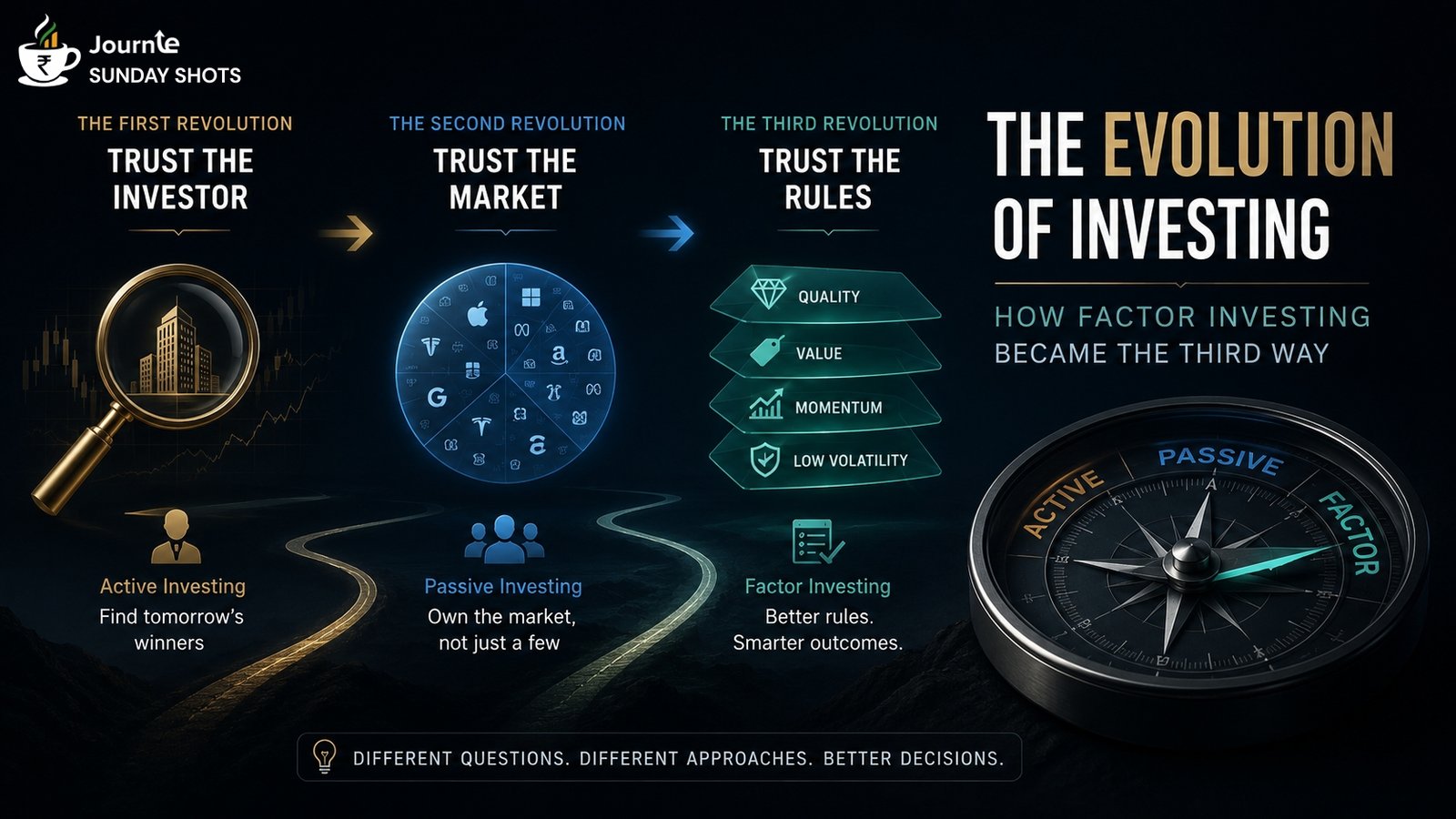
The First Revolution: Trust the Investor
Imagine investing forty years ago.
The internet didn’t exist. There were no financial apps. No earnings call recordings.
Research meant reading thick annual reports, visiting factories, meeting management teams and speaking with customers.
The belief was straightforward: Better research leads to better investment decisions.
This became the foundation of active investing.
Legendary investors like Warren Buffett, Peter Lynch and Benjamin Graham built extraordinary careers by identifying exceptional businesses long before they became household names.
For decades, this was considered the highest form of investing.
But there was one problem.
Finding great companies is difficult. Finding them consistently is even harder.
As markets matured, researchers began studying thousands of mutual funds across decades.
The conclusion was uncomfortable.
Many fund managers beat the market for a few years. Very few managed to do it consistently over long periods after accounting for fees.
That observation sparked the next revolution.
The Second Revolution: Trust the Market
Instead of asking, “Which company will outperform?”
Investors began asking, “Why not simply own the market?”
That simple question transformed investing.
Rather than trying to predict winners, investors simply bought the companies that made up a market index.
No forecasts. No stock picking. Just broad diversification at a lower cost.
John Bogle popularized this philosophy in 1976 with the launch of the first retail index fund, an idea many critics dismissed at the time as “Bogle’s Folly”.
Yet the logic was compelling.
If consistently beating the market is difficult, why not own the market itself?
Over time, evidence began to support that thinking. Many active managers struggled to consistently outperform broad market indices after fees, strengthening the case for passive investing.
Today, index investing has become one of the largest movements in global finance, managing trillions of dollars globally.
But Passive Investing Had One Blind Spot
Traditional indices follow one straightforward rule.
The larger a company’s market value, the larger its weight in the index.
Simple. Transparent. Efficient.
But ask yourself. Should company size alone decide how much you own?
Imagine two companies.
One is enormously valuable but growing slowly.
The other consistently delivers higher profitability, stronger balance sheets and disciplined capital allocation.
Should both be treated the same simply because one is bigger?
Researchers didn’t think so. They wondered if portfolios could be built around qualities that had historically mattered—not opinions.
And that changed everything.
The Third Revolution: Trust the Rules
Interestingly, factor investing wasn’t born inside an investment bank. It began in university classrooms.
In the early 1990s, economists Eugene Fama and Kenneth French analyzed decades of stock market data to answer a deceptively simple question.
Why do some groups of companies consistently behave differently from others over long periods?
Their research suggested that certain characteristics—or factors—help explain differences in returns across stocks.
Over time, researchers identified several factors that repeatedly appeared across markets.
Meet the Factors
Think of them as different personalities.
Value – The bargain hunter. Looks for companies trading below what they may truly be worth.
Quality – The disciplined performer. Favours businesses with healthy balance sheets, consistent profits and prudent capital allocation.
Momentum – The trend follower. Backs companies already demonstrating sustained price strength.
Low Volatility – The steady traveller. Seeks businesses that have historically experienced smaller price swings.
Each tells a different story. Each performs differently across market cycles.
No factor wins forever. And that’s precisely the point.
Think of these as different lenses through which investors view the market.
Factor investing isn’t about finding the perfect strategy. It’s about understanding that different market environments reward different characteristics.
From Academic Papers to Trillions of Dollars
What started as academic research has become one of the most widely adopted approaches in institutional investing.
According to S&P Dow Jones Indices, assets in factor-based ETFs grew from around US$178 billion in 2012 to roughly US$1.6 trillion by 2022.
Large pension funds, sovereign wealth funds, insurance companies and endowments now use factor strategies alongside traditional investments—not as replacements, but as complements.
India is following a similar path.
Over the past few years, exchanges and asset managers have launched indices based on Momentum, Quality, Alpha, Value and Low Volatility.
Investors who once had access only to traditional index funds can now choose portfolios built around different investment philosophies and market characteristics.
It’s a quiet shift. But an important one.
So, Does It Always Work?
Not always. And that’s exactly why factor investing is often misunderstood.
No single factor wins in every market.
Momentum can struggle when markets suddenly reverse. Value can remain out of favour for years. Quality may underperform during speculative rallies. Low Volatility can lag during strong bull markets.
That’s because each factor is designed to capture a different characteristic of the market—not to outperform all the time.
In practice, investors rarely rely on just one factor.
Much like building a cricket team, you wouldn’t fill the entire squad with only batters or only bowlers. You’d want a balanced team where different strengths complement each other.
Portfolio construction works the same way.
Rather than relying on a single factor, many investors combine Quality, Value, Momentum and Low Volatility to create multi-factor portfolios.
The idea isn’t that one factor will always outperform, but that different factors may complement each other across different market environments — potentially improving long-term risk-adjusted returns without relying entirely on human judgement.
So perhaps the better question isn’t, “Is factor investing better?” It’s, “Better for whom—and under what conditions?”
Active investing says: Trust the manager.
Passive investing says: Trust the market.
Factor investing says: Trust the rules—but choose the rules carefully.

Every generation of investors believes it has discovered the best way to invest.
History tells a different story.
Active investing didn't disappear because passive investing arrived.
Passive investingisn't disappearing because factor investing is growing.
Each approach solved a different problem. Perhaps that's the real lesson.
The future of investing isn't about choosing sides. It's about understanding why each philosophy exists—and when each one makes the most sense.
Because the biggest breakthroughs in finance rarely begin with a better answer. They begin with a better question.
See you next Sunday for another shot of insights!
Disclaimer: This update is for informational purposes only. Please consult a SEBI-registered advisor before investing.
Enjoyed this week’s Sunday Shots? Share it across WhatsApp, LinkedIn, or X — and invite someone else into the conversation.
Subscribe to Sunday Shots for a fresh perspective delivered every week.
Lorem ipsum dolor sit amet, consectetur adipiscing elit. Ut elit tellus, luctus nec ullamcorper mattis, pulvinar dapibus leo.