

Journie WealthTech Private Limited | AMFI Registered Mutual Fund & SIF Distributor (ARN: 318048)

The Liquidity Puzzle: When Money Stops Moving

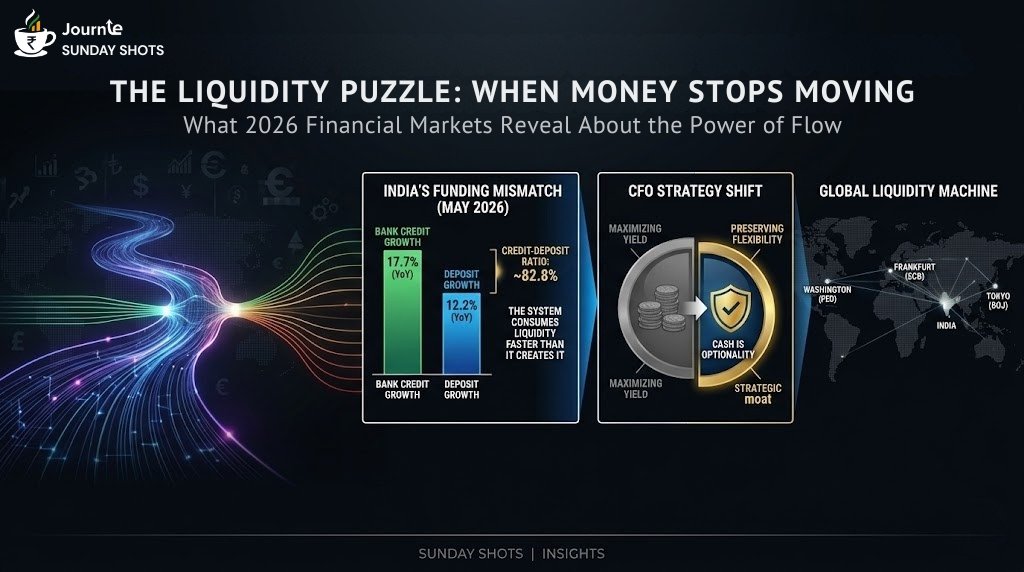
Infographic explaining India's liquidity puzzle in 2026, showing the credit-deposit growth mismatch, CFO strategy shift toward cash optionality, and global capital flows.

Imagine a river flowing through a vast city.

The bridges are standing, the roads are open, and every destination remains exactly where it was yesterday. Yet traffic suddenly slows. Not because the roads disappeared, but because the flow itself has weakened. A single bottleneck upstream changes everything downstream.

Financial markets in 2026 are facing a similar reality.

For years, investors watched interest rates to understand where markets were headed. Today, they are increasingly watching something less visible but arguably more powerful: liquidity.

Because in modern finance, the price of money matters, but the ability of money to move matters even more.

When the Cost of Money Stops Being the Main Story

Interest rates tell us how expensive money is.

Liquidity tells us whether money is available at all.

That distinction is becoming critical. The Reserve Bank of India has kept the repo rate unchanged at 5.25%, signaling policy stability.

Yet during periods of tight funding, overnight borrowing rates have traded above the policy rate, revealing a deeper truth: market conditions are increasingly being shaped by liquidity rather than policy announcements.

The market is no longer asking, “What is the rate?” It is asking, “Is funding available?”

History has shown that liquidity shortages can create disruptions even when interest rates remain stable. When cash becomes scarce inside the financial system, stress travels quickly across bonds, equities, currencies, and credit markets.

That dynamic is now visible in India.

India's Quiet Funding Mismatch

Beneath India’s strong economic growth lies a structural imbalance that deserves attention.

As of May 2026, bank credit was growing at 17.7% while deposits were growing at only 12.2%. The result is a credit-deposit ratio of roughly 82.8%, one of the highest levels seen in recent years. Banks are lending far faster than they are gathering deposits.

In simple terms: the system is consuming liquidity faster than it is creating it.

This does not signal a crisis. But it does mean banks must increasingly compete for funding, rely on wholesale borrowing, and manage liquidity more actively than before.

The RBI has repeatedly assured markets that sufficient liquidity support will remain available, yet the pressure is evident.

And when liquidity tightens, the first place it appears is often the bond market.

The Bond Market Becomes the Battlefield

Bond yields are traditionally viewed as a reflection of inflation and interest-rate expectations.

Today, they are also becoming a reflection of liquidity conditions.

Whenever liquidity becomes scarce, investors demand higher compensation to hold longer-duration assets. Funding costs rise, corporate borrowing becomes more expensive, and debt issuance slows.

Even small shifts in system liquidity can ripple through the entire fixed-income ecosystem.

This is precisely why India’s efforts to attract foreign capital have gained importance.

Policymakers are attempting to deepen domestic debt markets, improve participation, and ensure that liquidity remains broad enough to absorb growing financing needs.

In a world of larger bond markets, liquidity itself becomes an asset.

But liquidity is not merely a concern for bond traders and central bankers. The same forces shaping financial markets are increasingly influencing decisions inside corporate boardrooms.

Why CFOs Are Suddenly Obsessed with Cash

The liquidity story does not end in banking. It reaches corporate boardrooms.

Across the world, treasury teams are shifting focus from maximizing returns to preserving flexibility.

Recent treasury surveys show cash management has become one of the highest priorities for corporate finance leaders navigating geopolitical uncertainty, supply-chain risks, and volatile funding markets.

Cash is no longer viewed as idle. Cash is optionality.

The ability to meet obligations, seize opportunities, or withstand disruptions increasingly depends on maintaining liquidity buffers. For many companies, treasury management has evolved from a back-office function into a strategic advantage.

Yet even the best treasury teams operate within a larger ecosystem. The availability of liquidity inside a company is often influenced by the availability of liquidity across the world.

The Global Liquidity Machine

India’s liquidity conditions are also connected to decisions made thousands of miles away.

The balance sheets of the U.S. Federal Reserve, the European Central Bank, and the Bank of Japan continue to influence global capital flows. When global liquidity expands, investors search for higher returns in emerging markets. When liquidity contracts, capital becomes more selective and funding conditions tighten.

This transmission mechanism explains why events in Washington, Frankfurt, Tokyo—or even the Middle East, can affect Indian bond yields, currency movements, and funding costs.

Money today is global. Liquidity travels faster than ever.

And that means domestic markets are increasingly shaped by forces beyond domestic interest rates alone.

The Decade Ahead Belongs to Liquidity

The post-pandemic financial system looks fundamentally different from the one that existed before 2008.

Central-bank balance sheets remain large. Capital moves across borders at unprecedented speed. Bond markets are deeper, larger, and more interconnected. Artificial Intelligence is enabling real-time treasury and liquidity management.

In this environment, the availability of money may matter more than its price.

Interest rates will continue to influence borrowing decisions. But liquidity will increasingly determine market resilience, financial stability, and investor confidence.

The investors who understand liquidity cycles will likely understand market cycles.

Because the defining question of the next decade may not be, "What is the interest rate?"

It may be, "Where is the liquidity flowing?"

See you next Sunday for another shot of insights!
Disclaimer: This update is for informational purposes only. Please consult a SEBI-registered advisor before investing.

Enjoyed this week’s Sunday Shots? Share it across WhatsApp, LinkedIn, or X — and invite someone else into the conversation.
Subscribe to Sunday Shots for a fresh perspective delivered every week.

Recent Blogs

Lorem ipsum dolor sit amet, consectetur adipiscing elit. Ut elit tellus, luctus nec ullamcorper mattis, pulvinar dapibus leo.

Subscribe to Journie Shots — thoughtful, well-curated insights and market stories delivered every Sunday.