

Journie WealthTech Private Limited | AMFI Registered Mutual Fund & SIF Distributor (ARN: 318048)

The Day AI Became an Infrastructure Business

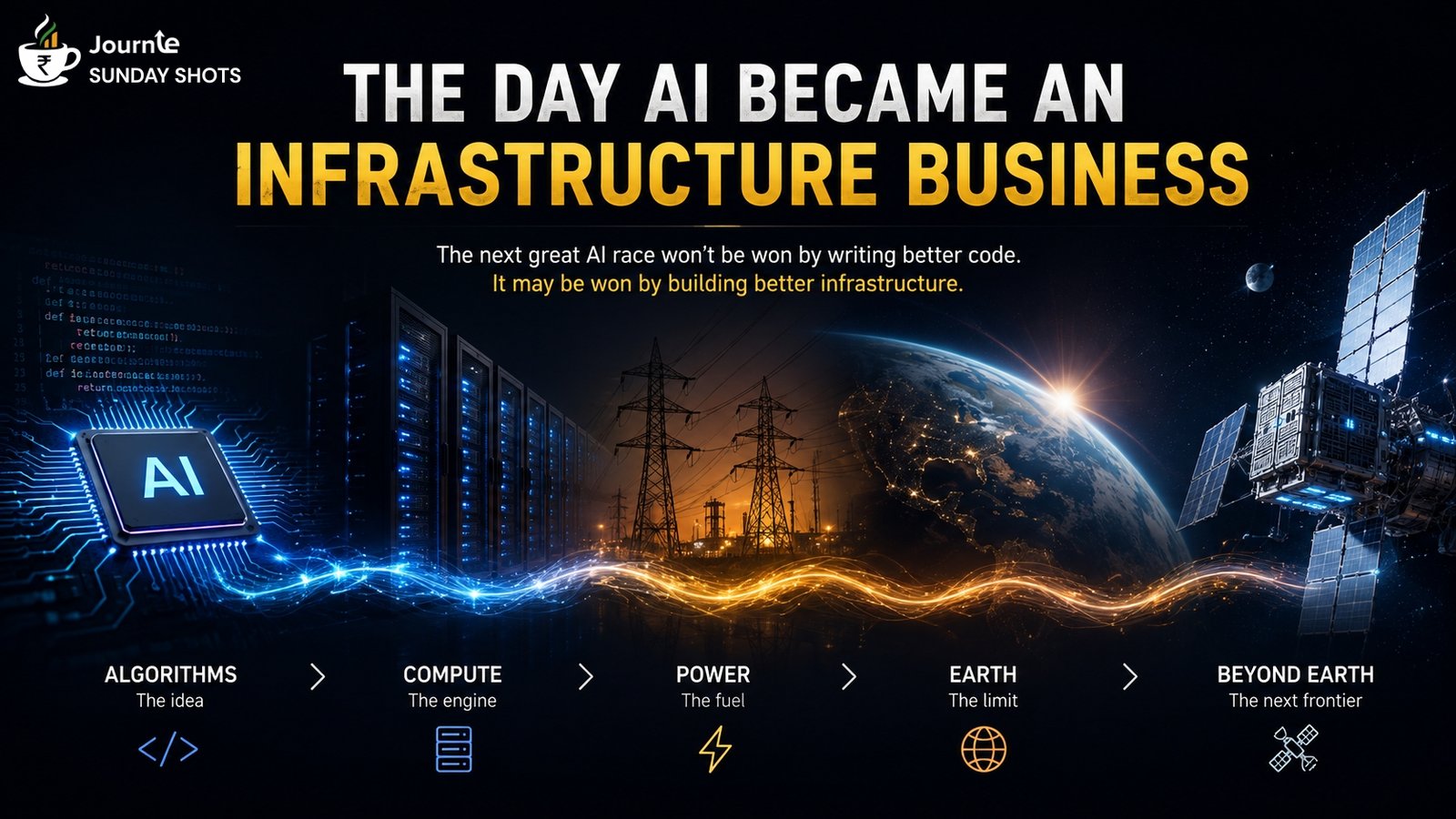
Illustration showing AI's evolution from software and semiconductors to data centres, power grids, Earth and orbital infrastructure, highlighting the future of AI infrastructure.

“The next great AI race won’t be won by writing better code. It may be won by building better infrastructure.”

Most of us think AI is a software revolution. It isn’t.

Or at least…It isn’t anymore.

When OpenAI launched ChatGPT, it ignited one of the fastest technology races in history.

Google responded with Gemini. Anthropic introduced Claude. Microsoft embedded AI across its products.

Meta accelerated its open-source Llama models. DeepSeek surprised the industry with high-performance models at a fraction of the expected cost.

Almost overnight, every major technology company was competing to build a smarter AI.

Build a smarter model. Train it on more data. Generate better answers.

For a while, intelligence was the competitive advantage. Today, that race has shifted.

The biggest constraint in AI isn’t intelligence anymore. It’s infrastructure.

Every Prompt Has A Physical Cost

AI feels invisible.

You type a question. A response appears. And it all happens in seconds.

But behind that simplicity lies one of the largest industrial systems ever built.

Warehouses the size of football fields. Hundreds of thousands of AI chips. Gigawatts of electricity. Massive cooling systems. And Miles of fibre-optic cables.

The moment you hit Enter, thousands of specialized processors begin working. Electricity starts flowing. Cooling systems roar into action. Data travels across continents.

Entire buildings come alive…just to answer a question that took you five seconds to type.

The AI revolution may feel digital. Beneath every prompt lies an extraordinary amount of physical infrastructure.

And that’s why AI is no longer just a software story.

History Has Seen This Before

Every major technological revolution eventually runs into a physical limit.

Railways weren’t limited by locomotives. They were limited by steel.

The internet wasn’t limited by websites. It was limited by fibre-optic cables and data centres.

Electric vehicles aren’t limited by cars. They’re limited by batteries and charging infrastructure.

Artificial Intelligence has reached the same stage.

The software is moving faster than the infrastructure supporting it.

The Scale Is Staggering

The International Energy Agency estimates that global electricity demand from data centres could more than double by 2030, largely driven by AI workloads.

Some of the largest AI data centres already consume electricity comparable to a medium-sized city.

At the same time, the world’s largest technology companies are collectively investing hundreds of billions of dollars every year to expand AI infrastructure.

This isn’t just another technology upgrade. It’s an industrial-scale build-out.

One that will reshape energy, manufacturing, construction and capital allocation for years to come.

The Infrastructure Race Has Already Begun

The shift becomes obvious when you look at where the world’s largest technology companies are investing.

Microsoft is securing long-term energy supplies—including nuclear power—to meet future AI demand.

Amazon continues expanding AWS with billions of dollars flowing into new AI data centres.

Google is building new data-centre campuses while designing custom AI chips to squeeze more performance from every watt of power.

Meta is constructing some of the world’s largest AI clusters, measured not just in GPUs, but in gigawatts.

Notice something?

These companies aren’t just investing in software anymore. They’re investing in electricity, power grids, semiconductors, cooling systems, transmission infrastructure and land.

Because the smartest AI model in the world is useless…if there isn’t enough infrastructure to power it.

When Earth Starts Pushing Back

Building a modern AI data centre isn’t as simple as buying land and installing servers.

Suitable land is becoming scarce. Power grids in many regions are already under pressure. Cooling systems consume enormous quantities of water.

Environmental approvals can take years. Transmission infrastructure is expensive. Demand for electricity is rising faster than many regions can expand supply.

The challenge is no longer building intelligence. It’s finding somewhere to put it.

Every industry eventually solves today’s constraint…until it encounters tomorrow’s.

The next chapter of AI won’t be defined by algorithms. It will be defined by infrastructure.

Which Leads To A Question Nobody Expected To Ask

Not, “How do we build a smarter AI?”

But, “Where do we put the next million GPUs?”

And once you ask that…Space no longer sounds like science fiction.

Researchers and private companies have begun exploring the idea of orbital data centres—computing infrastructure placed in Earth orbit rather than on the ground.

The idea sounds futuristic. But so did reusable rockets twenty years ago.

Almost continuous solar energy. No competition for land. Reduced dependence on freshwater cooling. Direct connectivity to the growing network of satellites already generating enormous volumes of data.

Of course, the challenges remain significant.

Launching hardware into orbit is still expensive. Repairing equipment is far more difficult. Electronic components must withstand radiation.

Heat management in the vacuum of space requires entirely different engineering. Orbital data centres are unlikely to replace terrestrial infrastructure anytime soon.

But the fact that serious discussions are taking place tells us something remarkable.

The conversation has changed.

We’re no longer asking, “Can AI become more powerful?”

We’re asking, “Where will we physically run it?”

The Biggest Winners May Not Build AI

History rarely rewards only the inventors. It also rewards those who build the ecosystem around them.

During the California Gold Rush, fortunes weren’t made only by those digging for gold. Many were made by selling the picks and shovels.

The Internet rewarded cloud providers, semiconductor companies and fibre builders.

The AI revolution is creating its own infrastructure economy.

Semiconductor manufacturers. Power equipment suppliers. Cooling technology companies. Electrical infrastructure providers. Grid modernization.

Renewable energy. Nuclear energy. Space launch providers. Satellite manufacturers.

Tomorrow’s AI leaders may not all write better code. Some will simply build the infrastructure that makes AI possible.

Because if AI is becoming an infrastructure business…then infrastructure becomes the investment opportunity.

Beyond the Horizon

Every technological revolution eventually encounters a physical limit.

Railways needed steel. The internet needed fibre.

Electric vehicles need batteries. Artificial intelligence needs infrastructure.

The question is no longer whether AI will continue growing. It almost certainly will.

The more interesting question is where that growth will live.

For now, the answer is Earth. One day, it may not be. And if that happens…

the next great infrastructure race won't be across continents. It will be above them.

AI isn't running out of ideas. It's running out of Earth.

See you next Sunday for another shot of insights!

Disclaimer: This update is for informational purposes only. Please consult a SEBI-registered advisor before investing.

Enjoyed this week’s Sunday Shots? Share it across WhatsApp, LinkedIn, or X — and invite someone else into the conversation.
Subscribe to Sunday Shots for a fresh perspective delivered every week.

Recent Blogs

Subscribe to Journie Shots — thoughtful, well-curated insights and market stories delivered every Sunday.