

Journie WealthTech Private Limited | AMFI Registered Mutual Fund & SIF Distributor (ARN: 318048)
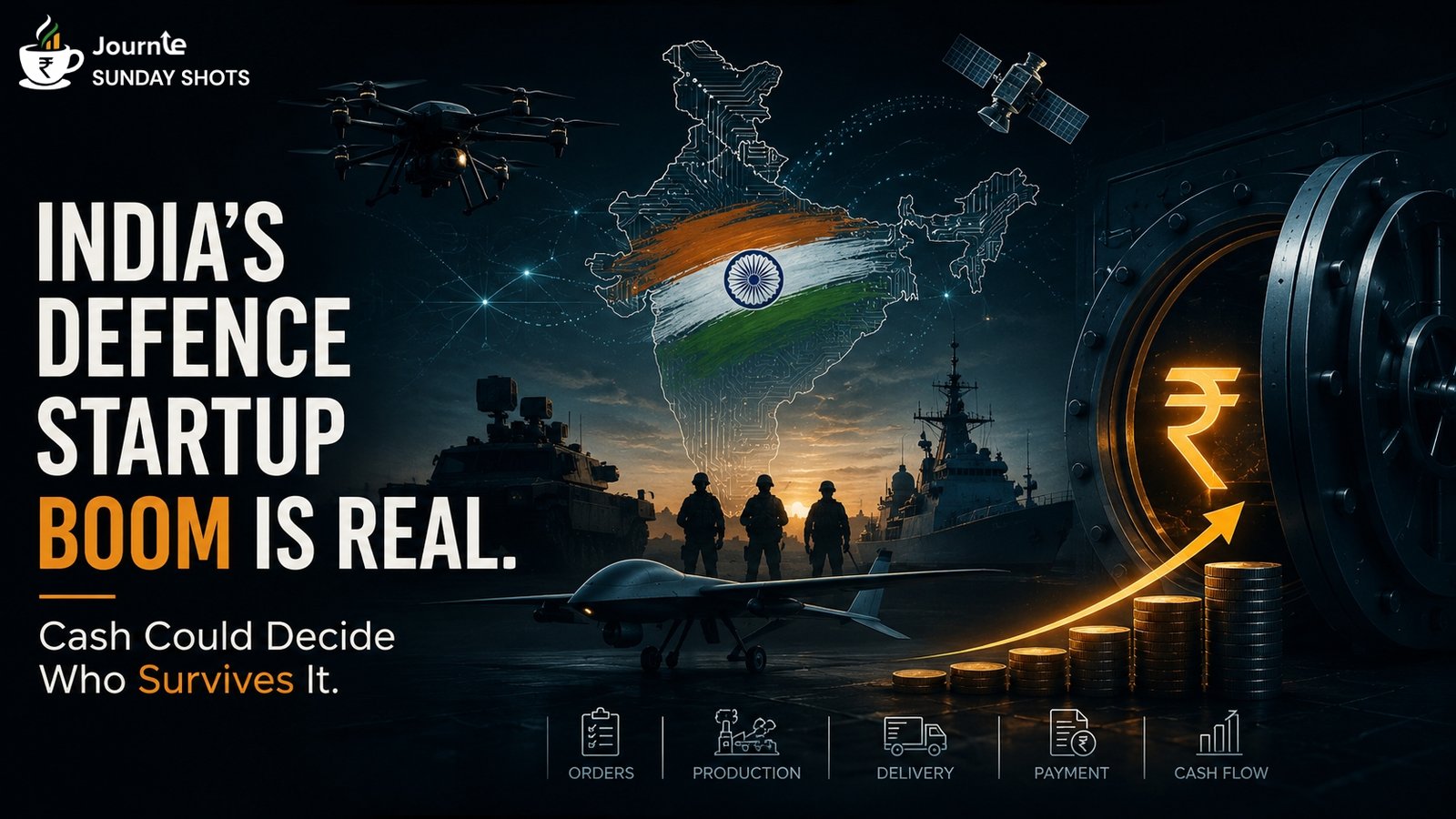
India’s Defence Startup Boom Is Real. Cash Could Decide Who Survives It.
Wishing everyone a Happy Independence Day 🇮🇳
Independence was never only about political freedom. It was also about building the ability to determine our own future.
And 79 years later, one part of that story is unfolding in a rather unexpected place:
India’s defence startups.
A Special Independence Day Edition
This week’s Sunday Shots is a special edition.
As we celebrate Independence Day, let’s also celebrate the spirit of building — businesses, ideas, communities and dreams that shape the India we are becoming.
And few stories capture that spirit better today than the rise of India’s defence startup ecosystem.
From drones and autonomous systems to AI, robotics, surveillance and advanced manufacturing, a new generation of Indian companies is beginning to build technologies that were once largely sourced from outside the country.
India is no longer just trying to buy defence equipment. It is increasingly trying to build it.
And the numbers are beginning to tell that story.
India’s defence production reached a record ₹1.78 lakh crore in FY2025–26, up 15.6% from the previous year and more than double its FY2020–21 level.
The private sector contributed around ₹42,000 crore, taking its share of India’s defence production to an all-time high of 24%.
Defence exports tell an even bigger story.
India exported ₹38,424 crore worth of defence equipment in FY2025–26, up 62.66% in a single year. And the private sector accounted for 45.16% of those exports.
The government is reinforcing this shift with capital.
The Ministry of Defence has received a ₹7.85 lakh crore allocation for FY2026–27, including ₹2.19 lakh crore under the capital head. Of that, ₹1.39 lakh crore is earmarked for procurement from domestic defence industries.
This is no longer just a story about more defence spending. It is the story of India building a defence industrial ecosystem.
And startups are increasingly sitting inside it.
The Startups Are Already Inside the Machine
One of the clearest signs is iDEX — Innovations for Defence Excellence.
Launched in 2018 to bring startups, MSMEs and innovators into defence technology development, iDEX is moving beyond simply funding ideas.
As of February 2026, approximately 676 startups, MSMEs and individual innovators had joined the ecosystem.
There had been 548 contracts signed.
More importantly, 58 prototypes had received procurement clearance worth around ₹3,853 crore, while 45 procurement contracts worth nearly ₹2,326 crore had already been signed.
The question is no longer simply: “Can you build it?”
Increasingly, the question is: “Can you build it at scale?”
And that is where the story gets interesting.
Because building one working prototype is one kind of business. Building hundreds of them is another.
Winning the Order Is Not the Same as Funding the Order
A defence contract can be one of the biggest milestones in a startup’s life.
And, paradoxically, it can also create one of its biggest cash-flow challenges.
Think about what happens between winning an order and delivering it.
The moment a defence startup moves from prototype to production, the financial problem changes.
The company may need to purchase components, build inventory, pay suppliers, hire engineers, expand production capacity, maintain testing infrastructure and commit capital to manufacturing.
And keep the business running while all of this is happening.
The customer, meanwhile, may not pay for everything when the order is signed.
Defence procurement contracts can contain specific provisions around advance payments, delivery schedules, guarantees and other commercial conditions.
So the relationship between an order and cash isn’t always straightforward.
And that creates a simple but important distinction: Revenue is not cash flow. And cash flow is not surplus cash.
A company can have a large order book while significant amounts of money are tied up in receivables, inventory, work-in-progress and operating commitments.
Which creates a peculiar problem:
Growth itself can consume cash. Not because growth is bad.
But because a company often has to spend money before it receives all the money associated with that growth.
Treasury management is usually associated with large corporations.
Foreign exchange. Debt. Interest rates. Surplus cash.
But for a growing defence company, treasury starts with something much more fundamental:
Knowing when cash will arrive, when it will leave, and what could change the equation in between.
A monthly P&L doesn’t answer those questions. A serious defence startup should increasingly know:
- How much cash is committed to each contract?
- When will suppliers need to be paid?
- When are customer milestones expected?
- How much inventory is sitting on the floor?
- What happens if a certification or delivery milestone moves by 60 days?
- How much runway remains if the next funding round takes longer than expected?
These aren’t just accounting questions. They are liquidity questions.
And they become increasingly important as the company moves from prototype development to serial production.
Then Comes the Hidden Layer
There is another risk sitting underneath all of this: the supply chain.
Advanced defence systems can depend on specialized components and imported inputs. That means a company can have a domestic customer and still carry foreign-exchange exposure.
A weaker rupee can increase the cost of imported components. A supplier delay can push back production. A delayed customer milestone can extend the cash-conversion cycle. A larger order can require more inventory before the corresponding cash arrives.
None of these necessarily mean the business is weak.
But they make cash visibility and planning much more important.
And this is why treasury shouldn’t simply mean: “Where should we park our surplus money?”
The more important question is: “How much of our cash is actually surplus in the first place?”
The Real Transition Is From Startup to Defence Company
This may be the most important part of the story.
India isn’t simply creating more defence startups. It is creating the conditions for some of them to become industrial companies.
The country’s defence production has risen from ₹46,429 crore in FY2014–15 to ₹1.78 lakh crore today. Defence exports have risen from ₹686 crore in FY2013–14 to ₹38,424 crore in FY2025–26. The Ministry says Indian defence products are now being exported to more than 80 countries.
That is a very different environment from the one in which a startup is simply trying to prove that its technology works.
The founder who once asked: “Can we build this?”
eventually has to ask: “Can we build this at scale, deliver it on time and manage the cash cycle along the way?”
That is the transition from startup to industrial company. And it changes the financial problem completely.
The Next Defence Moat May Be Financial Discipline
Technology will remain the primary moat. But technology alone doesn’t manufacture at scale.
Industrialization requires: inventory, suppliers, production capacity, working capital, receivables management, liquidity planning and capital discipline.
A defence startup doesn’t need a sophisticated treasury department from day one.
But it does need to start asking the right questions earlier.
How much cash is committed? How much is genuinely available? What needs to remain liquid? What happens if collections are delayed? What happens if production ramps faster than expected?
And perhaps most importantly: What does every major business decision do to the company’s cash position?
Because the bank balance alone doesn’t tell you what your cash is actually doing.
The government is creating demand. Policy is creating incentives. iDEX is creating an innovation pipeline.
Private companies are taking a larger share of production and exports.
And a new generation of Indian companies is moving from building prototypes to building products at scale.
That is a significant part of what self-reliance looks like in the next chapter of India's story.
But building a defence industry requires more than technology.
It requires companies that can survive the long journey from idea → prototype → order → production → delivery → payment.
And somewhere in that journey sits a question that rarely makes the headlines: Can you stay financially resilient long enough to get there?
Because India's defence story is no longer just about what we can build. It is about building companies capable of sustaining it.
See you next Sunday for another shot of insights!

Disclaimer: This update is for informational purposes only. Please consult a SEBI-registered advisor before investing.
Enjoyed this week’s Sunday Shots? Share it across WhatsApp, LinkedIn, or X — and invite someone else into the conversation.
Subscribe to Sunday Shots for a fresh perspective delivered every week.