
Journie WealthTech Private Limited | AMFI Registered Mutual Fund & SIF Distributor (ARN: 318048)
India Makes the Medicines. Who Owns the Value?
Imagine a vast hospital whose shelves are stocked from one country.
The medicines are manufactured there. The supply chains run through there. The scientists and engineers who make those medicines possible are there.
But the laboratories, patents and brands behind some of the world’s most valuable drugs sit thousands of miles away.
That is the paradox at the heart of Indian pharmaceuticals.
India has become indispensable to the global supply of medicines. But it still captures a smaller share of the economics created by the most valuable drugs.
And that distinction may define the next chapter of Indian pharma.
India's Pharmaceutical Scale
India’s reputation as the “Pharmacy of the World” is not just a slogan.
In FY2025, India’s pharmaceutical exports reached approximately $30.5 billion, up 9.4% from the previous year. Indian medicines reached 191 countries, with roughly half of exports going to highly regulated markets such as the United States and Europe.
The country’s manufacturing footprint is enormous.
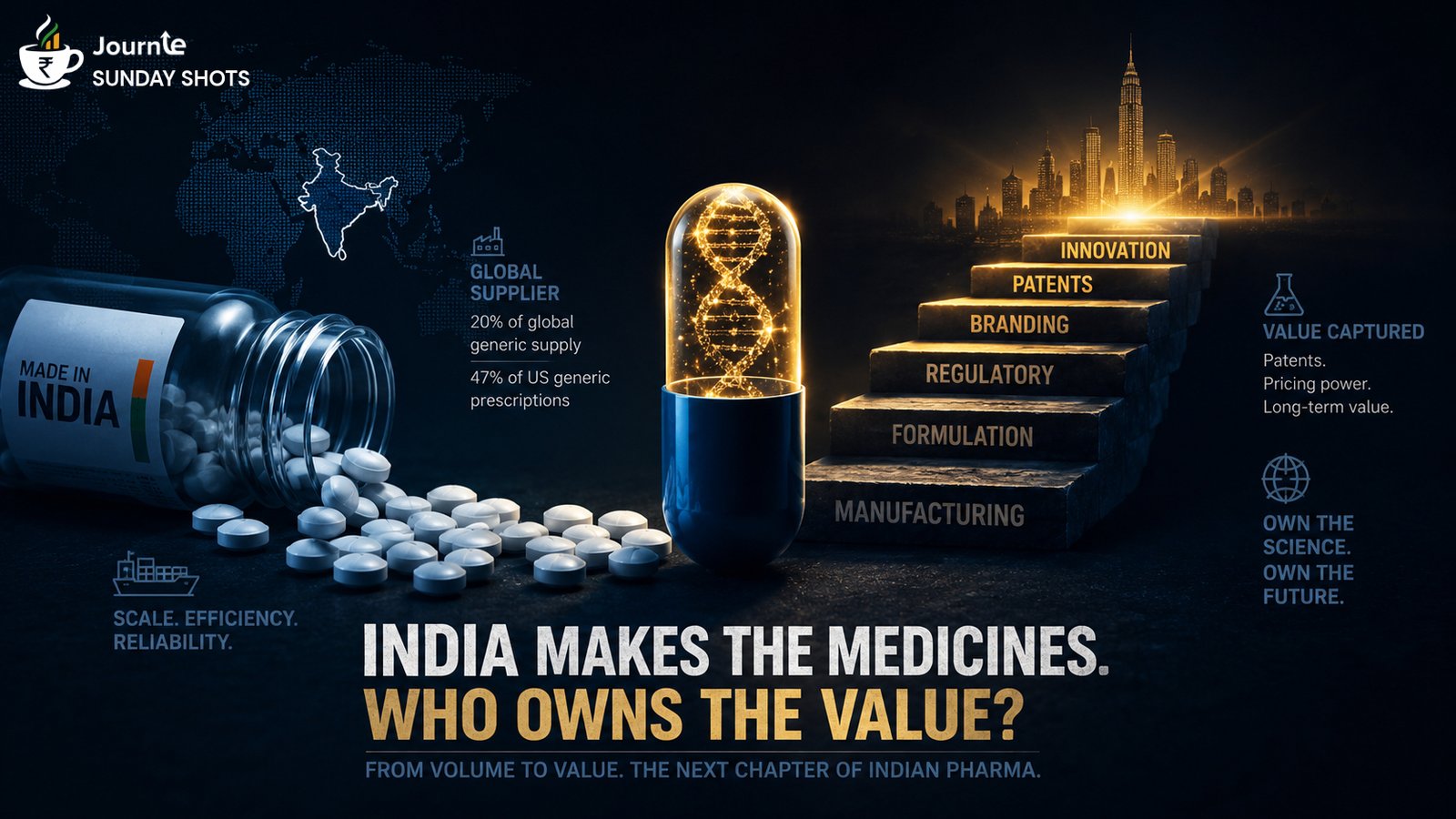
More than 3,000 pharmaceutical companies and around 10,500 manufacturing units operate across India. The country accounts for roughly 20% of global generic medicine supply and is one of the world’s largest vaccine suppliers.
Then there is the United States.
In 2022, Indian pharmaceutical companies supplied 47% of generic prescriptions filled in the US.
Those medicines didn’t just create revenue for Indian companies. According to IQVIA, they generated an estimated $219 billion in savings for the US healthcare system in 2022, and $1.3 trillion over 2013–2022.
Think about what that means.
India isn’t merely participating in the global pharmaceutical system. It is one of the reasons the system remains affordable.
But there is a subtle distinction hidden underneath all these impressive numbers. Industrial importance is not the same as economic capture.
India can manufacture a medicine at extraordinary scale. That does not necessarily mean it owns the intellectual property, controls the pricing power or captures the largest share of the value created by that medicine.
And that is where the story gets interesting.
The Patent That Changed Everything
This wasn’t an accident. It was partly the result of history.
India’s pharmaceutical industry developed under a very different patent regime from the one that exists today.
The Patents Act of 1970 did not provide product-patent protection for pharmaceuticals in the way modern regimes do. Instead, the system allowed Indian companies to develop alternative manufacturing processes for products whose underlying molecules had been developed elsewhere.
That changed the economics of the industry.
Indian companies became exceptionally good at figuring out how to make a molecule differently, cheaply and at scale.
It was not simply imitation. It was a form of technological capability built around the rules of the market. And it worked.
The industry developed deep expertise in chemistry, APIs, formulations, manufacturing and regulatory approvals.
But in 2005, the rules changed.
India amended its patent law to introduce product-patent protection across fields including pharmaceuticals, aligning the country with its TRIPS obligations.
Suddenly, the opportunity was different.
The question was no longer only: Can India make someone else’s molecule better and cheaper?
It became: Can India discover and own the next molecule?
The Money Sits Higher Up the Value Chain
A generic manufacturer typically enters the market after a drug’s exclusivity has expired. Its competitive advantage comes from something India has become exceptionally good at:
Process chemistry. Manufacturing efficiency. Regulatory execution. Scale. Distribution.
Once multiple companies can manufacture the same molecule, however, competition naturally pushes prices down.
The originator plays a different game. It discovers the molecule, funds the clinical trials, builds the evidence, develops the brand and secures intellectual property.
And, for a period of time, it can sell the medicine with far less direct competition.
That creates something much more valuable than manufacturing scale: Pricing power.
You can see these economics play out in India right now.
In March 2026, the Indian patent covering semaglutide expired.
Within days, Indian pharmaceutical companies moved in with their own versions of the molecule behind Ozempic and Wegovy.
Natco launched a multidose version starting at around ₹1,290 a month. Other Indian manufacturers followed with lower-priced versions. Sun Pharma launched its own semaglutide products the following day.
Novo Nordisk responded by cutting prices of Ozempic and Wegovy in India by as much as 36% and 48%, respectively, on certain doses.
What changed was exclusivity.
Same molecule. Very different economics.
The science hadn’t suddenly become cheaper. The factories hadn’t suddenly become ten times more efficient.
Making the Medicine Is Only Half the Story
Look at the companies operating at the top of this model.
Pfizer generated $62.6 billion of revenue in 2025 and spent $10.4 billion on internal R&D. Eli Lilly generated approximately $65.2 billion of revenue. Roche reported CHF61.5 billion of group sales and invested CHF12.2 billion in R&D.
Now look at India’s largest pharmaceutical companies.
Sun Pharma generated around ₹52,578 crore in FY2025 and spent approximately ₹3,250 crore on R&D. Dr. Reddy’s generated ₹32,554 crore and spent ₹2,738 crore on R&D. Cipla generated ₹27,548 crore.
The comparison isn’t perfectly apples-to-apples. Roche and Pfizer, for example, operate global originator businesses, while Indian companies have historically had much greater exposure to generics and other businesses.
But the underlying difference is important.
The companies that own differentiated medicines can capture economics that are difficult to replicate through manufacturing alone.
This is the difference between creating value and capturing value.
India has become exceptionally good at the first. The next challenge is to capture more of the second.
Because Innovation Needs a Different Kind of Capital
Manufacturing rewards operational excellence.
Drug discovery rewards something else: patience.
A generic manufacturing program can be built around relatively visible demand, known molecules and established regulatory pathways.
A novel drug program begins with uncertainty. You can spend years developing a molecule and still end up with nothing.
That changes the economics of capital. And India’s broader R&D ecosystem shows the scale of the challenge.
India is increasing its investment in R&D, but it still remains below the intensity seen in many major innovation economies. The latest government data puts India’s gross expenditure on R&D at 0.84% of GDP in 2023–24, with preliminary estimates of 0.87% for 2024–25 and 0.90% for 2025–26.
And this is where the gap becomes important.
The world’s largest pharmaceutical innovators aren’t just spending more on laboratories. They are continuously acquiring, licensing and partnering for intellectual property. They are effectively buying years of scientific risk.
That’s a very different capital model from manufacturing an established molecule.
Science needs capital that can survive failure. It needs investors willing to fund ten experiments knowing that nine may fail.
It needs clinical-trial infrastructure, specialist talent, biotech companies and commercial networks capable of turning a discovery into a global product.
Laboratories are only the beginning.
India Is Already Moving
This is where the story becomes more interesting.
It would be wrong to conclude that Indian pharma is simply stuck in the generic era. It isn’t.
Indian companies are moving into biosimilars, specialty medicines, complex generics, injectables, contract research and novel therapies.
Biocon has built a global biosimilars business. Sun Pharma has expanded aggressively into specialty medicines. Zydus has invested in vaccines and biologics. Companies such as Syngene have built businesses around the global drug-discovery ecosystem.
And now there is an even bigger signal.
In April 2026, Sun Pharma agreed to acquire Organon for an enterprise value of approximately $11.75 billion — one of the largest overseas acquisitions by an Indian pharmaceutical company. Organon brings a global portfolio of more than 70 products across Women’s Health and General Medicines, including biosimilars, commercialized across 140 countries.
That transaction is bigger than a single acquisition. It signals something about where Indian pharma wants to go.
If building every piece of intellectual property organically is slow, expensive and uncertain, another route is to buy, license and partner for global assets.
That is how industries climb value chains.
Not necessarily by abandoning what made them successful. But by using those strengths to buy their way into the next layer.
The Next Prescription Is Different
India does not need to become the next Pfizer. It doesn’t need to discover every blockbuster drug. And it certainly shouldn’t abandon the manufacturing capabilities that made it globally important.
The opportunity is more targeted.
Take the capabilities India already possesses:
manufacturing scale + chemistry + regulatory expertise + cost efficiency + global distribution.
Now combine them with:
proprietary IP + biotechnology + clinical research + patient capital + global commercialisation.
That combination could create something much more powerful than a larger generic industry.
It could create Indian companies that don’t just manufacture the world’s medicines.
They own more of the economics behind them.
Getting there won’t be easy.
It will require deeper biotech ecosystems, more university-industry collaboration, better clinical-trial infrastructure, more patient capital, and greater use of licensing and M&A.
And perhaps most importantly, a willingness to accept that some of the most valuable investments may fail.
Because that is the uncomfortable reality of moving up the pharmaceutical value chain.
You cannot discover the next blockbuster without funding the molecules that don’t become one.
For decades, India solved one of the world's biggest pharmaceutical problems: How do you make good medicines affordable at enormous scale?
It built an extraordinary answer.
Now the question is changing: How do you create the medicine in the first place — and own more of what it is worth?
That is not simply a pharmaceutical question. It is a capital-allocation question.
India has spent decades becoming extraordinarily good at what happens after a patent expires. The bigger opportunity is to become better at what happens before it does.
Because the next leap in Indian pharma may not come from making more medicines. It may come from owning more of them.
India has mastered volume. The next challenge is to turn that volume into value.
See you next Sunday for another shot of insights!
Disclaimer: This update is for informational purposes only. Please consult a SEBI-registered advisor before investing.
Enjoyed this week’s Sunday Shots? Share it across WhatsApp, LinkedIn, or X — and invite someone else into the conversation.
Subscribe to Sunday Shots for a fresh perspective delivered every week.