
Journie WealthTech Private Limited | AMFI Registered Mutual Fund & SIF Distributor (ARN: 318048)

Demat 2.0: The Next Chapter of India’s Bond Market

Demat 2.0 and the tokenization of India's corporate bond market

India has been testing a new way to move financial assets for nearly a year.

In 2025, the RBI began testing the tokenization of Certificates of Deposit (CDs) through its Unified Markets Interface, with settlement using wholesale Central Bank Digital Currency.

By September 2026, the experiment had already processed around 249 transactions — roughly two-thirds of them in the secondary market.

Then, last week, the experiment moved into a much bigger arena: Corporate bonds.

At Global Fintech Fest in Mumbai, we were there when SEBI and the RBI jointly announced Demat 2.0 — a pilot designed to test the tokenization of corporate bonds within India’s regulated financial-market infrastructure.

Just days earlier, REC had raised ₹500 crore through India’s first pilot issuance of a tokenized corporate bond.

Then came L&T. Then IIFL Finance.

Within days, ₹1,025 crore of corporate bonds had been issued through the new infrastructure.

So, this isn’t really a story about India discovering tokenization. It is a story about India testing whether the technology can move from a controlled experiment into the core of its capital markets.

And that raises the bigger question: Can tokenization make India’s bond market deeper, or will it simply make the existing market faster?

India’s Export Numbers Look Impressive

But The Full Story Is Far More Complicated.

India’s total exports touched a record USD 825.3 billion in FY25, while services exports alone crossed USD 387.6 billion.

On paper, that looks like the rise of a serious export economy. But behind those numbers lies another reality.

India’s merchandise imports surged to nearly USD 721.2 billion during the same period. And that reveals something important.

India still depends heavily on imported crude oil, electronics, semiconductor components, industrial machinery, chemicals and pharmaceutical raw materials.

Which means India’s export story is far more intertwined with imports than most headlines suggest.

Oil becomes costlier. Electronic components become more expensive. Manufacturing inputs rise. Imported APIs for pharma become pricier.

So, while India may earn more from exports, it also pays more for the very inputs required to produce them. The benefit of currency depreciation starts getting partially offset by rising import dependency.

That is the hidden vulnerability simplified export narratives often ignore.

First, what exactly is a tokenized bond?

Imagine a conventional corporate bond.

A company borrows money from investors. The investor receives a security that promises a fixed coupon, repayment at maturity, defined investor rights, and protection through existing regulatory and legal frameworks.

Now imagine representing that security as a digital token on a distributed ledger. That’s broadly what the new infrastructure is testing.

The ledger is maintained by market infrastructure institutions and owned by the depositories.

The tokenized bond continues to have the same legal characteristics as a conventional dematerialized bond — including its ISIN, issuer obligations, coupon, maturity, rating and investor rights.

So this isn’t a new asset class. It is a new way of moving an existing asset through the financial system.

And this isn’t a public blockchain experiment either. The pilot uses a permissioned distributed ledger within regulated market infrastructure.

And that’s where things get interesting.

The first corporate bond

On September 7, REC became the first issuer.

It raised ₹500 crore through a 7.30% bond with a maturity of 1 year and 9 months. The issue was structured with a ₹100 crore base issue and a ₹400 crore green-shoe option.

It received ₹796 crore of bids and ultimately accepted ₹500 crore. REC says the issue was approximately eight times subscribed on the basis of the base issue size.

But the amount raised isn’t the most interesting part. The interesting part is how the transaction was processed.

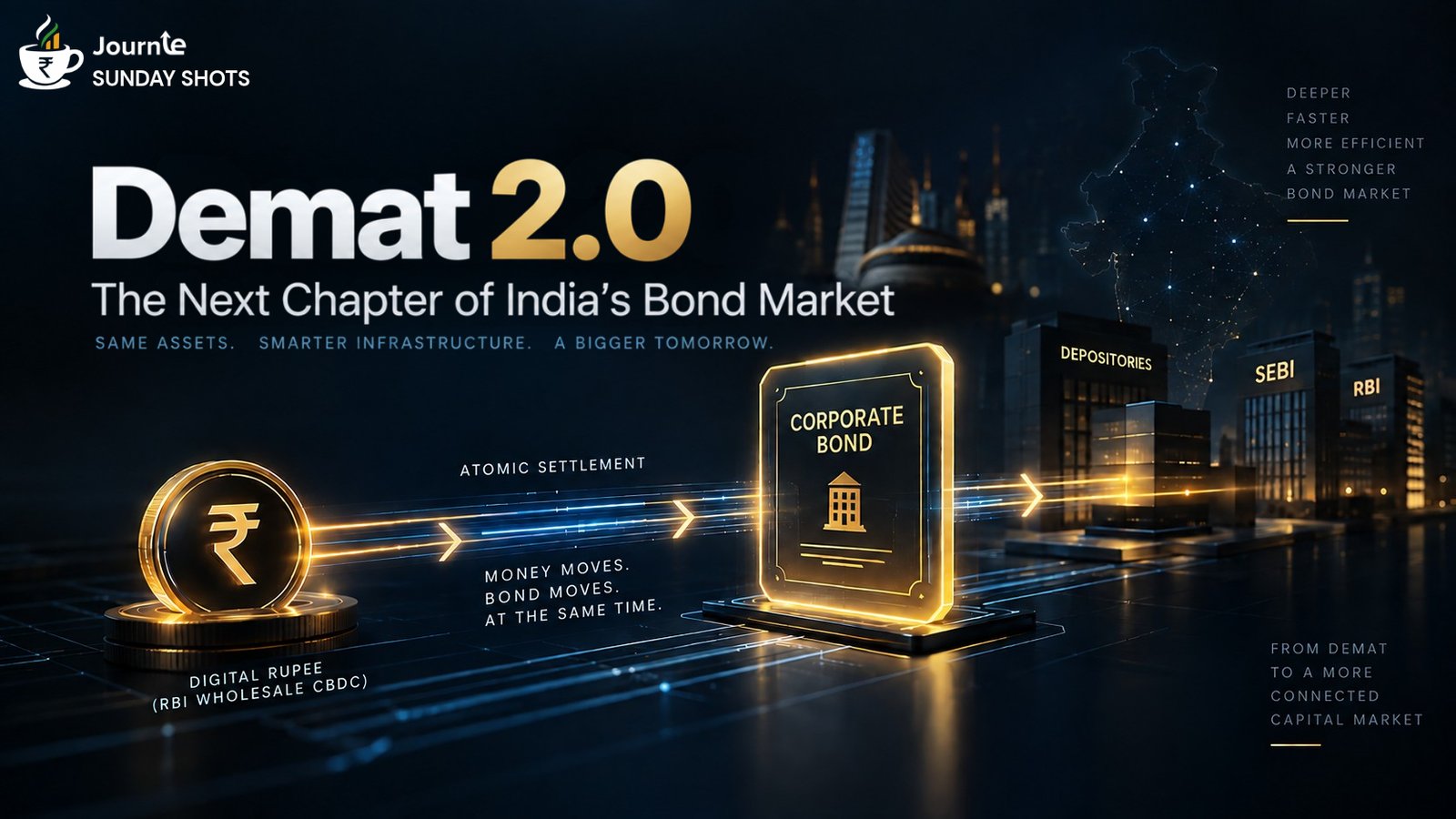
The tokenized security was recorded on a distributed ledger. The cash leg was connected to the RBI’s wholesale Central Bank Digital Currency — the digital rupee — through the Unified Market Interface.

That enables what is called atomic settlement.

In simple terms: The bond moves and the money moves, at the same time. And hence bypass the traditional clearing settlement and the delays linked with it.

For this pilot, that means the securities and cash legs can settle together rather than relying on the traditional separation between the two settlement processes.

And REC demonstrated something that matters operationally: pay-in, allotment and listing were completed on the same day.

Why does that matter?

Today’s financial markets are built from multiple interconnected systems.

One system knows who owns the security. Another handles the money. Another handles settlement.

Others handle reconciliation, reporting and corporate actions.

It works. But every additional handoff introduces operational complexity.

Demat 2.0 is attempting to bring more of those processes together.

SEBI says the pilot is designed to test a new way of issuing, holding, trading and settling corporate bonds, with the tokenized bond connected to RBI’s wholesale CBDC infrastructure.

The potential benefits include: faster settlement, lower reconciliation and manual processing, reduce settlement risk, efficient movement of money and securities, and automated asset servicing.

Plus, interest and redemption payments can potentially be automated through smart-contract infrastructure.

The technology is essentially trying to make the financial transaction behave more like a single event rather than a chain of separate events.

Then came L&T and IIFL

This is where the story gets more interesting.

REC could have been dismissed as a one-off regulatory experiment. It wasn’t.

L&T raised ₹500 crore through a tokenized bond at a 7.4% coupon with a three-year maturity. It became the first private-sector corporate to enter the pilot.

IIFL Finance subsequently raised ₹25 crore through a tokenized bond at 9.1% with a two-year maturity, becoming the first non-PSU NBFC in the segment.

Three issuers. ₹1,025 crore.

And the experiment is already moving beyond a single government-backed issuer.

From Demat 1.0 to Demat 2.0

There is a reason the regulator calls this Demat 2.0.

Think about what dematerialisation did.

Before demat, securities existed as physical certificates. Ownership required paper. Transfers required paperwork. Settlement took days.

Dematerialisation changed the model: Paper → Digital

India then kept improving the system.

Faster settlement. Electronic records. Central depositories. Online trading.

Now the next transition is potentially: Digital → Programmable

That is a bigger idea.

Because once an asset exists as a digital token inside regulated infrastructure, the financial system can potentially encode rules around how that asset behaves.

Coupon payments. Redemptions. Ownership. Settlement. Eligibility. Transfer. Corporate actions.

The opportunity isn’t simply to make a bond digital. It is to make the financial infrastructure around the bond more automated.

But here's the part nobody should overlook

There is a temptation to look at all this and say: “Tokenization will revolutionize the bond market.”

Maybe.

But the first question isn’t whether India can issue a tokenized bond. We’ve already established that it can.

The harder question is: Can this work beyond a pilot?

RBI has already had an early glimpse of the answer.

Its tokenized Certificate of Deposit pilot has processed around 249 transactions, with roughly two-thirds taking place in the secondary market.

So secondary trading is no longer purely theoretical.

The question now is whether the same infrastructure can support a much larger, more diverse and more complex market for corporate bonds.

Because faster settlement doesn’t automatically create liquidity. A tokenized bond can move from one wallet to another in seconds. But if there is no buyer on the other side, it is still illiquid.

And that is why the secondary market will remain one of the biggest tests.

The initial corporate-bond pilot focuses on issuance and settlement, with broader secondary-market trading and wider participation expected to develop in later phases.

That distinction matters.

Technology can make a transaction faster. It cannot manufacture demand.

What tokenization doesn't fix

A tokenized bond still carries the same fundamental risks as the underlying bond.

The issuer can still default. Interest rates can still move against you. The bond can still have duration risk. Credit spreads can still widen. And liquidity can still disappear.

Tokenization doesn’t eliminate those risks.

It changes the infrastructure through which the asset is issued, held and settled.

That may sound like a small distinction. It isn’t.

Financial markets are ultimately built on infrastructure. And infrastructure determines how efficiently capital can move.

India's interesting bet

What makes India’s experiment particularly interesting is that it isn’t creating a parallel financial system.

It is doing almost the opposite.

SEBI regulates the securities. Depositories maintain the digital securities infrastructure. RBI provides central-bank money through wholesale CBDC. The Unified Market Interface connects the two.

And existing requirements around credit ratings, debenture trustees, listing and disclosures continue to apply.

In other words: Blockchain-like infrastructure is being absorbed into regulated financial markets rather than replacing them.

And this is where the story gets bigger

Today, we’re talking about corporate bonds. But the underlying idea is much broader.

If financial assets can become digital, programmable and interoperable with digital money, the same architecture could eventually extend across other parts of capital markets.

Bonds are simply a logical place to start. They are large-ticket instruments and involve institutional investors. Plus require extensive settlement and servicing infrastructure.

And corporate bonds have historically been less liquid and less frequently traded than equities.

If tokenization can make that infrastructure meaningfully better, the implications could extend well beyond this ₹1,025 crore pilot.

The next test

For now, Demat 2.0 is still an experiment.

The first phase is demonstrating that the infrastructure works.

The next questions are harder:

Can secondary trading become more efficient? Can liquidity improve? Can more issuers participate?

Can the system work seamlessly with existing market infrastructure? Can retail investors eventually participate?

And perhaps the biggest question:

Can better technology actually create a deeper corporate bond market?

Because that is ultimately what matters. Not whether a bond is on a blockchain. Not whether settlement happens in seconds.

But whether capital can move more efficiently, more transparently and with less friction between the people who have it and the businesses that need it.

From Demat to Digital Capital Markets

India's first demat revolution made securities electronic. Demat 2.0 is testing whether they can become programmable.

That could change much more than the way a bond is settled. It could change how financial assets are issued, serviced, transferred and eventually traded.

But the real test has only just begun.

Moving a bond instantly is a technology problem.

Finding someone willing to buy it is a market problem.

And the future of India's tokenized bond market will depend on solving both. See you next Sunday for another shot of insights.

See you next Sunday for another shot of insights!

Disclaimer: This update is for informational purposes only. Please consult a SEBI-registered advisor before investing.

Enjoyed this week’s Sunday Shots? Share it across WhatsApp, LinkedIn, or X — and invite someone else into the conversation.
Subscribe to Sunday Shots for a fresh perspective delivered every week.

Recent Blogs

Lorem ipsum dolor sit amet, consectetur adipiscing elit. Ut elit tellus, luctus nec ullamcorper mattis, pulvinar dapibus leo.

Subscribe to Journie Shots — thoughtful, well-curated insights and market stories delivered every Sunday.