

Journie WealthTech Private Limited | AMFI Registered Mutual Fund & SIF Distributor (ARN: 318048)

When ₹2.8 Crore Became a ₹28,000 Crore Question

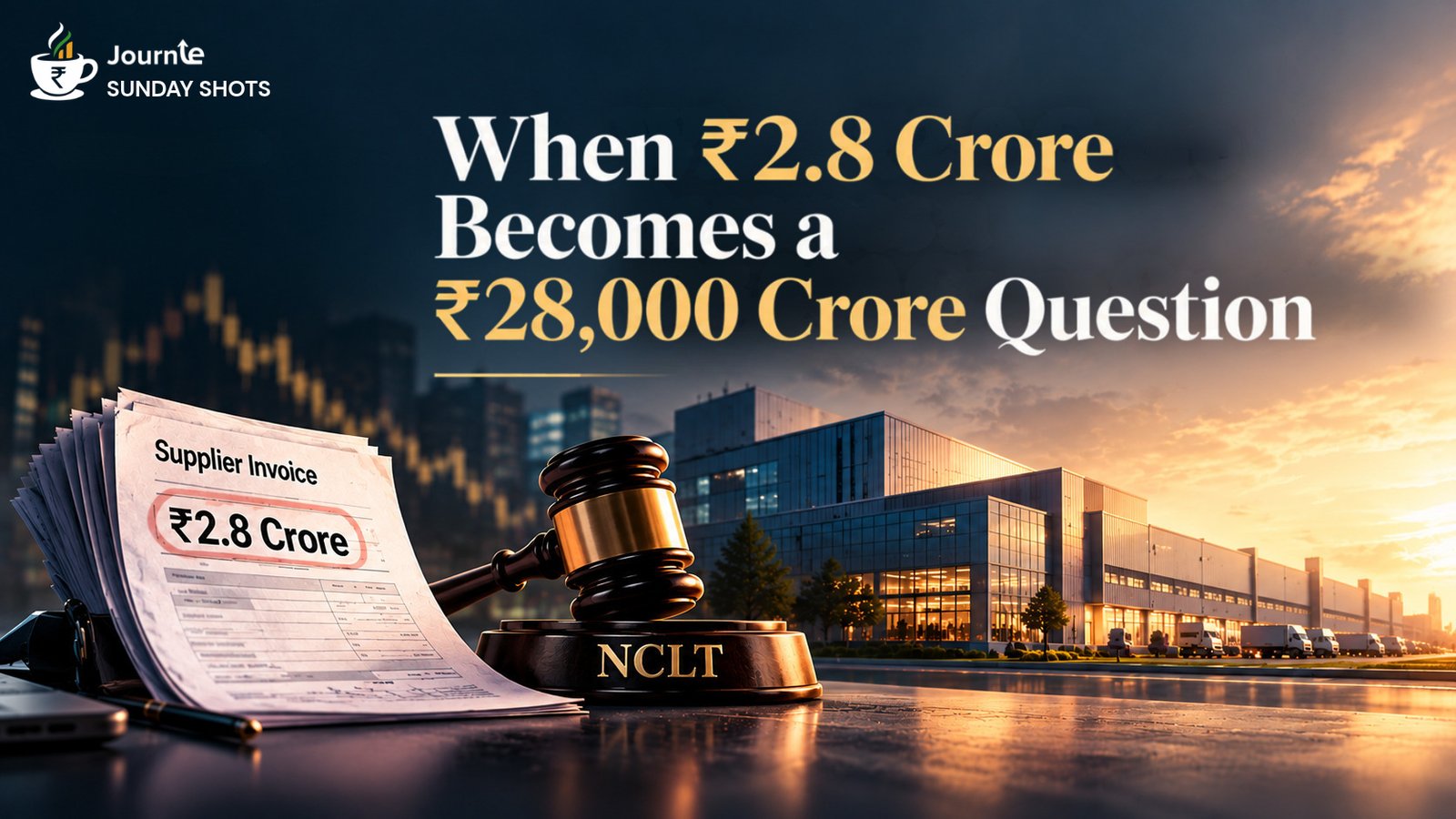
A ₹2.8 crore supplier invoice and legal gavel in front of a large industrial facility, illustrating corporate insolvency risk.

Imagine a company with annual revenues of over ₹28,000 crore.

It has factories across India, thousands of dealers, a presence in international markets and a balance sheet that most businesses would envy.

It has more than ₹4,000 crore in net cash. No net debt. A net worth running into thousands of crores.

Now picture this company facing insolvency proceedings over a disputed payment of approximately ₹2.8 crore.

That’s roughly 0.01% of its annual revenue.

Sounds absurd?

Welcome to the world of corporate India, where a small commercial dispute can sometimes shift the conversation around a business—from growth to litigation, from profits to legal risks.

The dispute that took an unexpected turn

In October 2026, a major listed Indian manufacturer of wires and cables found itself at the centre of an unexpected legal development.

A supplier approached the National Company Law Tribunal (NCLT), claiming that the company owed it approximately ₹2.79 crore in operational dues.

The supplier invoked Section 9 of the Insolvency and Bankruptcy Code (IBC), the law that allows an operational creditor to initiate insolvency proceedings when qualifying dues remain unpaid.

On October 7, the NCLT’s Ahmedabad bench admitted the insolvency petition.

This was not a declaration that the company had run out of money. Nor did it mean the business had suddenly become financially weak.

The company disputed the claim, describing it as a commercial dispute and pointing to issues involving credit notes and the underlying transactions.

But the legal process had taken a turn that few would have expected for a company of this size.

The company challenged the order before the National Company Law Appellate Tribunal (NCLAT).

On October 9, the appellate tribunal stayed the insolvency order, keeping it in abeyance pending further orders. The relief was subject to the company depositing the claimed amount, without prejudice to its rights and contentions. The appeal was listed for October 26.

In other words, the insolvency process was put on hold, but the underlying dispute was not finally resolved.

And that makes the episode worth studying.

When a small dispute becomes a big risk

At first glance, this looks like a straightforward dispute between a buyer and a supplier.

But the real story lies in the chain of events that happens next.

1. The legal domino

The IBC is a powerful tool. Once an insolvency petition is admitted, the consequences can be significant, including a moratorium and the commencement of a formal resolution process.

That is why an admission order can matter far beyond the amount being claimed.

2. The market’s reaction

Investors rarely react only to the rupee value of a dispute. They also react to uncertainty.

Will the matter be resolved quickly? Could it affect business relationships? Are there other unresolved issues? Does the event reveal something about the company’s processes or governance?

A dispute worth a few crores can raise questions about thousands of crores in market capitalization.

Not because the claim itself justifies that valuation change, but because uncertainty can alter how investors price risk.

3. The reputation cost

For a large company, reputation is an asset.

Banks, suppliers, distributors, employees and institutional investors all make decisions based on how they perceive a business.

Even when a company has the financial capacity to meet its obligations, a legal controversy can temporarily shift attention from its operating strengths to its unresolved risks.

That is the second-order effect: the original dispute may be small, but the consequences of uncertainty need not be.

The twist: the market doesn't wait for the final verdict

The story did not end with the appellate tribunal staying the insolvency order.

The National Stock Exchange had also initiated action under its insolvency-related framework. It announced that the stock would be excluded from the equity derivatives segment from December 30, 2026. From October 14, a 100% margin requirement applied to existing and new derivative positions under the exchange’s circular.

Existing October, November and December contracts would continue until their respective expiry dates, but no new expiry-month contracts would be introduced.

This created another layer of uncertainty for market participants.

For traders, the change affected how they could manage derivative positions. For investors, it raised questions about liquidity, sentiment and the difference between a company’s underlying business and the way its shares trade.

Importantly, the exclusion from derivatives trading was not a verdict on the company’s financial health or the merits of the supplier’s claim. It was an exchange action under the applicable framework.

When separate events become one big story

There was also a separate tax-related chapter.

Earlier in 2026, the company had disclosed an income-tax demand of ₹327.45 crore relating to an assessment for FY2023–24. After a rectification order addressing computational and clerical errors, the demand was reduced to ₹57.58 crore. The company maintained that the remaining demand was not sustainable in law and was pursuing further remedies.

These were separate proceedings, involving different issues and legal processes. They should not be treated as evidence that one caused the other.

Yet, when multiple developments arrive close together, markets can begin to view them as one larger story.

And that is where perception becomes important.

The Lessons Hidden in a Small Dispute

1. A Strong Balance Sheet Cannot Solve Everything

Cash, profits and net worth tell us a great deal about a company’s financial strength. But they cannot automatically settle contractual disputes or prevent legal action.

A company can be financially strong and still face legal uncertainty.

Financial strength and legal certainty are two different things.

2. Paperwork Can Protect More Than Money

Invoices, purchase orders, credit notes and payment terms may seem like routine paperwork when business is running smoothly.

But when a disagreement arises, those documents can become central to the outcome.

A dispute that appears minor can become a much bigger problem if the underlying transactions are poorly documented or disagreements are not formally recorded.

Sometimes, the smallest administrative details can carry the biggest consequences.

3. A Headline Is Not the Final Verdict

An insolvency admission, an appellate stay, a tax demand and a final judicial decision are not the same thing. Each represents a different stage of a process.

Reacting to a headline without understanding its legal status can lead to poor investment decisions. But dismissing every controversy simply because a company has a strong balance sheet can be equally dangerous.

The right approach is neither panic nor complacency.

It is to understand what has happened, what remains unresolved and what could happen next.

The business is one thing. The story is another

A business spends years building factories, distribution networks, customer relationships and financial strength.

Yet, an unexpected legal development can change the conversation around it in a matter of days.

That doesn't erase what the company has built. But its financial strength doesn't make every controversy irrelevant either.

For investors, the challenge is to separate the fundamentals of a business from the risks surrounding it.

For business owners, the lesson begins much earlier: strong financials matter, but so do clear contracts, reliable documentation and processes that hold up when disagreements arise.

Sometimes, the biggest lesson in a small dispute is not about the money involved. It is about how quickly the story can change.

Disclaimer: This update is for informational purposes only. Please consult a SEBI-registered advisor before investing.

Enjoyed this week’s Sunday Shots? Share it across WhatsApp, LinkedIn, or X — and invite someone else into the conversation.
Subscribe to Sunday Shots for a fresh perspective delivered every week.

Recent Blogs

Lorem ipsum dolor sit amet, consectetur adipiscing elit. Ut elit tellus, luctus nec ullamcorper mattis, pulvinar dapibus leo.

Subscribe to Journie Shots — thoughtful, well-curated insights and market stories delivered every Sunday.