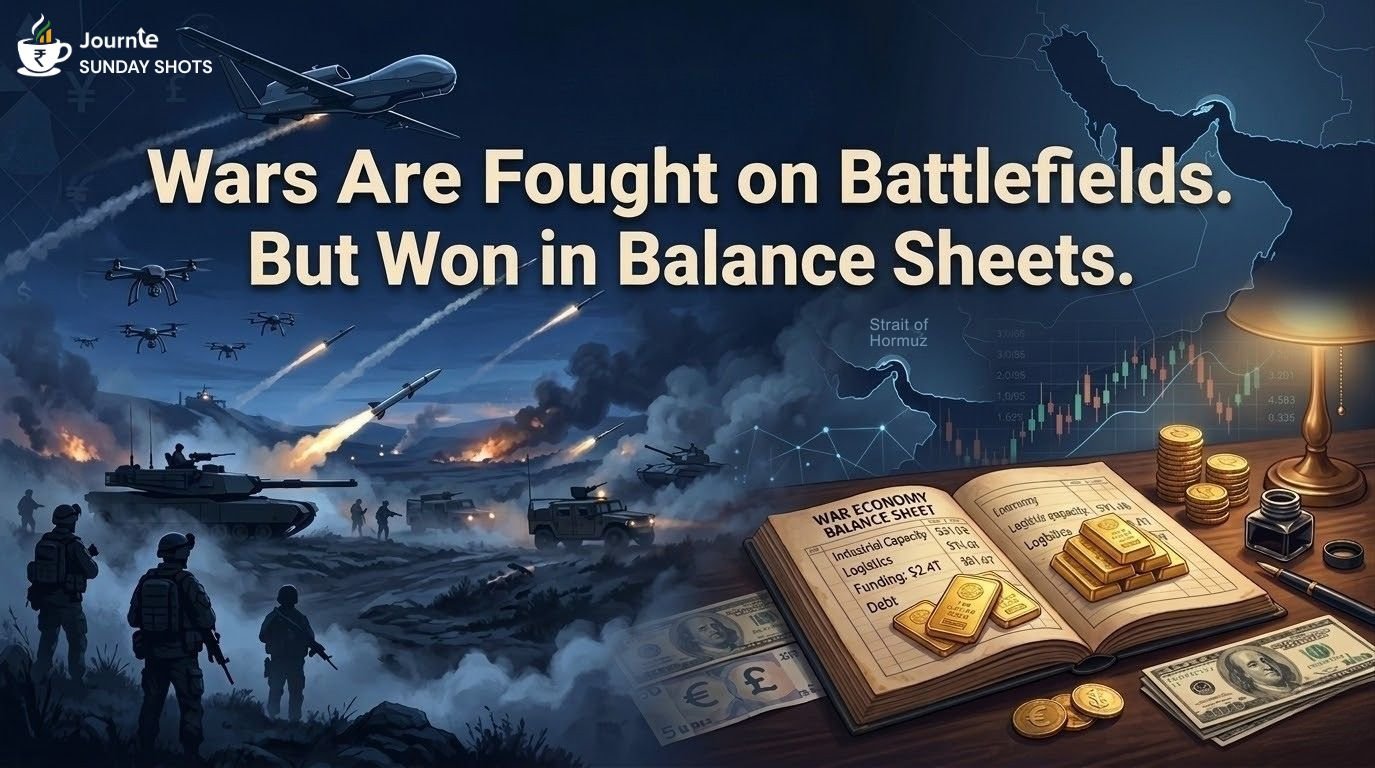

Wars Are Fought on Battlefields. But Won in Balance Sheets.
This week, markets reacted before diplomacy could catch up.
As tensions between Israel and Iran escalated sharply, oil prices jumped, global equities turned volatile, and investors quickly moved toward traditional safe havens.
The reason lies in a narrow stretch of water that sits at the centre of global energy markets: the Strait of Hormuz.
Roughly 21 million barrels of oil move through this corridor every day — about one out of every five barrels consumed globally.
If that route were disrupted even briefly, the impact would travel instantly across global markets, affecting fuel prices, inflation expectations, currencies, and interest rates.
Where Capital Hides
When geopolitical shockwaves hit, capital immediately searches for a bunker.
Historically, this has meant a surge in demand for Gold and the US Dollar.
Gold represents the ultimate stateless money — an asset with no counterparty risk and one that cannot be printed or frozen by a warring government.
Watching these assets during a crisis offers a real-time thermometer of global fear. But moments like this reveal something deeper.
Wars may appear to be fought with missiles, soldiers, and strategy. Yet history repeatedly shows that the real engine of conflict is economic power.
Battlefields may decide battles. But balance sheets often decide wars.
The Business of War
In 1935, decorated US Marine General Smedley Butler wrote a small but provocative book titled War Is a Racket.
His argument was blunt. Wars, he said, often enrich a narrow set of industries while the broader public bears the cost.
A few decades later, US President Dwight Eisenhower issued a similar warning.
In his farewell speech, he cautioned about the rise of the “military–industrial complex” — the powerful relationship between governments, armed forces, and defence contractors.
Once countries build large defence industries, war preparation itself becomes an economic ecosystem.
Factories depend on defence contracts. Jobs depend on military spending. Technologies emerge from military research.
War, in that sense, becomes more than a political event. It becomes an industry.
Wars Are Won Economically
Military historians often emphasize strategy and leadership. Economists look somewhere else: industrial capacity.
During World War II, the United States transformed its economy almost overnight. Automobile companies began producing tanks. Electronics firms manufactured radar systems. Shipyards expanded at extraordinary speed.
Within a few years, American factories were producing more military equipment than entire continents combined.
At one point, the United States was producing a new aircraft roughly every five minutes.
The war was fought across Europe and the Pacific. But the economic engine powering it was American industry.
Production capacity, supply chains, and financing ultimately determined how long nations could sustain the conflict.
The New Arsenal: Sanctions & Spending
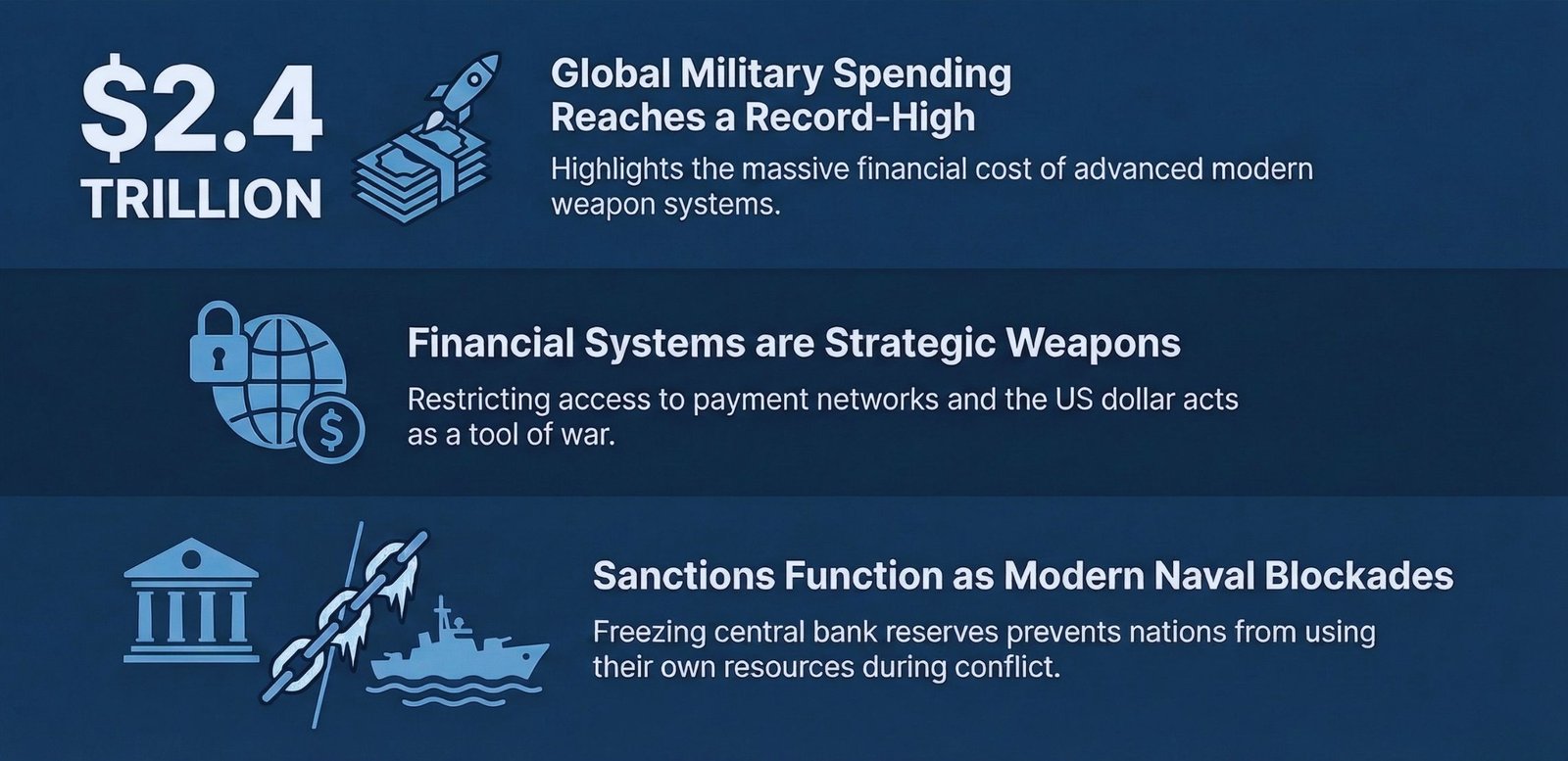
Modern warfare is becoming dramatically more expensive. Global military spending crossed $2.4 trillion last year, the highest level ever recorded.
Advanced weapon systems require enormous investments in technology, research, and manufacturing, turning prolonged conflict into a severe test of financial endurance.
But today’s wars are fought with more than weapons. Financial systems themselves have become strategic tools.
Cutting a nation off from global payment networks, freezing central bank reserves, or restricting access to the US dollar can act as powerful economic weapons.
In many ways, modern sanctions function as the financial equivalent of a naval blockade. They prove that a nation’s currency and banking infrastructure are just as critical to national security as its borders.
Why Markets React So Quickly
When geopolitical tensions rise, financial markets immediately begin pricing the economic consequences. They do this across three main channels:
- Energy Risk: Conflicts in the Middle East almost instantly affect oil prices because energy supply routes are among the most strategically important assets in the global economy.
- Government Spending: Wars typically lead to rising defence budgets, shifting fiscal priorities, and expanding national debt.
- Supply Chain Disruption: Shipping routes, commodity flows, and global trade networks can all become uncertain.
Markets do not wait for wars to unfold. They begin pricing the economic consequences immediately.
Markets and Memory
Financial markets have lived through wars before.
From world wars to regional conflicts, geopolitical shocks have repeatedly disrupted markets in the short term.
Yet history shows that while wars reshape economies and industries, markets eventually adapt.
Because beneath every geopolitical shock lies the same force that ultimately drives markets forward: the global economy.
Every war is fought on two fronts. The visible one is the battlefield. The invisible one is the economy.
Sustaining a war requires factories, fuel, logistics, and above all, financing.
As Napoleon once famously said: An army marches on its stomach.
Modern economists might add something else: An army also marches on capital markets.
History keeps repeating the same lesson: Wars may begin with politics, but they are sustained—and often decided—on balance sheets.
Because in the end, wars may be fought by soldiers, but they are financed by economies.
Until next Sunday!
Disclaimer: This update is for informational purposes only. Please consult a SEBI-registered advisor before investing.
Enjoyed this week’s Sunday Shots? Share it across WhatsApp, LinkedIn, or X — and invite someone else into the conversation.
Subscribe to Sunday Shots for a fresh perspective delivered every week.
Lorem ipsum dolor sit amet, consectetur adipiscing elit. Ut elit tellus, luctus nec ullamcorper mattis, pulvinar dapibus leo.