

Journie WealthTech Private Limited | AMFI Registered Mutual Fund & SIF Distributor (ARN: 318048)
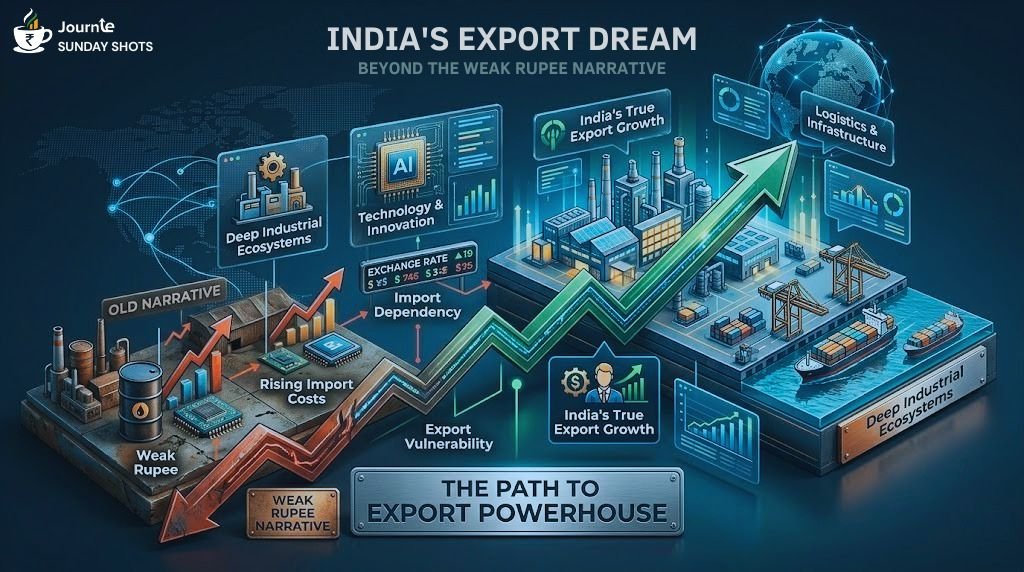
India’s Export Dream: Beyond the Weak Rupee Narrative
Every time the rupee weakens, the same optimism returns to the markets. Export stocks rally. IT companies gain attention. Pharma businesses come back into focus.
And once again, a familiar belief starts spreading across television debates, WhatsApp forwards, and market conversations: “A weaker rupee is good for India’s exports.”
At first glance, the logic sounds perfectly reasonable.
If the rupee falls against the dollar, Indian goods become cheaper globally. Foreign buyers can purchase more from India at lower relative prices. Exports rise. Economic growth improves.
Simple. Except the modern global economy is no longer that simple.
Because today, exports are not built on currency advantage alone. They are shaped by manufacturing depth, technology, logistics, energy access, production networks, and industrial capability.
And that changes the entire equation for India.
Because while India exports to the world, it also relies heavily on imported inputs underneath. So, when the rupee weakens, export revenues may improve in rupee terms, but production costs rise too.
That contradiction sits at the heart of India’s export story. And it is far more important than most market conversations acknowledge.
India’s Export Numbers Look Impressive
But The Full Story Is Far More Complicated.
India’s total exports touched a record USD 825.3 billion in FY25, while services exports alone crossed USD 387.6 billion.
On paper, that looks like the rise of a serious export economy. But behind those numbers lies another reality.
India’s merchandise imports surged to nearly USD 721.2 billion during the same period. And that reveals something important.
India still depends heavily on imported crude oil, electronics, semiconductor components, industrial machinery, chemicals and pharmaceutical raw materials.
Which means India’s export story is far more intertwined with imports than most headlines suggest.
Oil becomes costlier. Electronic components become more expensive. Manufacturing inputs rise. Imported APIs for pharma become pricier.
So, while India may earn more from exports, it also pays more for the very inputs required to produce them. The benefit of currency depreciation starts getting partially offset by rising import dependency.
That is the hidden vulnerability simplified export narratives often ignore.
What Actually Built Asia’s Export Giants
For decades, countries across Asia transformed themselves through exports.
Japan built world-class precision manufacturing and became a global leader in automobiles and electronics.
Taiwan became the backbone of the global semiconductor industry through deep investments in chip manufacturing and technology ecosystems.
South Korea dominated advanced electronics, shipbuilding, and consumer technology and Vietnam emerged as a major electronics assembly hub integrated into global supply chains.
Bangladesh built one of the world’s largest garment export industries through scale, labour efficiency, and focused industrial policy.
And yes, China eventually became the factory of the world.
But none of these economies succeeded and became export power houses because of weak currencies alone.
They built deep industrial ecosystems over decades — investing heavily in ports, logistics, manufacturing clusters, technical skilling, infrastructure, and tightly integrated supply chains.
That was the real foundation of export dominance.
The Uncomfortable Question for India
If so many Asian economies managed to build globally competitive export systems, why has India struggled for decades to fully replicate that success?
The answer is not capability. India absolutely has the scale, talent, and market potential.
The real issue is execution speed and industrial depth.
Quick fact: Over the last 14 years, the Rupee has steadily depreciated by almost 60%, yet our exports as a percentage of GDP actually compressed from 25% to 21%—proving that true trade dominance is earned through domestic supply chains, not currency devaluations.
India is trying to build manufacturing ecosystems in a far more difficult world — one that shaped by trade wars, geopolitical fragmentation, protectionism, energy insecurity and rapid technological disruption.
The rules of global trade are becoming harder precisely at the moment India is trying to scale up.
And that makes India’s manufacturing challenge significantly tougher than what earlier export economies faced.
Even India’s Strongest Export Sectors Have a Catch
Take pharmaceuticals. India exported nearly USD 30.5 billion worth of pharma products in FY25 and is often called the “pharmacy of the world.” It is genuinely one of India’s greatest export success stories.
But there is a catch.
A large portion of Active Pharmaceutical Ingredients (APIs) still comes from China and other foreign suppliers.
So, when the rupee depreciates:
- export revenues improve,
- but imported raw material costs rise as well.
Margins get squeezed.
The same issue exists in electronics.
India’s electronics imports were reported at about USD 98.65 billion in FY25, rising further to USD 116.17 billion in FY26, with China remaining one of the largest suppliers of critical components.
This means India is often assembling products domestically while much of the underlying component ecosystem still sits outside the country.
And that changes how much benefit a weak rupee can actually deliver.
The IT Sector Faces an Even Bigger Shift: AI
For years, India’s services industry acted as the country’s economic cushion.
India generated a record USD 188.8 billion services trade surplus in FY25, powered largely by IT and technology exports.
Traditionally, a weaker rupee benefited Indian IT firms significantly because dollar earnings translated into higher rupee revenues. But now another disruption is emerging.
Artificial intelligence.
And this shift may be much bigger than currency movements themselves.
For nearly two decades, India’s IT outsourcing model was built on labour arbitrage: skilled talent at lower global costs.
But generative AI is beginning to automate many repetitive coding, testing, support, and workflow functions that once required large offshore teams.
Which means global clients are starting to focus less on: “How cheap is the workforce?” And more on: “How productive is the system?”
That is a massive shift.
The future winners in services exports may not simply be companies with the largest workforce anymore. They may be the companies with: the strongest AI integration, best productivity, proprietary technology, and highest-value innovation.
The old export advantage is evolving rapidly.
India Has One Big Difference from Most Export Economies
A Massive Domestic Consumption Market. And this changes India’s economic priorities completely.
This is another reason India’s export story works differently.
India consumes a large portion of what it produces internally: food, energy, electronics, consumer products — domestic demand itself is enormous.
And that creates policy conflicts.
For example, agricultural exports grew from USD 34.5 billion in FY20 to USD 51.1 billion in FY25.
But whenever food inflation rises domestically, export restrictions quickly follow. Rice restrictions, wheat controls, export curbs.
Because for India, economic policy is not only about exports. It is also about social stability.
That balancing act makes India fundamentally different from pure export-led economies.
So What Does India Actually Need?
India absolutely has the ingredients to become a much larger export economy.
The country has demographic scale, geopolitical relevance, digital infrastructure, a growing manufacturing push, and one of the world’s strongest services ecosystems.
But becoming an export powerhouse requires something much deeper than a weak currency.
It requires industrial capability.
That means: stronger manufacturing clusters, lower logistics costs, semiconductor ecosystems, reduced API dependence, better ports and freight corridors, advanced skilling, and deeper integration into global supply chains.
The government’s Production-Linked Incentive (PLI) schemes are already pushing in that direction. Electronics and telecom exports have shown strong momentum.
Trade agreements with the UK, EU, and other partners could also help India integrate more deeply into global commerce.
But industrial transformations of this scale do not happen in a few years.
China took decades. South Korea took decades. Taiwan took decades.
India’s transition will likely take time too.
A weaker rupee may temporarily support exports by improving price competitiveness in select industries. However, durable economic strength is not built through currency depreciation alone.
The world’s leading export economies did not emerge because they had cheaper currencies. They succeeded because they developed industrial depth, technological capability, efficient logistics, integrated supply chains, and highly skilled workforces.
That remains the larger lesson often overlooked in market conversations.
India possesses the scale, strategic relevance, and economic potential to become a far more influential export economy. .
But achieving that transformation will depend less on exchange-rate movements and far more on the country’s ability to strengthen its industrial foundation in the coming decade.
See you next Sunday for another shot of insights!

Disclaimer: This update is for informational purposes only. Please consult a SEBI-registered advisor before investing.
Enjoyed this week’s Sunday Shots? Share it across WhatsApp, LinkedIn, or X — and invite someone else into the conversation.
Subscribe to Sunday Shots for a fresh perspective delivered every week.
Lorem ipsum dolor sit amet, consectetur adipiscing elit. Ut elit tellus, luctus nec ullamcorper mattis, pulvinar dapibus leo.