
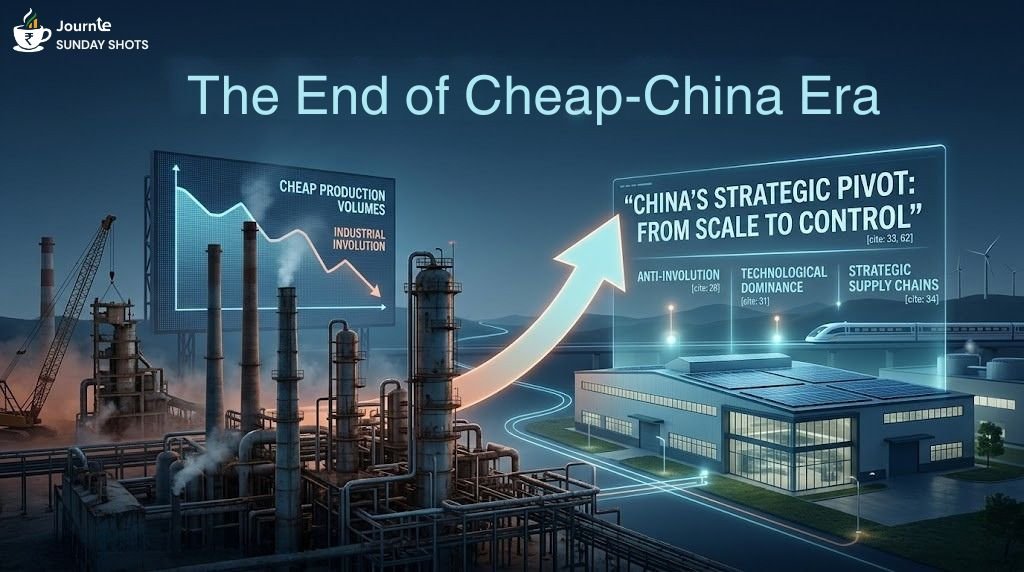

The End of Cheap-China Era: Why Beijing is Breaking its Own Playbook
For years, China didn’t just manufacture goods. It manufactured prices.
By producing at unmatched scale and relentlessly undercutting costs, it became one of the most powerful deflationary forces in the global economy. Steel, chemicals, electronics—if the world needed something cheaper and faster, China delivered.
At its peak, China was producing more than half of the world’s steel, even as several producers operated on margins of less than 2%. In chemicals, capacity utilization had already slipped below 75% by 2024, yet expansion continued.
The model was simple: produce more, price lower, capture share.
And for decades, it worked. Until it didn’t.
When More Becomes Less
At some point, scale stops being an advantage—and starts becoming a trap.
This is what economists call involution. But stripped of jargon, it’s far simpler than it sounds. It’s what happens when an entire industry keeps running faster, yet somehow ends up standing still.
Factories produce more. Prices fall further. Margins disappear.
Effort increases. Returns don’t.
The signs are now difficult to ignore. China’s chemical product price index has declined nearly 36% over the past three years, even as production volumes stayed elevated.
Across petrochemicals, excess capacity has built up to uncomfortable levels, triggering sustained price wars. Refining margins have thinned to near unsustainable levels, while utilization across segments of the industry has quietly drifted lower.
What once looked like industrial dominance is beginning to resemble industrial fatigue.
A Realization in Beijing
For policymakers in Beijing, this is no longer just about weak profitability. It’s about control slipping.
Excess production is now feeding into deflation at home, financial stress across companies, rising global backlash, and increasing environmental costs—all at the same time.
More than 20 countries have already responded with anti-dumping duties or trade restrictions, pushing back against what they see as distorted pricing from Chinese overcapacity.
At the same time, stricter environmental standards are raising the cost of sustaining older, more polluting industrial capacity.
Compliance costs across several industrial sectors have reportedly increased by nearly 15–20%. Producing more is no longer as cheap or as strategically useful as it once was.
And that is forcing a shift in thinking.
From Scale to Control
China’s response is not to step back from manufacturing dominance—but to redefine it.
The new approach, often described as “anti-involution”, is less about how much is produced and more about how it is produced and at what cost to the system.
Inefficient capacity is being targeted. Production discipline is being encouraged. Environmental compliance is no longer optional. Reports suggest China could shut nearly 10–15% of inefficient coal chemical plants through tighter emission rules and production controls.
The capital is being redirected toward sectors where pricing power and technological control matter more than sheer volume—EV supply chains, batteries, specialty chemicals, and advanced manufacturing.
This is not a retreat. It is a recalibration.
For years, China competed through scale. Increasingly, it now wants to compete through control. Control over supply, pricing and over the strategic parts of global value chains.
A Shift the World Will Feel
For decades, China exported deflation to the rest of the world.
Its ability to produce in excess kept industrial goods cheap, often suppressing prices globally in ways that few economies could match.
If that excess begins to reduce, the effect may not be immediate, but it will be meaningful.
Prices across segments of the industrial economy may gradually firm up by nearly 5–10%. Regions already dealing with cost pressures could feel that shift more sharply. Europe, already under pressure from elevated energy costs, could see industrial input inflation rise by 8–12% in selected sectors.
At the same time, companies that once relied heavily on China are increasingly rethinking that dependence—not just for cost reasons, but for resilience. Nearly $100 billion in global trade flows could potentially be redistributed as companies diversify manufacturing footprints beyond China.
What emerges may not be a single replacement for China, but a redistribution of manufacturing power.
India’s Moment—If It Can Take It
For India, this could be one of the most important manufacturing windows in recent decades.
For years, competing with China meant competing with structurally lower prices. In sectors like chemicals, Chinese exports often entered global markets significantly cheaper, leaving limited room for others to scale competitively.
The contrast in scale remains stark: India’s chemical exports stand near $25 billion, compared to China’s roughly $120 billion.
That dynamic may now begin to shift.
Even a 3-5% diversion of global sourcing away from China could meaningfully expand India’s export footprint and India could potentially gain an additional $18–25 billion in chemical exports over the coming years.
Under the broader “China+1” framework, India may also attract nearly $50–80 billion in incremental manufacturing investment over the next decade.
Manufacturing exports could increase by nearly $60–100 billion cumulatively by 2030, particularly if initiatives like PLI translate into real capacity and not just intent.
But this is where realism matters. Opportunity does not automatically translate into outcome.
Execution—across infrastructure, logistics, policy consistency, and manufacturing depth—will determine whether this becomes a breakthrough or just another near-miss.
For decades, globalization followed a simple idea: produce more, produce cheaper, and let scale do the rest.
China mastered that playbook better than anyone. And now, it appears to be moving beyond it.
What is emerging instead is a more controlled version of globalization—one where output is measured, pricing is protected, and strategic sectors are carefully managed.
This is not de-globalization. It is a redesign.
And at the centre of that redesign is a subtle but important shift: China is no longer optimizing only for growth. It is optimizing for control.
See you next Sunday, for another Shot of insights.!

Disclaimer: This update is for informational purposes only. Please consult a SEBI-registered advisor before investing.
Journie WealthTech Private Limited | AMFI Registered Mutual Fund Distributor | ARN- 318048
Enjoyed this week’s Sunday Shots? Share it across WhatsApp, LinkedIn, or X — and invite someone else into the conversation.
Subscribe to Sunday Shots for a fresh perspective delivered every week.
Lorem ipsum dolor sit amet, consectetur adipiscing elit. Ut elit tellus, luctus nec ullamcorper mattis, pulvinar dapibus leo.