
When One Post Moves Trillions: How Trump and Musk Turned Social Media Into a Trading Terminal

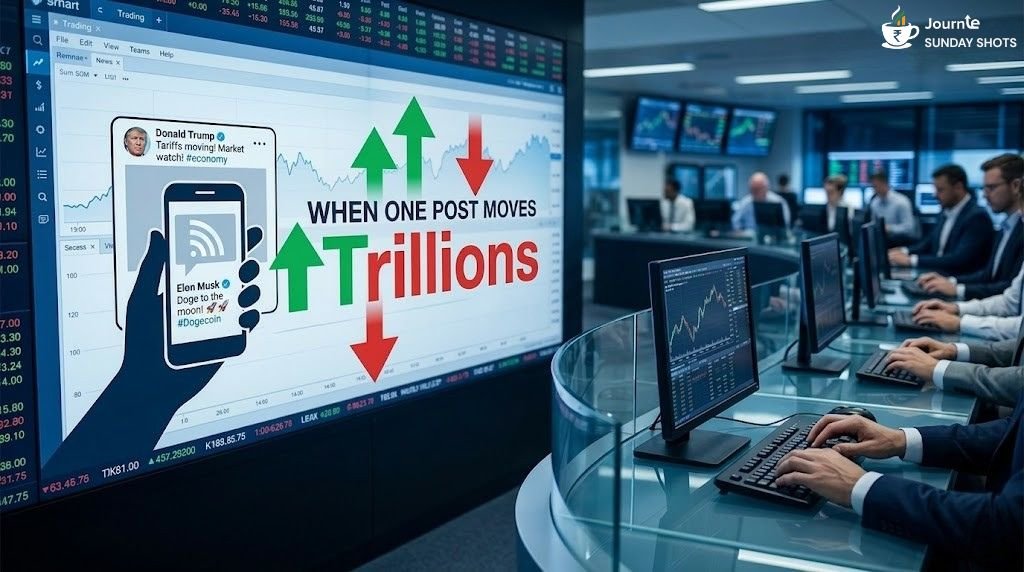
A wide-angle shot of a financial trading floor with multiple monitors. The central large screen displays a smartphone interface showing market-moving posts from Donald Trump regarding tariffs and Elon Musk regarding Dogecoin, flanked by large green and red arrows indicating trillions in market movement.

For decades, markets were expected to move on fundamentals. Earnings growth, inflation data, central bank policy, productivity, and corporate performance were the primary drivers of asset prices. Investors studied balance sheets, tracked macroeconomic indicators, and built positions based on long-term expectations.

Today, that framework still exists—but it is no longer the full story.

Modern markets now react to something much faster: social media communication. Platforms like X are no longer just social networks; they have become real-time transmission channels for market sentiment.

When the people posting are figures like Donald Trump or Elon Musk, the financial consequences can run into billions—or even trillions—of dollars.

The Day Markets Began Pricing Posts

The old market equation was straightforward: companies created value, and investors priced that value over time. The newer equation is more immediate: influential figures communicate online, and markets instantly reprice future expectations.

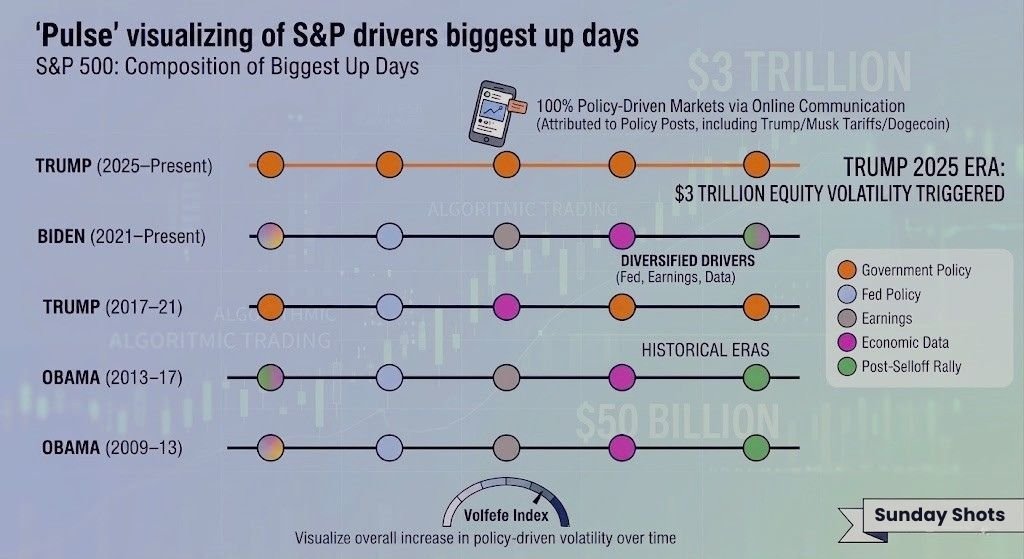
This shift is not theoretical. In 2019, JPMorgan Chase created the Volfefe Index, a model designed to track how Trump’s tweets impacted U.S. Treasury yields and market volatility.

One of the world’s largest banks effectively acknowledged that political tweets had become a financial variable that warranted institutional measurement.

The Trump Effect: Repricing on Probability

Trump’s posts matter because markets do not wait for laws to be signed or policies to be implemented; they move on probability. This was visible in April 2025, when tariff-related announcements triggered a sharp selloff across U.S. markets.

Public reports estimated that more than $3 trillion of equity value was wiped out in a short span as investors reassessed global growth, supply chains, and inflation risk. Nothing physical had changed—factories were still open—but expectations had changed, and markets price expectations first.

War Posts and the New Geopolitical Trade

The same mechanism now applies to geopolitical tensions. When leaders post warnings or ceasefire hints, traders reposition immediately:

  • Commodities: Oil prices can spike on fears of supply disruption, while Gold rises as a safe haven.
  • Sector Risk: Airline and shipping stocks can fall due to operational risk.
  • Currencies: Emerging market currencies often weaken as capital moves toward safer assets.

Markets no longer wait for missiles to launch; they respond to language itself. Market reactions happen in seconds, meaning the probability of conflict has become as tradable as the conflict itself.

Elon Musk and the Monetization of Attention

If Trump demonstrated how political communication could move macro markets, Elon Musk demonstrated how personal influence could move speculative assets. During 2020 and 2021, Musk’s references to Dogecoin helped trigger enormous buying interest.

Dogecoin briefly crossed a market capitalization of around $50 billion. This wasn’t due to cash flows or utility; it rose because attention itself became a catalyst. But attention is volatile. Once enthusiasm fades, prices often correct faster than they rose, leaving late participants exposed.

Who Actually Wins in This Environment?

The biggest beneficiaries are those with speed and systems. Institutional traders and algorithmic desks scan headlines and execute trades within milliseconds—often before most retail investors have even seen the post.

Retail participants usually enter later, often buying after prices spike out of FOMO or selling after a panic-driven decline has already occurred. Wealth often transfers not just from weak to strong investors, but from slower investors to faster ones.

Why India Should Care More Than It Appears

India is deeply connected to these global capital flows and investor sentiment.

  • FII Flows: If global funds turn defensive due to tariff threats, Indian equities face pressure even when domestic fundamentals remain unchanged.
  • The Oil Link: As a major oil importer, geopolitical posts that push crude higher can worsen inflation and strain India’s current account deficit.
  • The Morning Gap: Overnight statements in Washington frequently become a morning market gap in Mumbai, particularly for IT stocks with global revenue exposure.
When Markets Start Listening Too Closely

Markets once moved because companies-built products, improved margins, gained customers, or invested in growth. Today, they can also move because someone posts a threat before market open or a meme late at night.

Technology has democratized participation, but it has also concentrated influence in the hands of a few voices.

For investors, the challenge is no longer just identifying the right company. It is staying rational in a market increasingly designed to reward reaction over reflection.

While attention can move prices quickly, it rarely builds durable value. Let the algorithms trade the milliseconds; the real wealth is still built in the years.

See you next Sunday, for another Shot of insights.!

Disclaimer: This update is for informational purposes only. Please consult a SEBI-registered advisor before investing.

Enjoyed this week’s Sunday Shots? Share it across WhatsApp, LinkedIn, or X — and invite someone else into the conversation.
Subscribe to Sunday Shots for a fresh perspective delivered every week.

Recent Blogs

Lorem ipsum dolor sit amet, consectetur adipiscing elit. Ut elit tellus, luctus nec ullamcorper mattis, pulvinar dapibus leo.

Subscribe to Journie Shots — thoughtful, well-curated insights and market stories delivered every Sunday.