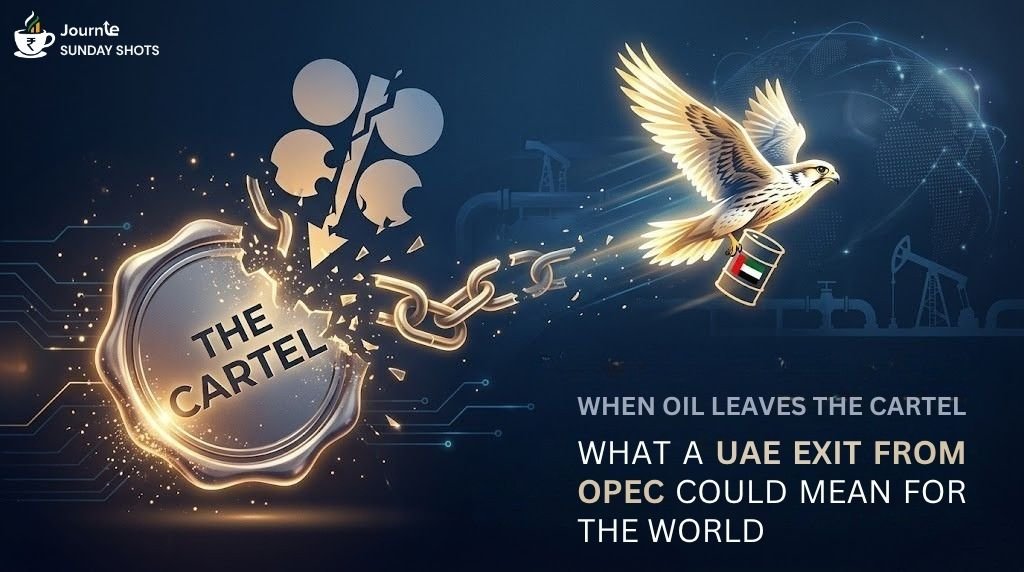

When Oil Leaves the Cartel: What a UAE Exit from OPEC Could Mean for the World
For decades, the global oil market has functioned on a delicate agreement: a handful of producers coordinate supply so that prices don’t collapse.
At the center of that system is the Organization of the Petroleum Exporting Countries, later expanded into OPEC+. Together, they influence nearly half of global oil supply, in a market that produces roughly 86–100 million barrels per day.
At $80–$100 per barrel, that translates into a $2.5–$3.5 trillion annual market one of the largest and most systemically important industries in the world.
Now place that against a single decision: the United Arab Emirates stepping out of that coordination.
This is not just another policy shift. It changes how oil itself gets priced.
The UAE Problem with OPEC: Capacity vs Constraint
The UAE is not a marginal player. It contributes roughly 12% of OPEC’s total output and produces about 3.2–3.5 million barrels per day, with capacity already near 4.8–4.85 million bpd and a target of 5 million bpd by 2027.
In global terms, this represents 3–4% of total supply—a scale large enough to shatter pricing dynamics. Here lies the conflict:
- The OPEC Model: Limit output to keep prices artificially high.
- The UAE Reality: Every barrel not pumped under a quota is, effectively, revenue deferred.
With oil demand expected to peak in the coming decades, the logic for low-cost producers is shifting from “preserve price over time” to “maximize volume while demand still exists”.
This strategic shift makes an OPEC exit rational, not rebellious.
The Iran War: Why Timing Matters More Than the Decision
The timing of a UAE exit is shaped heavily by tensions involving Iran. Even without being directly involved, the UAE sits along critical trade routes, so any escalation quickly raises shipping costs, insurance premiums, and market risk.
In effect, the UAE absorbs part of the economic shock of a conflict it didn’t create.
At the same time, OPEC hasn’t acted as a political stabilizer because it isn’t built for that. Its role is supply management, not conflict resolution. So as tensions rise, countries respond individually rather than collectively.
That’s where timing becomes crucial. In a high-risk environment, sticking to production limits makes less sense. The ability to control output and secure revenue becomes more valuable than staying aligned.
The Situational Exit: How Geopolitics and Supply Expectations are Clashing
The decision to consider leaving OPEC, then, is not just strategic it’s situational.
Recent disruptions in the Strait of Hormuz through which nearly 20% of global oil trade flows have already stranded supply and pushed prices above $110 per barrel at points.
At one stage, disruptions linked to the conflict affected up to 13 million barrels per day of supply, creating a severe supply shock.
This creates a strange contradiction:
- War pushes prices up due to supply risk
- UAE exit pushes prices down due to future supply expansion
The market isn’t reacting to a single force; it is balancing geopolitical scarcity against strategic oversupply. As always, oil markets price these expectations long before the first extra barrel is even pumped.
What Happens to Oil Prices Now?
The immediate reaction is not straight forward but the direction becomes clearer when broken into phases.
- Short term (0–6 months): Prices remain elevated due to Iran-related disruptions. Supply constraints and volatility dominate the sentiment.
- Medium term (6–24 months): As logistics normalize, the UAE increases production. OPEC discipline weakens without a key member, and the risk of a global oversupply emerges.
- Long term: If other producers follow the UAE’s lead, cartel influence declines. Oil pricing shifts from coordination to competition, and volatility becomes structural rather than episodic.
Goldman Sachs has already flagged that UAE’s exit increases the “medium-term supply upside risk” a polite way of saying more oil could hit the market than expected.
So, the question is no longer whether oil goes up or down. It’s whether it stops being predictable at all.
The Global Economy: Stability Matters More Than Price
Oil doesn’t just affect energy it feeds directly into inflation, trade balances, and monetary policy.
When prices spike: Inflation rises globally, Central banks delay rate cuts and Growth slows.
And when prices crash: Oil-producing economies face fiscal stress and Investment in energy infrastructure declines
But what hurts the most is uncertainty.
A coordinated OPEC system, for all its flaws, provided a degree of predictability. A fragmented system where each producer acts independently introduces higher hedging costs, more volatile commodity cycles and uneven economic shocks across countries.
In simple terms, the world economy can handle expensive oil or cheap oil. What it struggles with is unstable oil.
India: The Immediate Macro Impact
For India, the impact is immediate and measurable. India imports 80–85% of its crude oil needs, consuming about 5 million barrels per day.
- The Cost of Conflict: A $10 price increase equals roughly $18–$20 billion in additional import costs per year.
- The Economic Triple-Whammy: This flows through the economy via inflation (rising transport costs), a widening Current Account Deficit (putting pressure on the Rupee), and increased fiscal pressure on government subsidies.
However, if the UAE’s exit leads to a more competitive market and lower prices, India stands to be the primary beneficiary. Lower import bills would ease inflation and allow the government to build strategic reserves at a discount.
At its peak, OPEC controlled over 50% of global supply. Today, that has dropped closer to 30% as non-OPEC producers like the U.S. expand output.
The UAE’s exit accelerates a massive structural transition: from collective control to individual optimization.
The UAE leaving OPEC does not immediately flood the world with oil. It does something more subtle: it tells the market that the era of coordination is over.
In oil, the biggest shift is never in the data—it’s in the expectations.
See you next Sunday, for another Shot of insights.

Disclaimer: This update is for informational purposes only. Please consult a SEBI-registered advisor before investing.
Journie WealthTech Private Limited | AMFI Registered Mutual Fund Distributor | ARN- 318048
Enjoyed this week’s Sunday Shots? Share it across WhatsApp, LinkedIn, or X — and invite someone else into the conversation.
Subscribe to Sunday Shots for a fresh perspective delivered every week.
Lorem ipsum dolor sit amet, consectetur adipiscing elit. Ut elit tellus, luctus nec ullamcorper mattis, pulvinar dapibus leo.