
Journie WealthTech Private Limited | AMFI Registered Mutual Fund & SIF Distributor (ARN: 318048)
Who Owns Customer Attention? What the Hindware-Google Case Reveals About Online Discovery
Imagine owning a store on a busy street.
Customers know your name. They know your products. They are already walking toward your entrance.
Now imagine somebody charging you money every time those customers approach your store.
Sounds absurd?
After all, you spent years building your reputation. You paid for the marketing. You earned the trust. You created the demand.
Why should anyone else get paid when a customer is already looking for you?
Yet for years, many businesses have been doing exactly that on the internet.
And last week, an Indian court decided it may have gone too far.
The Cost of Owning Your Own Customers
One of the most overlooked realities of the digital economy is that businesses often pay to protect customers they have already earned.
Not to attract new customers. Not to increase market share. But simply to defend visibility that should already belong to them.
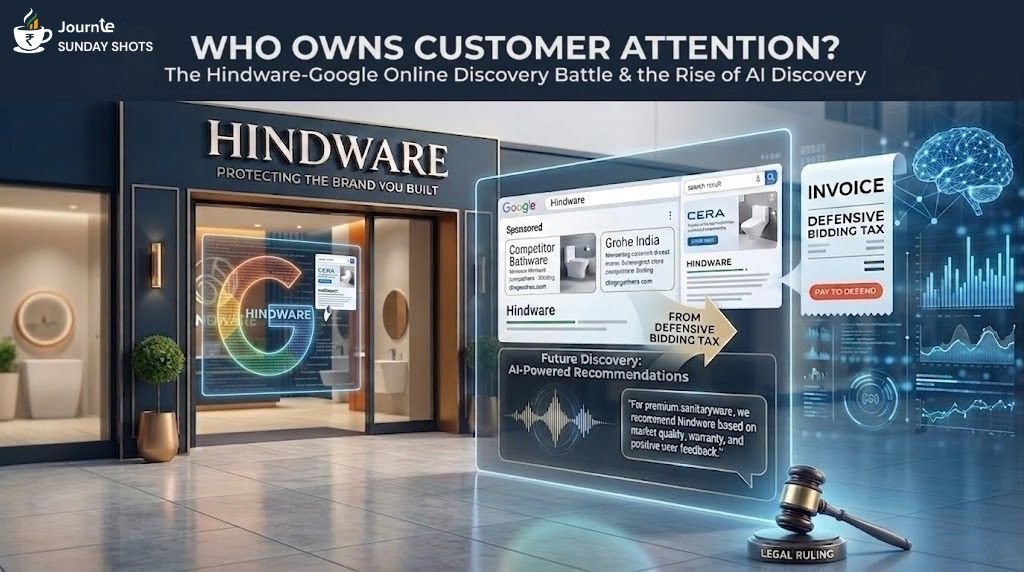
Marketers have a name for this: Defensive Bidding.
Companies bid on their own brand names to ensure competitors do not appear ahead of them when customers search online.
For digital platforms, this created a powerful business model.
For brands, it increasingly felt like a tax. A recurring cost of protecting traffic they had already created.
This arrangement was treated as a normal part of doing business online, for years.
Until Hindware decided to challenge it.
The Search That Started A Debate
Every few years, a court case arrives that appears to be about one company. But in reality, it is about an entire system.
The recent Hindware versus Google judgment may be one of those cases.
At first glance, it looks like a routine trademark dispute.
An Indian sanitaryware company takes on one of the world’s largest technology firms. A court rules in its favour. Damages are awarded. The story ends.
Or does it?
Because hidden beneath this legal battle is a question, businesses around the world have wrestled with for almost two decades:
Should companies have to pay to protect customers who were already looking for them?
The Delhi High Court’s answer was surprisingly clear: No.
And that answer could have consequences far beyond Hindware.
A Customer Types One Word
Imagine a customer sitting at home. They have already decided what they want.
They open Google and type a single word: “Hindware.”
In traditional business logic, that customer belongs to Hindware.
Years of advertising, brand-building, and customer trust brought them to that exact moment.
But inside Google’s advertising ecosystem, something different could happen.
A competitor could purchase “Hindware” as a keyword.
And when that customer searched for Hindware, a competing advertisement could appear before the actual Hindware result.
The customer may still find Hindware. Or they may not.
Either way, someone was paying for access to a customer they did not originally create.
And Google was earning revenue from that transaction.
That simple mechanism became one of the most powerful and controversial features of modern digital advertising.
The Invisible Marketplace Most Consumers Never See
Most internet users think search is simple.
You search. Google finds. You click.
But behind every search query exists an invisible auction taking place in milliseconds.
Advertisers compete for attention. Keywords are bought. Positions are sold. Clicks are monetized.
For years, this system allowed businesses to bid not only on generic terms but also on the registered trademarks of competitors.
And that matters more than most people realize.
Because trademarks are not merely words. They are economic assets built through years of investment, reputation, and customer loyalty.
Yet under the keyword-bidding model, competitors could position themselves between a brand and a customer who was already searching for that brand.
And that is what made the practice so controversial.
The customer wasn’t searching for a category. They were searching for a specific brand.
Then Came Hindware
When Hindware challenged Google, the dispute was not merely about a keyword. It was about whether an invisible digital trigger could still amount to trademark use.
Google argued that keywords existed behind the scenes. Consumers never saw them. Therefore, keyword purchases should not automatically qualify as trademark infringement.
The court disagreed.
The Delhi High Court ruled that a trademark does not need to physically appear inside an advertisement to be used in advertising.
The act of using that trademark to trigger a commercial advertisement was sufficient.
The Court not only imposed a permanent injunction but also directed Google to pay damages, holding that the use of “HINDWARE” as a keyword amounted to trademark infringement.
The court also rejected Google’s argument that it was merely acting as an intermediary within the advertising ecosystem.
For trademark owners, that distinction could prove far more important than the damages themselves.
Because it shifts accountability from advertisers alone to the platform facilitating the transaction.
And for businesses across India, that distinction changes everything.
Why This Matters Beyond Hindware
Large corporations can absorb inefficiencies. Startups often cannot.
When a young company spends years building brand recognition, every customer search matters.
Every click matters. Every conversion matters.
If competitors can intercept branded searches, customer acquisition becomes more expensive precisely when resources are most limited.
This is why the Hindware judgment matters beyond trademark law.
It speaks directly to growth economics. To founders trying to scale. To brands trying to build trust. To companies trying to convert recognition into revenue.
The issue is not simply legal protection.
It is whether businesses should be forced to repeatedly pay for access to demand they already created.
The World's Most Valuable Toll Booths
India absolutely has the ingredients to become a much larger export economy.
The country has demographic scale, geopolitical relevance, digital infrastructure, a growing manufacturing push, and one of the world’s strongest services ecosystems.
But becoming an export powerhouse requires something much deeper than a weak currency.
It requires industrial capability.
That means: stronger manufacturing clusters, lower logistics costs, semiconductor ecosystems, reduced API dependence, better ports and freight corridors, advanced skilling, and deeper integration into global supply chains.
The government’s Production-Linked Incentive (PLI) schemes are already pushing in that direction. Electronics and telecom exports have shown strong momentum.
Trade agreements with the UK, EU, and other partners could also help India integrate more deeply into global commerce.
But industrial transformations of this scale do not happen in a few years.
China took decades. South Korea took decades. Taiwan took decades.
India’s transition will likely take time too.
Why This Matters Beyond Hindware
Large corporations can absorb inefficiencies. Startups often cannot.
When a young company spends years building brand recognition, every customer search matters.
Every click matters. Every conversion matters.
If competitors can intercept branded searches, customer acquisition becomes more expensive precisely when resources are most limited.
This is why the Hindware judgment matters beyond trademark law.
It speaks directly to growth economics. To founders trying to scale. To brands trying to build trust. To companies trying to convert recognition into revenue.
The issue is not simply legal protection.
It is whether businesses should be forced to repeatedly pay for access to demand they already created.
Search Was Only The First Battle
The most interesting part of this story may not be about search at all. It may be about what comes next.
For two decades, businesses fought to appear at the top of search results. Entire industries emerged around search engine optimization, paid advertising, and keyword bidding.
Now a new shift is underway.
People are increasingly asking AI instead of search engines.
Instead of ten links, users may receive one answer. One recommendation. One summary. One suggestion.
That changes the economics of discovery once again.
The battle of the last decade was about appearing on the first page. The battle of the next decade may be about appearing inside the answer itself.
If search created a marketplace for keywords, AI may create a marketplace for recommendations.
And the questions being asked today about customer intent, platform power, and digital gatekeepers may become even more important tomorrow.
Perhaps the biggest lesson from the Hindware case is that attention has become one of the most valuable assets in the modern economy.
Businesses spend years earning it. Platforms monetize it. Consumers rarely think about it.
Yet every search, every recommendation, and every click is a part of a vast marketplace operating quietly in the background.
The Delhi High Court may have ruled on a trademark.
But the question it raised is much larger:
When a customer is already looking for you, should somebody else be allowed to stand in the way?
As search gives way to AI, that question may become even more important.
Because tomorrow's battle may not be about who appears first on a search page. It may be about who appears in the answer itself.
See you next Sunday for another shot of insights!

Disclaimer: This update is for informational purposes only. Please consult a SEBI-registered advisor before investing.
Enjoyed this week’s Sunday Shots? Share it across WhatsApp, LinkedIn, or X — and invite someone else into the conversation.
Subscribe to Sunday Shots for a fresh perspective delivered every week.
Lorem ipsum dolor sit amet, consectetur adipiscing elit. Ut elit tellus, luctus nec ullamcorper mattis, pulvinar dapibus leo.