
Journie WealthTech Private Limited | AMFI Registered Mutual Fund & SIF Distributor (ARN: 318048)

Small Magnets, Big Power: The Rare Earth Race Reshaping the Global Economy

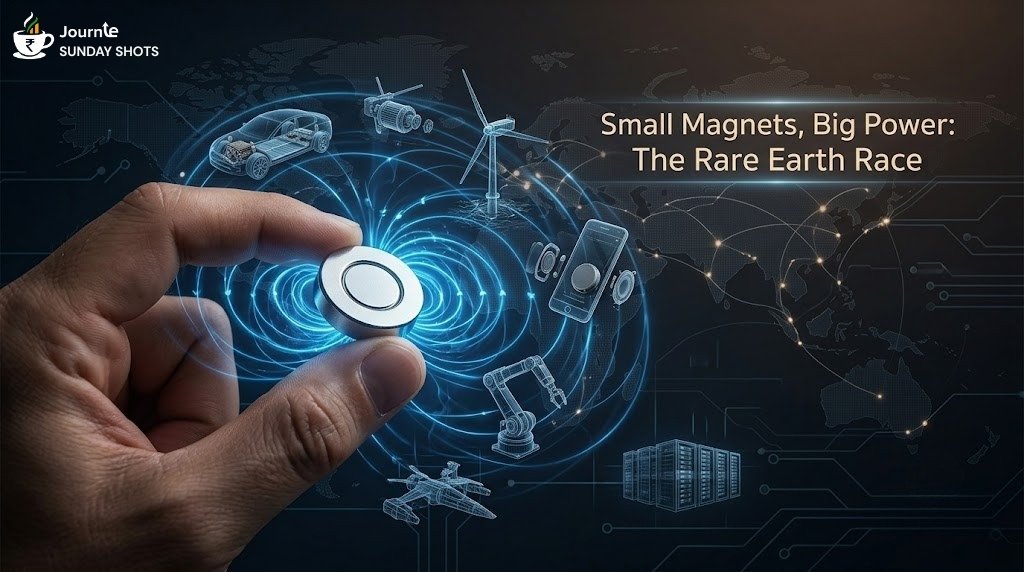
Infographic for Journie Sunday Shots titled Small Magnets, Big Power: The Rare Earth Race, depicting a hand holding a powerful rare earth magnet surrounded by magnetic field lines linking EVs, wind turbines, smartphones, and robotics.

Imagine waking up to a world where electric vehicle factories fall silent, offshore wind farms slow their expansion, smartphones become harder to manufacture, and defense contractors begin rationing critical components. Not because of a shortage of oil or semiconductors but because of a magnet that weighs less than a chocolate bar.

It sounds improbable. Yet that is the reality of the modern economy.

A neodymium magnet costs only a few dollars and is often smaller than a coin. Yet remove it from the global supply chain, and trillion-dollar industries begin to slow. Electric vehicles lose efficiency, wind turbines become heavier and more expensive, industrial robots lose precision, and advanced defence systems face critical bottlenecks. Sometimes, the smallest components carry the greatest strategic weight.

The Material Powering a Trillion-Dollar Transition

Every technological revolution has had its defining resource. Coal fueled the Industrial Revolution. Oil powered the twentieth century. Today, the clean-energy revolution is increasingly being driven by rare earth magnets.

Neodymium-Iron-Boron (NdFeB) magnets are the strongest commercially available permanent magnets in the world, producing exceptional magnetic force while remaining remarkably compact.

Their importance is reflected in the numbers.

The International Energy Agency estimates that global demand for rare earth magnets almost doubled between 2015 and 2023, reaching nearly 93,000 tonnes, with demand expected to accelerate as electric mobility and renewable energy scale further.

A single electric vehicle typically contains 1–2 kilograms of rare earth permanent magnets, while a large direct-drive offshore wind turbine can require hundreds of kilograms to generate electricity efficiently.

These magnets are everywhere:

  • Electric Vehicles: High-efficiency traction motors
  • Wind Turbines: Direct-drive generators
  • Smartphones: Speakers and vibration systems
  • Industrial Robots: Precision servo motors
  • Data Centres: Hard drives and cooling systems
  • Defence Systems: Missiles, radar, guidance systems and drones

The energy transition, artificial intelligence boom and industrial automation revolution all share one invisible dependency.

China: The World's Most Important Supply Chain Nobody Talks About

Many assume China’s strength comes from owning the largest rare earth reserves. It doesn’t.

Countries such as India, Brazil and Australia possess substantial reserves, with India alone estimated to hold around 6.9 million tonnes of rare earth resources.

China’s real advantage lies further down the value chain.

According to the U.S. Geological Survey and the International Energy Agency, China accounts for approximately:

  • 69% of global rare earth mine production
  • Nearly 90% of global rare earth refining capacity
  • The overwhelming majority of permanent magnet manufacturing

That distinction changes everything.

Mining is only the beginning of the value chain. The real challenge lies in separating rare earth elements, converting them into oxides, producing specialized alloys and manufacturing high-performance magnets.

In effect, even rare earth minerals extracted in other countries often travel to China before returning to global manufacturers as finished products.

The world’s supply chain doesn’t simply start in China, it flows through China.

When Magnets Become Geopolitical Weapons

For years, this dominance was viewed as an industrial advantage.

Over the past year, it has evolved into strategic leverage.

In April 2025, China imposed export controls on several medium and heavy rare earth elements and finished magnets, requiring exporters to obtain government licenses before shipments could leave the country.

The impact was immediate. Automobile manufacturers reported delays, electronics companies reassessed inventories, and defence supply chains began searching for alternative sources. Reuters reported that magnet exports dropped sharply following the new licensing requirements, exposing how concentrated the global supply chain had become.

Fast forward to mid-2026, and the geopolitical chess board has tightened significantly. Beijing has systematically expanded its leverage—blacklisting key Western independent mineral suppliers and tightening global tracking rules. What began as localized industrial friction has evolved into a zero-sum game of absolute supply chain oversight.

Unlike oil shocks that send prices soaring overnight, rare earth disruptions create something more subtle and arguably more dangerous.

Factories continue operating, but inventories shrink, production schedules slip, procurement costs rise and companies begin redesigning products around constrained supplies.

The disruption spreads silently through the global economy.

Can the World Reduce Its Dependence?

Australia, the United States, Canada and several European economies are investing billions of dollars to diversify rare earth supply chains.

Australia’s Lynas has emerged as the largest producer outside China, while the United States is expanding domestic refining and recycling capabilities.

Yet experts believe meaningful diversification will take years.

Building a competitive rare earth ecosystem requires advanced chemical processing, specialized metallurgy, environmental approvals, highly skilled labor and enormous capital investment.

Opening a mine may take a few years.

Building an integrated industrial ecosystem can take decades.

That reality explains why China’s position remains remarkably resilient despite growing global efforts to reduce dependence.

India's Moment of Opportunity

For India, the rare earth story presents both a challenge and an opportunity.

Despite possessing one of the world’s significant reserve bases, India historically remained dependent on imports for refined rare earth products and high-performance magnets. But New Delhi is aggressively rewriting this script.

Backed by the National Critical Mineral Mission, the government recently put serious financial muscle behind self-reliance by rolling out a massive ₹7,280 crore manufacturing scheme dedicated specifically to producing Sintered Rare Earth Permanent Magnets (REPMs).

To complement this, Dedicated Rare Earth Corridors have been established across four mineral-rich coastal states—Odisha, Kerala, Andhra Pradesh, and Tamil Nadu. The goal is clear: co-locate mining, refining, and magnet fabrication to break the processing bottleneck at home.

The objective is straightforward but ambitious:

  • Build End-to-End Capabilities: Move beyond exporting raw minerals to master advanced domestic refining, alloy production, and magnet manufacturing.
  • Scale Secondary Sourcing: Leverage a newly structured processing ecosystem that has already attracted critical mineral recycling commitments at three times the government’s initial targets, transforming electronic and industrial waste into a reliable domestic supply.

Because in the twenty-first century, value is increasingly created not by extracting resources but by processing them.

A Tiny Magnet with Global Consequences

At first glance, a neodymium magnet appears insignificant.

It fits comfortably in a hand and costs only a fraction of the products it powers.

Yet without it, electric vehicles become less efficient, wind farms become more expensive, industrial robots lose precision and defense manufacturing faces critical bottlenecks.

The world once measured strategic power in barrels of oil and semiconductor chips. Today, it is increasingly measured in processing capacity, advanced manufacturing and supply chain control.

And nowhere is that more evident than in the rare earth industry.

In a world obsessed with oil fields and semiconductor fabs, the next balance of power may well be decided by something that fits in the palm of your hand – a small magnet with extraordinarily big power.

See you next Sunday for another shot of insights!

Disclaimer: This update is for informational purposes only. Please consult a SEBI-registered advisor before investing.

Enjoyed this week’s Sunday Shots? Share it across WhatsApp, LinkedIn, or X — and invite someone else into the conversation.
Subscribe to Sunday Shots for a fresh perspective delivered every week.

Recent Blogs

Lorem ipsum dolor sit amet, consectetur adipiscing elit. Ut elit tellus, luctus nec ullamcorper mattis, pulvinar dapibus leo.

Subscribe to Journie Shots — thoughtful, well-curated insights and market stories delivered every Sunday.