
Journie WealthTech Private Limited | AMFI Registered Mutual Fund & SIF Distributor (ARN: 318048)

The Shift Inside India’s Markets: Is India’s Financial System Entering A New Phase?

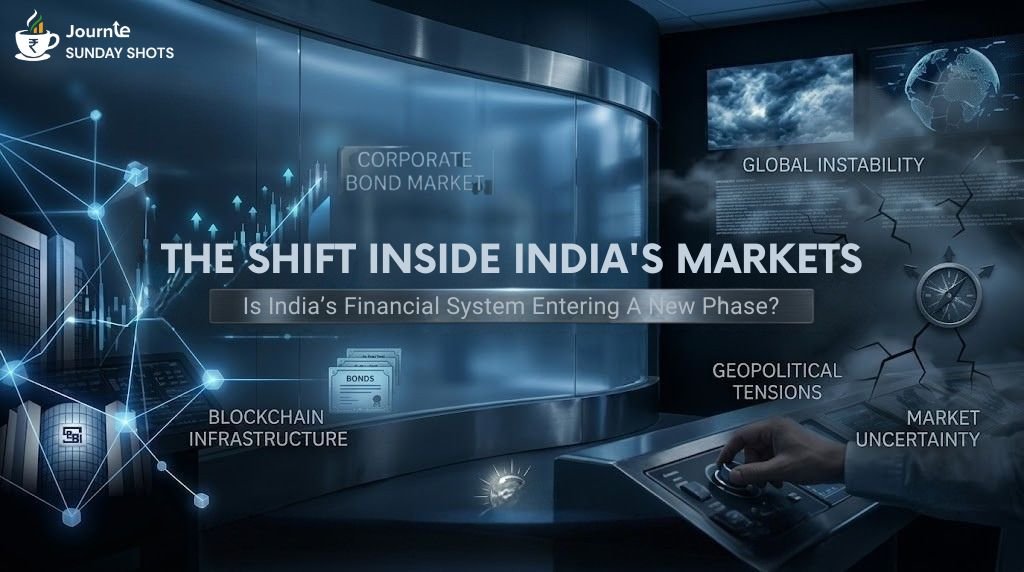
A high-tech financial control room display tracking the modernization of India's debt market alongside global instability events, designed for the Journie Sunday Shots macro-financial briefing.

Every few years, India’s financial markets reach moments that feel bigger than daily headlines.

Moments where regulation, technology, geopolitics, and investor sentiment all begin colliding at the same time.

This feels like one of those moments.

Because while most conversations still revolve around stock market highs, interest rates, and inflation, two recent developments are quietly revealing something much larger about where India’s financial system may be headed next.

The first came from SEBI.

India’s market regulator is now exploring stronger disclosure standards for debt markets while also preparing to test tokenized corporate bonds using blockchain infrastructure.

The second came from Kent RO.

One of India’s most recognized consumer brands decided to postpone its IPO plans — not because business was weak, but because rising geopolitical tensions suddenly made market conditions too uncertain.

At first glance, these may look like two unrelated developments. But together, they reveal something important.

India is simultaneously trying to modernize its financial system for the future while navigating a world becoming far more unstable. And that tension may define the next phase of India’s markets.

India Wants Deeper Markets, Not Just Bigger Markets

Over the last two decades, India’s equity markets have evolved rapidly.

Retail participation surged. SIP culture expanded. Digital investing became mainstream. IPO activity exploded.

But one part of India’s financial system still remains relatively underdeveloped compared to large global economies:

The corporate bond market.

And that matters far more than most people realize.

Because mature economies are not only financed only through banks. They are also financed through deep debt markets.

Infrastructure projects. Corporate expansion. Institutional financing. Long-term capital allocation. All of this becomes easier when companies can efficiently raise money through bonds instead of depending excessively on banks.

Because economies that depend too heavily on banks eventually face capital bottlenecks as they scale.

That is exactly where SEBI now appears to be focusing.

Recently, SEBI Chairman Tuhin Kanta Pandey indicated that India may move toward stronger disclosure standards for debt markets — bringing them closer to the transparency levels seen in equities.

At first glance, this sounds technical. But the larger implication is actually simple: Trust. Because capital flows where visibility improves.

The more transparent markets become, the more institutional participation increases. And deeper participation eventually creates stronger, more liquid, and more resilient markets.

India Is Experimenting with Blockchain-Based Bonds

Alongside disclosure reforms, SEBI also announced plans to test tokenized corporate bonds using Distributed Ledger Technology (DLT).

In simple words: India is now experimenting with blockchain infrastructure inside its bond markets.

Not for hype. Not for headlines. But for efficiency.

Today, bond settlements often involve multiple intermediaries, fragmented records, operational friction, and settlement delays. Tokenization attempts to simplify parts of that system through digitally recorded ownership and faster settlement infrastructure.

The broader goal is straightforward: Lower friction, better traceability, Faster execution and deeper liquidity. And this matters because India’s long-term economic ambitions cannot rely only on equity markets.

Large economies require sophisticated debt markets to finance growth efficiently. More importantly, India is no longer waiting for global consensus before experimenting with new financial infrastructure.

Which means this is not just a technology experiment. It is a financial infrastructure story.

Yet building stronger markets is only one side of the equation.

Because no matter how sophisticated financial infrastructure becomes, markets still operate within the realities of the world around them.

And that reality was visible in another development this week.

Kent RO’s IPO Delay Reveals the Other Side Of Markets

But while regulators were discussing the future, another reality was quietly unfolding at the same time.

Kent RO Systems had already received regulatory approval for its IPO. Business remained stable. Demand remained intact. Yet the company still decided to postpone its listing plans.

Why? Because geopolitical tensions and Middle East instability suddenly weakened market sentiment and increased uncertainty. And this reveals something important about modern markets.

Today, even fundamentally strong businesses are vulnerable to events happening far beyond their own industries or borders.

Oil prices rise →Transportation costs increase →Raw material inflation returns →Investor sentiment weakens →Volatility spikes.

And suddenly even IPO timing becomes difficult.

The company chose patience over rushing into uncertain conditions. And that decision reflects a broader shift now visible across global markets.

This is no longer an environment where strong fundamentals alone are enough. Stability itself has become a market variable.

India’s Markets Are Now Operating In Two Timelines

And that may be the most fascinating part of this entire story.

On one side, India is aggressively modernizing: stronger transparency, deeper debt markets, digital financial infrastructure, blockchain experimentation, and broader institutional participation.

But simultaneously, the global environment is becoming more fragmented and unpredictable.

Wars. Energy shocks. Supply-chain disruptions. Geopolitical realignments. Interest-rate uncertainty.

All of these now influence investor behavior and capital flows far more aggressively than before.

Which means India’s markets are now operating in two timelines at once.

One focused on building the future. The other focused on navigating instability in the present.

The Bigger Shift Most People May Be Missing

The real story here is not simply about debt disclosures or one delayed IPO. It is about how financial systems evolve during periods of uncertainty.

Strong markets are not built only through stock rallies or bull runs. They are built through: institutional trust, regulatory credibility, technological efficiency, deep capital markets, and resilience during volatility.

That remains the larger lesson often overlooked in market conversations.

Most people notice rallies and IPOs. Very few notice the financial plumbing underneath an economy being rebuilt in real time.

And that is exactly what India now appears to be doing.

The next phase of India’s markets may not simply be about becoming bigger. It may be about becoming stronger, smarter, and resilient enough for a far more unpredictable world.

See you next Sunday for another shot of insights!
Disclaimer: This update is for informational purposes only. Please consult a SEBI-registered advisor before investing.

Enjoyed this week’s Sunday Shots? Share it across WhatsApp, LinkedIn, or X — and invite someone else into the conversation.
Subscribe to Sunday Shots for a fresh perspective delivered every week.

Recent Blogs

Lorem ipsum dolor sit amet, consectetur adipiscing elit. Ut elit tellus, luctus nec ullamcorper mattis, pulvinar dapibus leo.

Journie WealthTech Private Limited | AMFI Registered Mutual Fund & SIF Distributor (ARN: 318048)

India’s Export Dream: Beyond the Weak Rupee Narrative

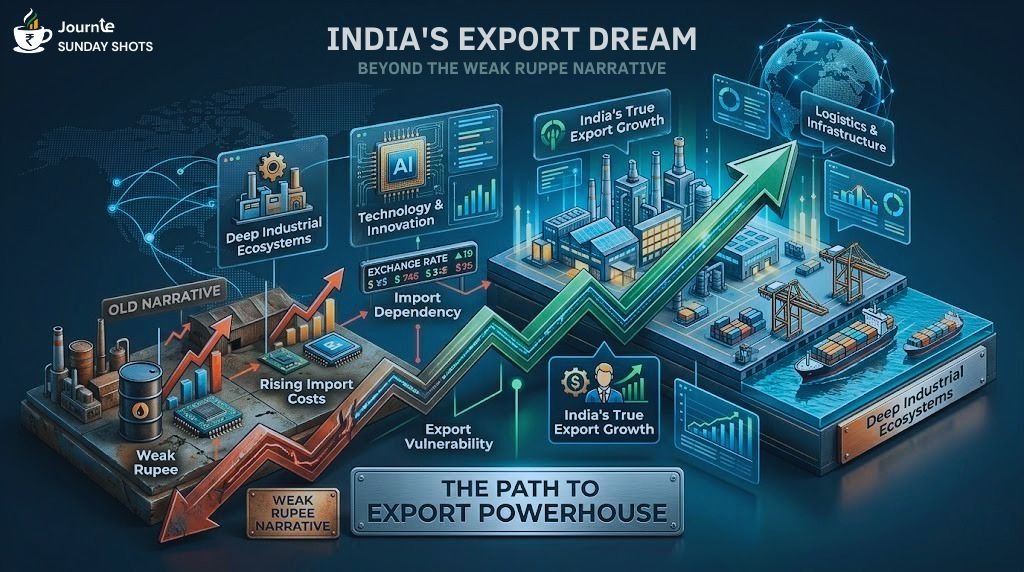
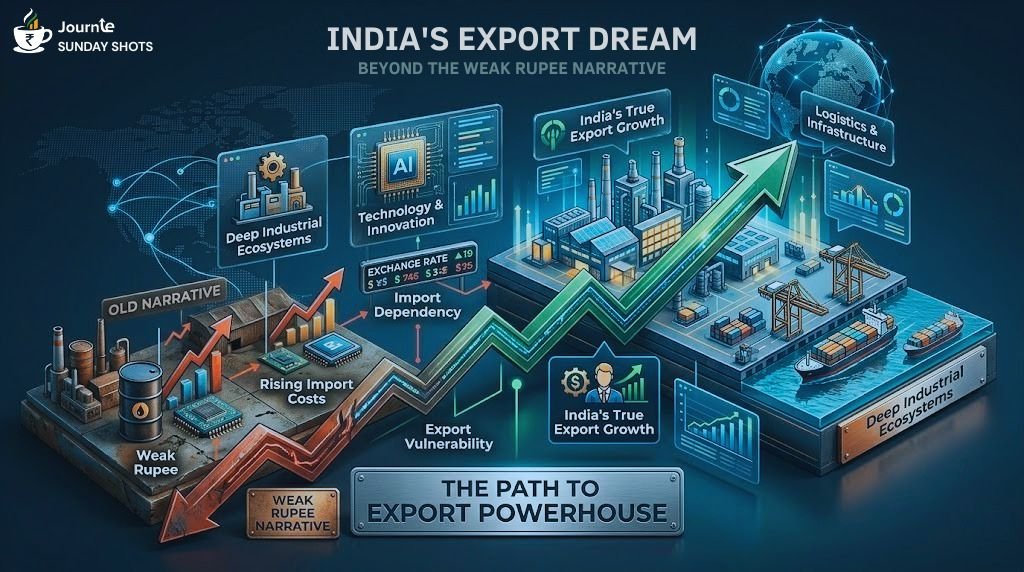
An isometric 3D macroeconomic infographic diagram with a clean, dark background titled "India's Export Powerhouse," illustrating the friction between import dependencies and structural export growth.

Every time the rupee weakens, the same optimism returns to the markets. Export stocks rally. IT companies gain attention. Pharma businesses come back into focus.

And once again, a familiar belief starts spreading across television debates, WhatsApp forwards, and market conversations: “A weaker rupee is good for India’s exports.”

At first glance, the logic sounds perfectly reasonable.

If the rupee falls against the dollar, Indian goods become cheaper globally. Foreign buyers can purchase more from India at lower relative prices. Exports rise. Economic growth improves.

Simple. Except the modern global economy is no longer that simple.

Because today, exports are not built on currency advantage alone. They are shaped by manufacturing depth, technology, logistics, energy access, production networks, and industrial capability.

And that changes the entire equation for India.

Because while India exports to the world, it also relies heavily on imported inputs underneath. So, when the rupee weakens, export revenues may improve in rupee terms, but production costs rise too.

That contradiction sits at the heart of India’s export story. And it is far more important than most market conversations acknowledge.

India’s Export Numbers Look Impressive

But The Full Story Is Far More Complicated.

India’s total exports touched a record USD 825.3 billion in FY25, while services exports alone crossed USD 387.6 billion.

On paper, that looks like the rise of a serious export economy. But behind those numbers lies another reality.

India’s merchandise imports surged to nearly USD 721.2 billion during the same period. And that reveals something important.

India still depends heavily on imported crude oil, electronics, semiconductor components, industrial machinery, chemicals and pharmaceutical raw materials.

Which means India’s export story is far more intertwined with imports than most headlines suggest.

Oil becomes costlier. Electronic components become more expensive. Manufacturing inputs rise. Imported APIs for pharma become pricier.

So, while India may earn more from exports, it also pays more for the very inputs required to produce them. The benefit of currency depreciation starts getting partially offset by rising import dependency.

That is the hidden vulnerability simplified export narratives often ignore.

What Actually Built Asia’s Export Giants

For decades, countries across Asia transformed themselves through exports.

Japan built world-class precision manufacturing and became a global leader in automobiles and electronics.

Taiwan became the backbone of the global semiconductor industry through deep investments in chip manufacturing and technology ecosystems.

South Korea dominated advanced electronics, shipbuilding, and consumer technology and Vietnam emerged as a major electronics assembly hub integrated into global supply chains.

Bangladesh built one of the world’s largest garment export industries through scale, labour efficiency, and focused industrial policy.

And yes, China eventually became the factory of the world.

But none of these economies succeeded and became export power houses because of weak currencies alone.

They built deep industrial ecosystems over decades — investing heavily in ports, logistics, manufacturing clusters, technical skilling, infrastructure, and tightly integrated supply chains.

That was the real foundation of export dominance.

The Uncomfortable Question for India

If so many Asian economies managed to build globally competitive export systems, why has India struggled for decades to fully replicate that success?

The answer is not capability. India absolutely has the scale, talent, and market potential.

The real issue is execution speed and industrial depth.

Quick fact: Over the last 14 years, the Rupee has steadily depreciated by almost 60%, yet our exports as a percentage of GDP actually compressed from 25% to 21%—proving that true trade dominance is earned through domestic supply chains, not currency devaluations.

India is trying to build manufacturing ecosystems in a far more difficult world — one that shaped by trade wars, geopolitical fragmentation, protectionism, energy insecurity and rapid technological disruption.

The rules of global trade are becoming harder precisely at the moment India is trying to scale up.

And that makes India’s manufacturing challenge significantly tougher than what earlier export economies faced.

Even India’s Strongest Export Sectors Have a Catch

Take pharmaceuticals. India exported nearly USD 30.5 billion worth of pharma products in FY25 and is often called the “pharmacy of the world.” It is genuinely one of India’s greatest export success stories.

But there is a catch.

A large portion of Active Pharmaceutical Ingredients (APIs) still comes from China and other foreign suppliers.

So, when the rupee depreciates:

  • export revenues improve,
  • but imported raw material costs rise as well.

Margins get squeezed.

The same issue exists in electronics.

India’s electronics imports were reported at about USD 98.65 billion in FY25, rising further to USD 116.17 billion in FY26, with China remaining one of the largest suppliers of critical components.

This means India is often assembling products domestically while much of the underlying component ecosystem still sits outside the country.

And that changes how much benefit a weak rupee can actually deliver.

The IT Sector Faces an Even Bigger Shift: AI

For years, India’s services industry acted as the country’s economic cushion.

India generated a record USD 188.8 billion services trade surplus in FY25, powered largely by IT and technology exports.

Traditionally, a weaker rupee benefited Indian IT firms significantly because dollar earnings translated into higher rupee revenues. But now another disruption is emerging.

Artificial intelligence.

And this shift may be much bigger than currency movements themselves.

For nearly two decades, India’s IT outsourcing model was built on labour arbitrage: skilled talent at lower global costs.

But generative AI is beginning to automate many repetitive coding, testing, support, and workflow functions that once required large offshore teams.

Which means global clients are starting to focus less on: “How cheap is the workforce?” And more on: “How productive is the system?”

That is a massive shift.

The future winners in services exports may not simply be companies with the largest workforce anymore. They may be the companies with: the strongest AI integration, best productivity, proprietary technology, and highest-value innovation.

The old export advantage is evolving rapidly.

India Has One Big Difference from Most Export Economies

A Massive Domestic Consumption Market. And this changes India’s economic priorities completely.

This is another reason India’s export story works differently.

India consumes a large portion of what it produces internally: food, energy, electronics, consumer products — domestic demand itself is enormous.

And that creates policy conflicts.

For example, agricultural exports grew from USD 34.5 billion in FY20 to USD 51.1 billion in FY25.

But whenever food inflation rises domestically, export restrictions quickly follow. Rice restrictions, wheat controls, export curbs.

Because for India, economic policy is not only about exports. It is also about social stability.

That balancing act makes India fundamentally different from pure export-led economies.

So What Does India Actually Need?

India absolutely has the ingredients to become a much larger export economy.

The country has demographic scale, geopolitical relevance, digital infrastructure, a growing manufacturing push, and one of the world’s strongest services ecosystems.

But becoming an export powerhouse requires something much deeper than a weak currency.

It requires industrial capability.

That means: stronger manufacturing clusters, lower logistics costs, semiconductor ecosystems, reduced API dependence, better ports and freight corridors, advanced skilling, and deeper integration into global supply chains.

The government’s Production-Linked Incentive (PLI) schemes are already pushing in that direction. Electronics and telecom exports have shown strong momentum.

Trade agreements with the UK, EU, and other partners could also help India integrate more deeply into global commerce.

But industrial transformations of this scale do not happen in a few years.

China took decades. South Korea took decades. Taiwan took decades.

India’s transition will likely take time too.

The Lesson Markets Often Miss

A weaker rupee may temporarily support exports by improving price competitiveness in select industries. However, durable economic strength is not built through currency depreciation alone.

The world’s leading export economies did not emerge because they had cheaper currencies. They succeeded because they developed industrial depth, technological capability, efficient logistics, integrated supply chains, and highly skilled workforces.

That remains the larger lesson often overlooked in market conversations.

India possesses the scale, strategic relevance, and economic potential to become a far more influential export economy. .

But achieving that transformation will depend less on exchange-rate movements and far more on the country’s ability to strengthen its industrial foundation in the coming decade.

See you next Sunday for another shot of insights!
Disclaimer: This update is for informational purposes only. Please consult a SEBI-registered advisor before investing.

Enjoyed this week’s Sunday Shots? Share it across WhatsApp, LinkedIn, or X — and invite someone else into the conversation.
Subscribe to Sunday Shots for a fresh perspective delivered every week.

Lorem ipsum dolor sit amet, consectetur adipiscing elit. Ut elit tellus, luctus nec ullamcorper mattis, pulvinar dapibus leo.

The End of Cheap-China Era: Why Beijing is Breaking its Own Playbook

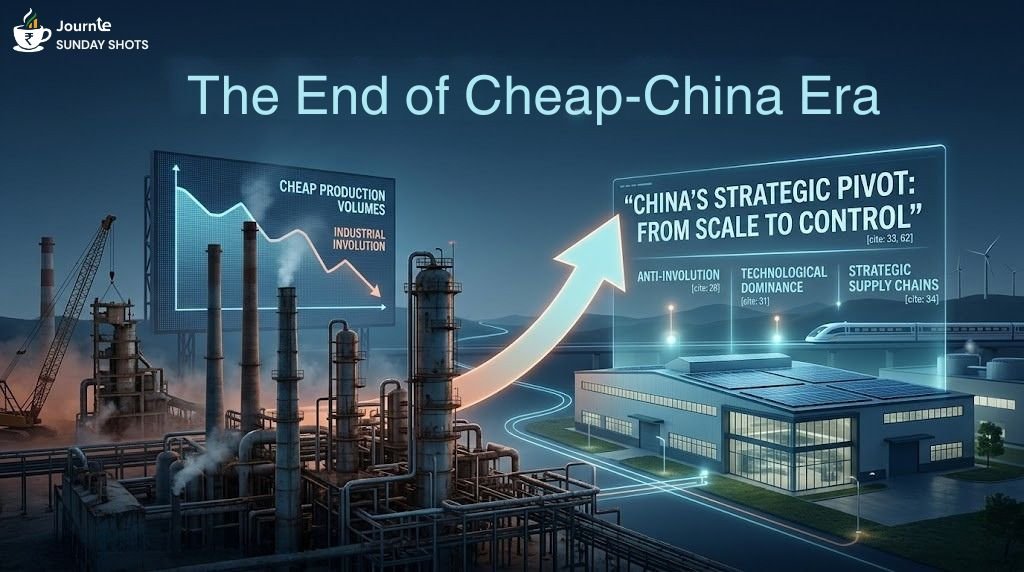
Infographic showing the shift from growth to control in global manufacturing.

For years, China didn’t just manufacture goods. It manufactured prices.

By producing at unmatched scale and relentlessly undercutting costs, it became one of the most powerful deflationary forces in the global economy. Steel, chemicals, electronics—if the world needed something cheaper and faster, China delivered.

At its peak, China was producing more than half of the world’s steel, even as several producers operated on margins of less than 2%. In chemicals, capacity utilization had already slipped below 75% by 2024, yet expansion continued.

The model was simple: produce more, price lower, capture share.

And for decades, it worked. Until it didn’t.

When More Becomes Less

At some point, scale stops being an advantage—and starts becoming a trap.

This is what economists call involution. But stripped of jargon, it’s far simpler than it sounds. It’s what happens when an entire industry keeps running faster, yet somehow ends up standing still.

Factories produce more. Prices fall further. Margins disappear.
Effort increases. Returns don’t.

The signs are now difficult to ignore. China’s chemical product price index has declined nearly 36% over the past three years, even as production volumes stayed elevated.

Across petrochemicals, excess capacity has built up to uncomfortable levels, triggering sustained price wars. Refining margins have thinned to near unsustainable levels, while utilization across segments of the industry has quietly drifted lower.

What once looked like industrial dominance is beginning to resemble industrial fatigue.

A Realization in Beijing

For policymakers in Beijing, this is no longer just about weak profitability. It’s about control slipping.

Excess production is now feeding into deflation at home, financial stress across companies, rising global backlash, and increasing environmental costs—all at the same time.

More than 20 countries have already responded with anti-dumping duties or trade restrictions, pushing back against what they see as distorted pricing from Chinese overcapacity.

At the same time, stricter environmental standards are raising the cost of sustaining older, more polluting industrial capacity.

Compliance costs across several industrial sectors have reportedly increased by nearly 15–20%. Producing more is no longer as cheap or as strategically useful as it once was.

And that is forcing a shift in thinking.

From Scale to Control

China’s response is not to step back from manufacturing dominance—but to redefine it.

The new approach, often described as “anti-involution”, is less about how much is produced and more about how it is produced and at what cost to the system.

Inefficient capacity is being targeted. Production discipline is being encouraged. Environmental compliance is no longer optional. Reports suggest China could shut nearly 10–15% of inefficient coal chemical plants through tighter emission rules and production controls.

The capital is being redirected toward sectors where pricing power and technological control matter more than sheer volume—EV supply chains, batteries, specialty chemicals, and advanced manufacturing.

This is not a retreat. It is a recalibration.

For years, China competed through scale. Increasingly, it now wants to compete through control. Control over supply, pricing and over the strategic parts of global value chains.

A Shift the World Will Feel

For decades, China exported deflation to the rest of the world.

Its ability to produce in excess kept industrial goods cheap, often suppressing prices globally in ways that few economies could match.

If that excess begins to reduce, the effect may not be immediate, but it will be meaningful.

Prices across segments of the industrial economy may gradually firm up by nearly 5–10%. Regions already dealing with cost pressures could feel that shift more sharply. Europe, already under pressure from elevated energy costs, could see industrial input inflation rise by 8–12% in selected sectors.

At the same time, companies that once relied heavily on China are increasingly rethinking that dependence—not just for cost reasons, but for resilience. Nearly $100 billion in global trade flows could potentially be redistributed as companies diversify manufacturing footprints beyond China.

What emerges may not be a single replacement for China, but a redistribution of manufacturing power.

India’s Moment—If It Can Take It

For India, this could be one of the most important manufacturing windows in recent decades.

For years, competing with China meant competing with structurally lower prices. In sectors like chemicals, Chinese exports often entered global markets significantly cheaper, leaving limited room for others to scale competitively.

The contrast in scale remains stark: India’s chemical exports stand near $25 billion, compared to China’s roughly $120 billion.

That dynamic may now begin to shift.

Even a 3-5% diversion of global sourcing away from China could meaningfully expand India’s export footprint and India could potentially gain an additional $18–25 billion in chemical exports over the coming years.

Under the broader “China+1” framework, India may also attract nearly $50–80 billion in incremental manufacturing investment over the next decade.

Manufacturing exports could increase by nearly $60–100 billion cumulatively by 2030, particularly if initiatives like PLI translate into real capacity and not just intent.

But this is where realism matters. Opportunity does not automatically translate into outcome.

Execution—across infrastructure, logistics, policy consistency, and manufacturing depth—will determine whether this becomes a breakthrough or just another near-miss.

The Beginning of a Different Globalization

For decades, globalization followed a simple idea: produce more, produce cheaper, and let scale do the rest.

China mastered that playbook better than anyone. And now, it appears to be moving beyond it.

What is emerging instead is a more controlled version of globalization—one where output is measured, pricing is protected, and strategic sectors are carefully managed.

This is not de-globalization. It is a redesign.

And at the centre of that redesign is a subtle but important shift: China is no longer optimizing only for growth. It is optimizing for control.

See you next Sunday, for another Shot of insights.!

Disclaimer: This update is for informational purposes only. Please consult a SEBI-registered advisor before investing.

Journie WealthTech Private Limited | AMFI Registered Mutual Fund Distributor | ARN- 318048

Enjoyed this week’s Sunday Shots? Share it across WhatsApp, LinkedIn, or X — and invite someone else into the conversation.
Subscribe to Sunday Shots for a fresh perspective delivered every week.

Lorem ipsum dolor sit amet, consectetur adipiscing elit. Ut elit tellus, luctus nec ullamcorper mattis, pulvinar dapibus leo.

When Oil Leaves the Cartel: What a UAE Exit from OPEC Could Mean for the World

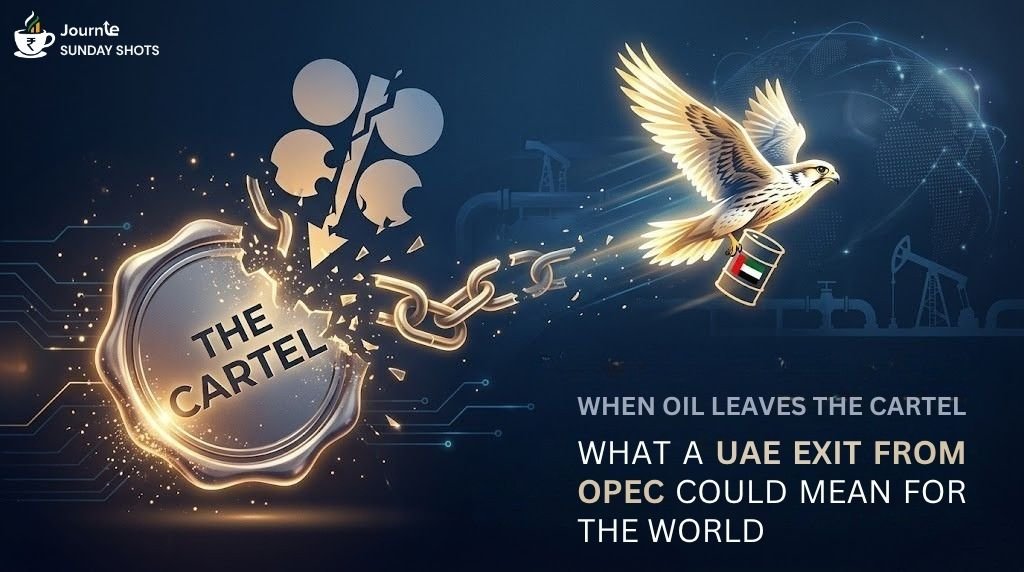
A conceptual macroeconomic image titled "When Oil Leaves the Cartel," featuring a golden falcon carrying an oil barrel with the UAE flag, flying away from a shattered silver seal labeled "The Cartel" and a broken OPEC+ logo. The background is a soft, dark blue with digital circuit patterns and a glowing globe, symbolizing a shift in global energy dynamics.

For decades, the global oil market has functioned on a delicate agreement: a handful of producers coordinate supply so that prices don’t collapse.

At the center of that system is the Organization of the Petroleum Exporting Countries, later expanded into OPEC+. Together, they influence nearly half of global oil supply, in a market that produces roughly 86–100 million barrels per day.

At $80–$100 per barrel, that translates into a $2.5–$3.5 trillion annual market one of the largest and most systemically important industries in the world.

Now place that against a single decision: the United Arab Emirates stepping out of that coordination.

This is not just another policy shift. It changes how oil itself gets priced.

The UAE Problem with OPEC: Capacity vs Constraint

The UAE is not a marginal player. It contributes roughly 12% of OPEC’s total output and produces about 3.2–3.5 million barrels per day, with capacity already near 4.8–4.85 million bpd and a target of 5 million bpd by 2027.

In global terms, this represents 3–4% of total supply—a scale large enough to shatter pricing dynamics. Here lies the conflict:

  • The OPEC Model: Limit output to keep prices artificially high.
  • The UAE Reality: Every barrel not pumped under a quota is, effectively, revenue deferred.

With oil demand expected to peak in the coming decades, the logic for low-cost producers is shifting from “preserve price over time” to “maximize volume while demand still exists”.

This strategic shift makes an OPEC exit rational, not rebellious.

The Iran War: Why Timing Matters More Than the Decision

The timing of a UAE exit is shaped heavily by tensions involving Iran. Even without being directly involved, the UAE sits along critical trade routes, so any escalation quickly raises shipping costs, insurance premiums, and market risk.

In effect, the UAE absorbs part of the economic shock of a conflict it didn’t create.

At the same time, OPEC hasn’t acted as a political stabilizer because it isn’t built for that. Its role is supply management, not conflict resolution. So as tensions rise, countries respond individually rather than collectively.

That’s where timing becomes crucial. In a high-risk environment, sticking to production limits makes less sense. The ability to control output and secure revenue becomes more valuable than staying aligned.

The Situational Exit: How Geopolitics and Supply Expectations are Clashing

The decision to consider leaving OPEC, then, is not just strategic it’s situational.

Recent disruptions in the Strait of Hormuz through which nearly 20% of global oil trade flows have already stranded supply and pushed prices above $110 per barrel at points.

At one stage, disruptions linked to the conflict affected up to 13 million barrels per day of supply, creating a severe supply shock.

This creates a strange contradiction:

  • War pushes prices up due to supply risk
  • UAE exit pushes prices down due to future supply expansion

The market isn’t reacting to a single force; it is balancing geopolitical scarcity against strategic oversupply. As always, oil markets price these expectations long before the first extra barrel is even pumped.

What Happens to Oil Prices Now?

The immediate reaction is not straight forward but the direction becomes clearer when broken into phases.

  • Short term (0–6 months): Prices remain elevated due to Iran-related disruptions. Supply constraints and volatility dominate the sentiment.
  • Medium term (6–24 months): As logistics normalize, the UAE increases production. OPEC discipline weakens without a key member, and the risk of a global oversupply emerges.
  • Long term: If other producers follow the UAE’s lead, cartel influence declines. Oil pricing shifts from coordination to competition, and volatility becomes structural rather than episodic.

Goldman Sachs has already flagged that UAE’s exit increases the “medium-term supply upside risk” a polite way of saying more oil could hit the market than expected.

So, the question is no longer whether oil goes up or down. It’s whether it stops being predictable at all.

The Global Economy: Stability Matters More Than Price

Oil doesn’t just affect energy it feeds directly into inflation, trade balances, and monetary policy.

When prices spike: Inflation rises globally, Central banks delay rate cuts and Growth slows.

And when prices crash: Oil-producing economies face fiscal stress and Investment in energy infrastructure declines

But what hurts the most is uncertainty.

A coordinated OPEC system, for all its flaws, provided a degree of predictability. A fragmented system where each producer acts independently introduces higher hedging costs, more volatile commodity cycles and uneven economic shocks across countries.

In simple terms, the world economy can handle expensive oil or cheap oil. What it struggles with is unstable oil.

India: The Immediate Macro Impact

For India, the impact is immediate and measurable. India imports 80–85% of its crude oil needs, consuming about 5 million barrels per day.

  • The Cost of Conflict: A $10 price increase equals roughly $18–$20 billion in additional import costs per year.
  • The Economic Triple-Whammy: This flows through the economy via inflation (rising transport costs), a widening Current Account Deficit (putting pressure on the Rupee), and increased fiscal pressure on government subsidies.

However, if the UAE’s exit leads to a more competitive market and lower prices, India stands to be the primary beneficiary. Lower import bills would ease inflation and allow the government to build strategic reserves at a discount.

The Final Shot: From Cartel to Competition

At its peak, OPEC controlled over 50% of global supply. Today, that has dropped closer to 30% as non-OPEC producers like the U.S. expand output.

The UAE’s exit accelerates a massive structural transition: from collective control to individual optimization.

The UAE leaving OPEC does not immediately flood the world with oil. It does something more subtle: it tells the market that the era of coordination is over.

In oil, the biggest shift is never in the data—it’s in the expectations.

See you next Sunday, for another Shot of insights.

Disclaimer: This update is for informational purposes only. Please consult a SEBI-registered advisor before investing.
Journie WealthTech Private Limited | AMFI Registered Mutual Fund Distributor | ARN- 318048

Enjoyed this week’s Sunday Shots? Share it across WhatsApp, LinkedIn, or X — and invite someone else into the conversation.
Subscribe to Sunday Shots for a fresh perspective delivered every week.

Lorem ipsum dolor sit amet, consectetur adipiscing elit. Ut elit tellus, luctus nec ullamcorper mattis, pulvinar dapibus leo.

When One Post Moves Trillions: How Trump and Musk Turned Social Media Into a Trading Terminal

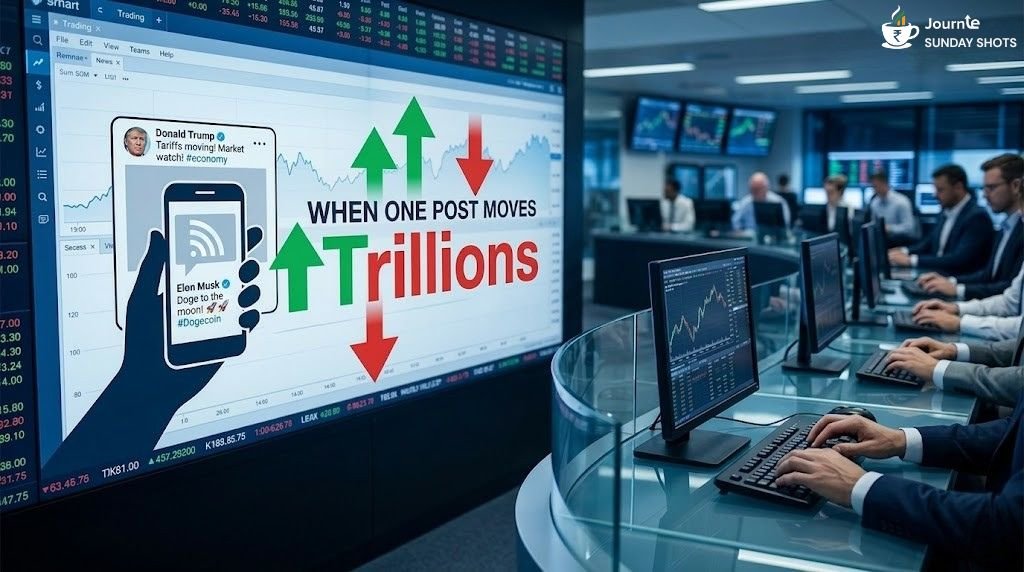
A wide-angle shot of a financial trading floor with multiple monitors. The central large screen displays a smartphone interface showing market-moving posts from Donald Trump regarding tariffs and Elon Musk regarding Dogecoin, flanked by large green and red arrows indicating trillions in market movement.

For decades, markets were expected to move on fundamentals. Earnings growth, inflation data, central bank policy, productivity, and corporate performance were the primary drivers of asset prices. Investors studied balance sheets, tracked macroeconomic indicators, and built positions based on long-term expectations.

Today, that framework still exists—but it is no longer the full story.

Modern markets now react to something much faster: social media communication. Platforms like X are no longer just social networks; they have become real-time transmission channels for market sentiment.

When the people posting are figures like Donald Trump or Elon Musk, the financial consequences can run into billions—or even trillions—of dollars.

The Day Markets Began Pricing Posts

The old market equation was straightforward: companies created value, and investors priced that value over time. The newer equation is more immediate: influential figures communicate online, and markets instantly reprice future expectations.

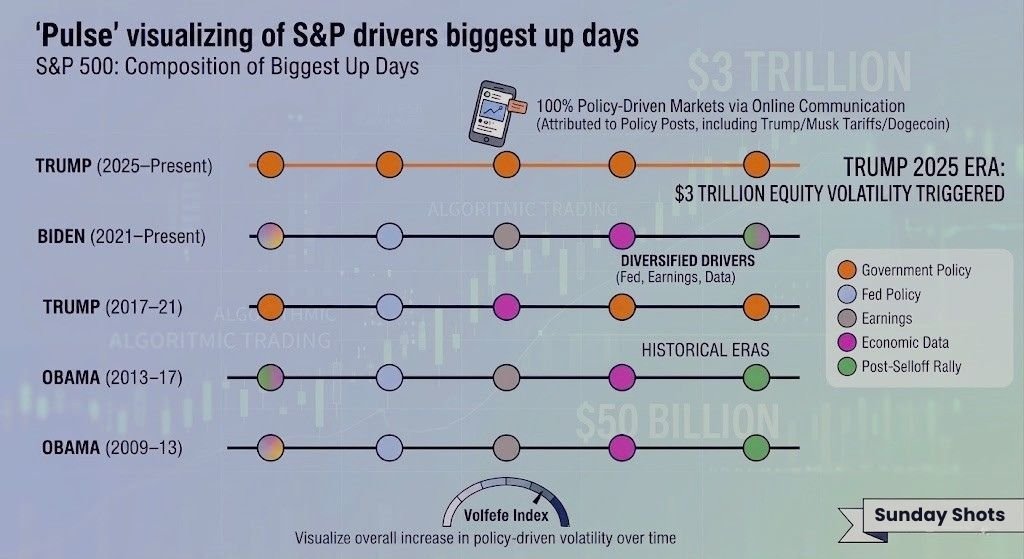
This shift is not theoretical. In 2019, JPMorgan Chase created the Volfefe Index, a model designed to track how Trump’s tweets impacted U.S. Treasury yields and market volatility.

One of the world’s largest banks effectively acknowledged that political tweets had become a financial variable that warranted institutional measurement.

The Trump Effect: Repricing on Probability

Trump’s posts matter because markets do not wait for laws to be signed or policies to be implemented; they move on probability. This was visible in April 2025, when tariff-related announcements triggered a sharp selloff across U.S. markets.

Public reports estimated that more than $3 trillion of equity value was wiped out in a short span as investors reassessed global growth, supply chains, and inflation risk. Nothing physical had changed—factories were still open—but expectations had changed, and markets price expectations first.

War Posts and the New Geopolitical Trade

The same mechanism now applies to geopolitical tensions. When leaders post warnings or ceasefire hints, traders reposition immediately:

  • Commodities: Oil prices can spike on fears of supply disruption, while Gold rises as a safe haven.
  • Sector Risk: Airline and shipping stocks can fall due to operational risk.
  • Currencies: Emerging market currencies often weaken as capital moves toward safer assets.

Markets no longer wait for missiles to launch; they respond to language itself. Market reactions happen in seconds, meaning the probability of conflict has become as tradable as the conflict itself.

Elon Musk and the Monetization of Attention

If Trump demonstrated how political communication could move macro markets, Elon Musk demonstrated how personal influence could move speculative assets. During 2020 and 2021, Musk’s references to Dogecoin helped trigger enormous buying interest.

Dogecoin briefly crossed a market capitalization of around $50 billion. This wasn’t due to cash flows or utility; it rose because attention itself became a catalyst. But attention is volatile. Once enthusiasm fades, prices often correct faster than they rose, leaving late participants exposed.

Who Actually Wins in This Environment?

The biggest beneficiaries are those with speed and systems. Institutional traders and algorithmic desks scan headlines and execute trades within milliseconds—often before most retail investors have even seen the post.

Retail participants usually enter later, often buying after prices spike out of FOMO or selling after a panic-driven decline has already occurred. Wealth often transfers not just from weak to strong investors, but from slower investors to faster ones.

Why India Should Care More Than It Appears

India is deeply connected to these global capital flows and investor sentiment.

  • FII Flows: If global funds turn defensive due to tariff threats, Indian equities face pressure even when domestic fundamentals remain unchanged.
  • The Oil Link: As a major oil importer, geopolitical posts that push crude higher can worsen inflation and strain India’s current account deficit.
  • The Morning Gap: Overnight statements in Washington frequently become a morning market gap in Mumbai, particularly for IT stocks with global revenue exposure.
When Markets Start Listening Too Closely

Markets once moved because companies-built products, improved margins, gained customers, or invested in growth. Today, they can also move because someone posts a threat before market open or a meme late at night.

Technology has democratized participation, but it has also concentrated influence in the hands of a few voices.

For investors, the challenge is no longer just identifying the right company. It is staying rational in a market increasingly designed to reward reaction over reflection.

While attention can move prices quickly, it rarely builds durable value. Let the algorithms trade the milliseconds; the real wealth is still built in the years.

See you next Sunday, for another Shot of insights.!

Disclaimer: This update is for informational purposes only. Please consult a SEBI-registered advisor before investing.

Enjoyed this week’s Sunday Shots? Share it across WhatsApp, LinkedIn, or X — and invite someone else into the conversation.
Subscribe to Sunday Shots for a fresh perspective delivered every week.

Lorem ipsum dolor sit amet, consectetur adipiscing elit. Ut elit tellus, luctus nec ullamcorper mattis, pulvinar dapibus leo.

The End of the Passive Shareholder: A Watershed Moment for Indian Corporate Governance

Illustration of Indian corporate governance showing a promoter moving capital and shareholders holding a Section 245 class action suit document to demand market accountability.

For a long time, there has been an unspoken understanding in Indian markets: You may own shares in a company, you may track its performance, you may even believe in its long-term story—but when it comes to how major decisions are actually made, you are often just along for the ride.

Historically, this wasn’t because investors didn’t notice the shadows being cast by promoters; it was because questioning them rarely changed the outcome.

But something is unfolding right now that is shifting the tectonic plates of Indian corporate governance. It involves a ₹2,500 crore question mark, a sleeping law, and a date—April 30—that marks a new chapter in India’s investing journey.

A Story That Feels Uncomfortably Familiar

Imagine you invest ₹700 with someone you trust. A few years later, you’re told the business didn’t work out and your money is effectively gone. You accept the loss and move on.

Now, imagine discovering later that the business didn’t just survive, it thrived. Its debts were waived, and its value returned.

But instead of that recovery flowing back to you, your stake—once written off as worthless, was transferred to the friend’s personal trust at an 85% discount.

The Anatomy of the Disappearing Value

Jindal asset manoeuvre

Over the past decade, a variation of this exact scenario played out in the public markets. To understand why shareholders are finally pushing back, you have to look at the mechanics of how the value was moved.

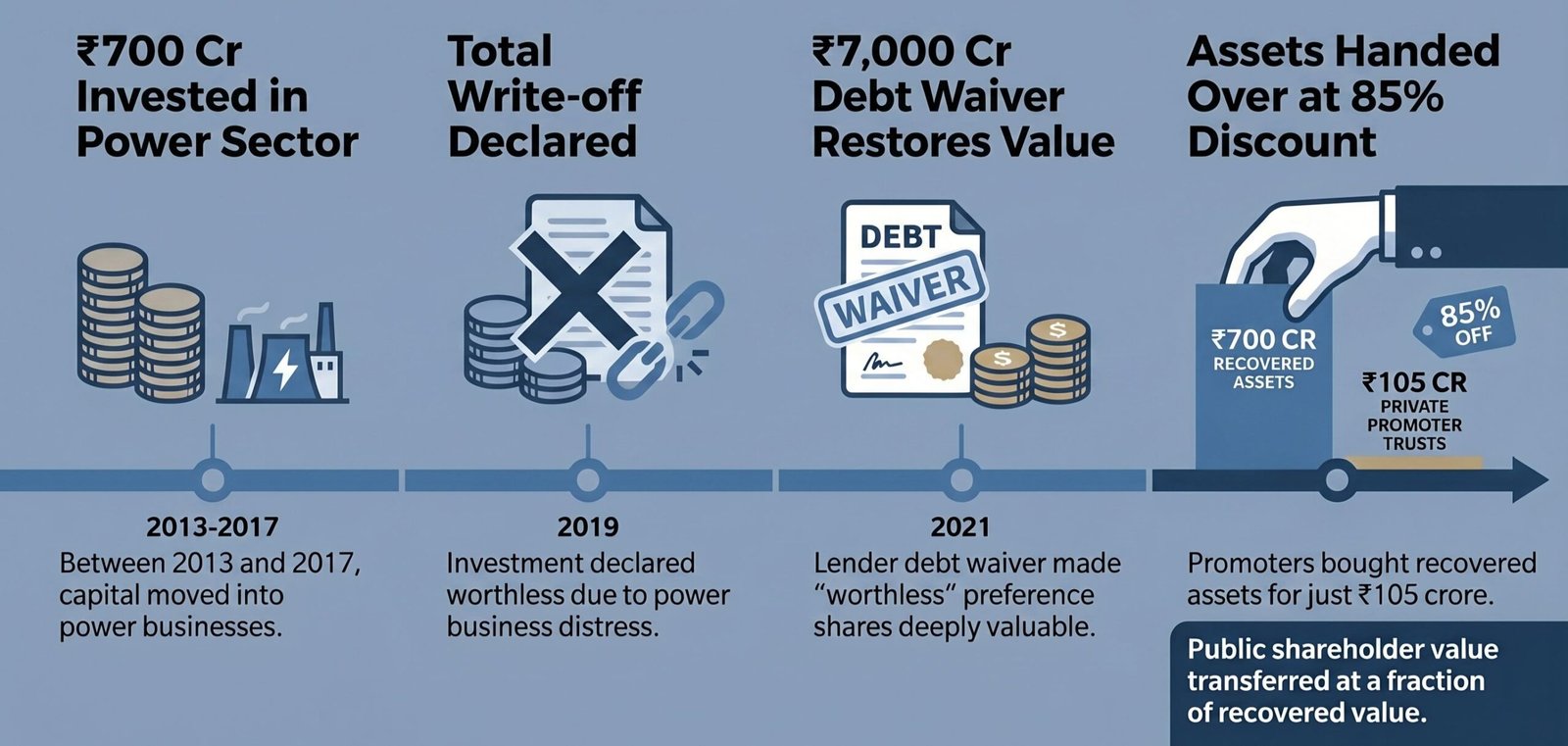
The Setup: Between 2013 and 2017, a major listed packaging company invested roughly ₹700 crore into its broader group’s power businesses using preference shares.

The Distress: By 2019, the company wrote off the entire investment. The message to the public shareholders was clear: The power business is in distress, and your money is gone. Ordinarily, that would have been the end of the story.

The Recovery: But in 2021, a plot twist arrived. Those same power companies received a massive debt waiver of nearly ₹7,000 crore from lenders. Overnight, their financial position improved drastically, and the “worthless” preference shares became deeply valuable again.

The Transfer: At that point, one would expect a reversal in the narrative—a recognition that shareholder capital was saved. Instead, the promoters sold these newly valuable assets to their own private family trusts at an 85% discount. Roughly ₹700 crore in assets were silently handed over for just about ₹105 crore.

The most glaring part? The listed company was sitting on over ₹1,200 crore in cash at the time.

There was no financial urgency. No capital constraints forcing a fire sale. Just a decision where the value was moved from the public pocket to a private one.

When the Dormant "Superpower" Woke Up

A group of shareholders chose not to just accept or simply exit. Instead, they came together and invoked a provision that had existed in Indian law for years but had rarely been used in any meaningful way.

Section 245—the Class Action Suit: A class action mechanism that allows shareholders to collectively seek accountability.

Introduced in 2013, this framework was meant to empower investors. In practice, it remained largely dormant—complex, untested, and often seen as impractical.

Until now.

This time, the case was filed. It was admitted. Attempts to dismiss it did not succeed. And the country’s market regulator also stepped in, adding another layer of scrutiny.

For the first time, the mechanism is not just theoretical—it is being actively tested.

A Larger Question Beneath the Surface

At its core, this case is not just about one company or one set of transactions. It brings into focus a deeper question: Who does a listed company ultimately serve?

Is it an extension of the promoters who built it, or is it an institution accountable to every person who has capital at stake?

For a long time, the answer existed somewhere in between, shaped more by implicit trust than explicit enforcement. But as our markets deepen, that balance is inevitably evolving.

Why This Moment Matters

An upcoming hearing later this month is unlikely to be the final word on the matter. Legal processes of this nature tend to unfold over time.

But this moment is significant for a different reason. It represents a shift from passive acceptance to active participation.

For years, the default response available to minority shareholders was simple—if you were uncomfortable, you exited.

Markets absorbed governance concerns through valuation discounts, not through enforcement. Now, that default response is being challenged in real-time.

A Shift That Markets Eventually Price In

In more developed markets, shareholder litigation is not uncommon. It plays a role in shaping corporate behaviour, influencing board decisions, and reinforcing accountability.

India has traditionally relied more on promoter credibility and regulatory oversight than on shareholder-led action.

But as markets deepen and capital becomes more discerning, this balance tends to evolve.

Because ultimately, markets do not just price earnings. They price the reliability of those earnings. And that reliability is inseparable from governance.

When Ownership Finds Its Voice

Something meaningful has already changed. The assumption that minority shareholders will remain passive participants is beginning to weaken.

For years, the only real right a minority shareholder had was the right to sell and leave. What we are seeing now is the emergence of an alternative path—where investors do not just price in risk, but actively question it.

As this case unfolds, one thing is becoming clearer: the journey of investing in India is no longer just about returns. It is also about rights.

See you next Sunday, for another Shot of insights.

Disclaimer: This update is for informational purposes only. Please consult a SEBI-registered advisor before investing.

Enjoyed this week’s Sunday Shots? Share it across WhatsApp, LinkedIn, or X — and invite someone else into the conversation.
Subscribe to Sunday Shots for a fresh perspective delivered every week.

Lorem ipsum dolor sit amet, consectetur adipiscing elit. Ut elit tellus, luctus nec ullamcorper mattis, pulvinar dapibus leo.

The Great Unwind: How a Currency Defense Sparked a $7 Billion Arbitrage Play

$7 Billion Arbitrage Play

Imagine staring down a rapid currency depreciation. In 2013, the “Taper Tantrum” saw the rupee slide 20% in just four months, pushing the central bank into a ferocious defense.

Taper Tantrum —a period of extreme market volatility triggered when global investors panicked and pulled funds out of emerging markets because the US Federal Reserve hinted at slowing its bond-buying program.

Fast forward to early 2026, and a familiar pressure gauge started blinking red. Global equity weakness, rising oil prices from the West Asian conflict, and an exodus of foreign investors pushed the Indian Rupee toward historic lows, breaching the 94-to-a-dollar mark.

But this time, the battleground shifted. The way the central bank responded and how corporate treasuries reacted, offers a fascinating glimpse into the modern financial ecosystem.

A Shift in the Playbook

Traditionally, the first line of defense against currency depreciation is burning through forex reserves to supply dollars to the market.

The RBI did exactly that initially, seeing reserves deplete by over $30 billion to cushion the fall. However, defending a currency solely with reserves is an expensive and finite strategy.

To prevent a full-blown crisis reminiscent of 1997 or 2013, the regulator shifted to an unconventional playbook.

On March 27, it capped the daily foreign currency net open positions of banks at a mere $100 million, setting a tight compliance deadline of April 10.

The objective was deliberate: force the unwinding of an estimated $30 to $40 billion in arbitrage trades that were fueling market volatility.

The Unintended Consequence

As banks scrambled to exit their massive positions, market mechanics temporarily warped.

Banks began aggressively selling dollars in the domestic onshore market while simultaneously buying them in the offshore Non-Deliverable Forwards (NDF) market. This forced unwinding created a sudden, significant price dislocation. The spread between onshore and offshore rates widened dramatically.

The NDF market is an offshore, over-the-counter market where investors can trade currencies like the rupee that are not freely convertible. Instead of exchanging the actual currency at the end of the contract, counterparties simply settle the profit or loss difference in dollars

The $7 Billion Arbitrage Window

For agile corporate treasuries, this was a clear window to capitalize on.

On March 30 alone, corporate activity in the NDF segment surged to over $7.5 billion. To put that magnitude in perspective, that is nearly seven times the usual daily volume.

Treasury desks executed a textbook arbitrage strategy: buying dollars domestically and aggressively selling them offshore to lock in the spread.

This sudden surge in onshore dollar demand by corporates is the precise reason the initial regulatory cap didn’t immediately strengthen the rupee, briefly pushing it past the 95 mark.

It was a real-time display of capital discipline, where firms seized a fleeting liquidity opportunity.

Closing the Loop

Recognizing that the market had adapted faster than anticipated, the regulator intensified its clampdown.

To plug the gap, banks were barred from offering NDF products to clients, and companies were disallowed from rebooking cancelled forward contracts.

This second, coordinated push flushed out the remaining speculative bets and closed the arbitrage window, finally helping the rupee recover to the 92.6 levels and halting the slide.

A Tale of Two Balance Sheets

While agile treasuries made an arbitrage play, the core currency volatility fundamentally shifts operational realities.

For import-heavy manufacturing sectors, this environment instantly squeezes margins and complicates procurement planning.

Conversely, for IT and Pharma exporters, a depreciating rupee temporarily pads the books.

It reinforces a critical reality: currency movement isn’t just a treasury problem; it is a core operational variable.

The Liquidity Ripple

There is a secondary, critical consequence to this aggressive defense.

When the central bank sells dollars, it sucks rupees out of the financial system.

This tightening of domestic liquidity invariably pushes up short-term borrowing costs and commercial paper yields.

It subtly changes the calculus for debt structures and capital allocation across the board.

Looking ahead to the upcoming quarter, corporate treasurers should prepare for this elevated yield environment to persist.

Approaching the rollover of short-term debt requires a tactical reassessment, as traditional low-cost borrowing channels may remain constrained.

Beyond the Trade

This episode is more than a fleeting market event; it is a live case study in how regulatory shifts can temporarily distort markets.

For modern treasuries, the ability to monitor these macro cross-currents and execute true-to-label hedging strategies is no longer just a defensive necessity—it is an active driver of value.

Managing liquidity and seizing strategic arbitrage through such volatility separates the reactive from the prepared.

Until next Sunday!

Disclaimer: This update is for informational purposes only. Please consult a SEBI-registered advisor before investing.

Enjoyed this week’s Sunday Shots? Share it across WhatsApp, LinkedIn, or X — and invite someone else into the conversation.
Subscribe to Sunday Shots for a fresh perspective delivered every week.

The Butterfly Effect: A Conflict, A Supply Chain, A Missing Pint

Infographic showing empty beer shelves and the broken glass supply chain from the Middle East to India. Sunday Shots.

It’s the peak of an Indian summer.

The heat lingers a little longer in the evening. Conversations stretch. Glasses clink more often.

You order your usual cold pint.

The server pauses. “Out of stock, Sir.”

You assume it’s a spike in demand. Maybe a busy weekend. Maybe a supply delay.

But the real reason your premium lager is missing from the shelf is unfolding thousands of miles away — far from breweries, bars, or anything resembling a beer tap.

Welcome to the 2026 summer supply chain shock.

A Disruption Far From the Shelf

What looks like a local shortage is actually the result of a global disruption.

The ongoing Israel-Iran conflict has started to do what conflicts often do best: disrupt systems that seem completely unrelated at first glance.

Not just oil. Not just shipping routes. But something far less visible: industrial energy flows.

India is the world’s fourth-largest importer of natural gas, drawing roughly 40% of its supply from Qatar. As geopolitical tensions rise, supply tightens. Availability becomes uncertain.

And that’s where the story naturally shifts—from a geopolitical chessboard to a manufacturing floor.

The Shift: From Gas to Glass

To understand why Indian breweries are staring down a crisis, we have to look beyond the beer and focus on the bottle.

Glass manufacturing is a game of continuous heat. Furnaces run 24/7 at extremely high temperatures. They are not designed to be turned on and off. They are designed to stay on.

That continuity depends entirely on a steady, commercial supply of natural gas. When that supply tightens, the system doesn’t gradually adjust. It breaks.

Production slows. Output becomes unpredictable. Costs rise sharply.

Within weeks:

  • Glass bottle prices have surged by roughly 20%
  • Paper carton costs have nearly doubled, up by 100%.

Suddenly, a basic assumption: that packaging will always be available, no longer holds.

The Illusion of Alternatives

So, why not just switch to cans or plastic?

Because global supply chains don’t break in isolation. They gridlock.

Aluminium supply chains, delayed by ships rerouting around the Strait of Hormuz, have begun to strain. At the same time, surging petroleum costs are driving up the price of plastics.

There is no easy pivot. What looks like flexibility on paper turns out to be dependency in reality.

The Pressure Builds

For brewers, this couldn’t come at a worse time.

April and May are peak season. It is when volumes are highest and margins matter most.

But as input costs rise sharply and with the industry seeking 12-15% price hikes, pricing remains artificially constrained.

Alcohol pricing in India is not a free, fluid market. It requires individual state approvals. It moves slowly.

So, when costs rise overnight but retail prices don’t: Margins compress. Decisions change.

The Working Capital Squeeze

It’s not just the 15-20% spike in direct costs. It’s the hidden tax of time.

With global shipping routes diverted, transit times are suddenly 12 to 14 days longer.

For businesses, longer transit times plus higher input costs equal trapped working capital.

Inventory is stuck on the water, cash is tied up, and CFOs are left sweating over liquidity just as peak season kicks off.

When Prices Can’t Move, Supply Does

This is where the system reveals how it really works.

If you are sitting in a boardroom and you cannot raise prices, you don’t sell everywhere. You choose.

Supply is strategically directed toward markets where pricing is viable. States like Maharashtra or Karnataka that might allow emergency price revisions. Not because demand is weak, but because the unit economics no longer work. It becomes corporate triage.

Shortages begin to appear. Not uniformly across the country, but selectively. A soft form of rationing.

The View: Headwinds vs. Tailwinds

For those watching the markets, this creates a complex valuation puzzle.

Take the market leader, United Breweries (UBL). It trades at a premium multiple—roughly 70x P/E, reflecting its dominance in the Indian consumption story. That premium leaves it highly sensitive to sudden margin compressions.

Yet, the market is rarely one-dimensional. While the geopolitical headwind threatens margins, there are localized regulatory tailwinds.

Karnataka, which alone accounts for 13% of India’s beer consumption, recently proposed shifting to an “alcohol-in-beverage” tax structure.

If passed, this could drop the price of economy beer by 25–30%. A potential massive volume boom that could offset packaging inflation.

A Much Larger Signal

Beer is simply where the impact becomes visible first. But the system underneath is far broader.

The exact same packaging infrastructure supports the $5 billion bottled water market (which is already seeing 11% price hikes)—soft drinks, juices, and everyday FMCG goods.

Which means this isn’t just about one industry. It’s a masterclass in how modern supply chains are built.

Highly efficient.Deeply interconnected. And often, soundlessly fragile.

The Beer Shot

Most people look at markets through the lens of demand.

Are people buying more? Are prices rising? But moments like this tell a different story. Markets don’t break at the product level. They break at the dependency level.

Energy. Materials. Logistics. These are the foundational layers where real pressure builds—long before it ever reaches the consumer.

So, if your favorite premium pint costs a little more this summer or is remarkably hard to find, remember: you aren't just paying for the brew. You're paying the geopolitical premium of a highly connected world.

Until next Sunday!

Disclaimer: This update is for informational purposes only. Please consult a SEBI-registered advisor before investing.

Enjoyed this week’s Sunday Shots? Share it across WhatsApp, LinkedIn, or X — and invite someone else into the conversation.
Subscribe to Sunday Shots for a fresh perspective delivered every week.

Lorem ipsum dolor sit amet, consectetur adipiscing elit. Ut elit tellus, luctus nec ullamcorper mattis, pulvinar dapibus leo.

From Geopolitics to the Gas Stove: The Economics of the Hormuz Blockade

Two weeks ago, we explored the broader economics of war — how conflicts reshape supply chains and ripple through inflation and markets.

This week, those linkages are no longer theoretical.

Over the past few days, something unusual began unfolding across parts of India’s energy supply chain.

Restaurants in several cities reported difficulty sourcing commercial LPG cylinders. Households rushed to buy induction stoves amid whispers of cooking gas shortages. Energy distributors moved quickly to prioritize domestic supply as tensions in West Asia escalated.

At first glance, these may appear like isolated supply disruptions. But they tell something deeper about how the global energy system actually works.

Because India’s energy security, like much of the world’s, depends on supply chains that stretch thousands of kilometers across oceans.

And at the centre of those supply chains lies one narrow stretch of water.

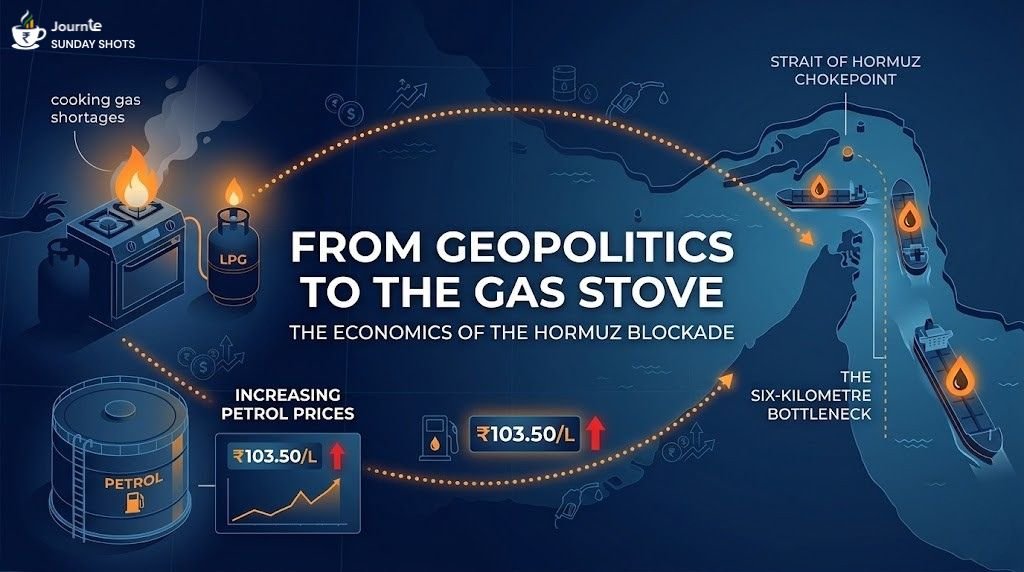
The Six-Kilometre Bottleneck

If global energy markets had a heartbeat, it would probably be heard here.

The Strait of Hormuz connects the Persian Gulf to the Arabian Sea. At its narrowest point, the corridor is about 33 kilometres wide.

But the space used by the world’s oil tankers is far smaller. International maritime rules divide the strait into two shipping lanes — each about three kilometres wide, separated by a safety buffer. Which means most of the world’s energy flows through an effective corridor of just six kilometres.

Nearly one-fifth of global oil consumption passes through this bottleneck every day.

Around 20 million barrels of crude oil and petroleum products move through it daily. The same route also carries a large share of global LNG exports from Qatar.

In the architecture of global trade, Hormuz is not just important. It is irreplaceable.

A Gateway Long Before Oil

Long before oil tankers filled these waters, the Strait of Hormuz was already one of the most valuable trade gateways in the world.

In the medieval period, the rulers of the Kingdom of Hormuz made an unusual decision. They shifted their capital to a small island in the middle of the strait.

The island had almost no fresh water and virtually no agriculture. Yet it soon became one of the richest ports in the region.

Why? Because every merchant ship moving between India, Persia, Arabia, and East Africa had to pass through this narrow corridor.

The rulers simply taxed the traffic.

By the 1400s, Hormuz had become a thriving commercial hub trading silk, spices, pearls, and Persian horses. A Portuguese traveller once described it as “a great emporium of the world.”

Even then, the power of the strait was clear. Whoever controlled it controlled trade.

When Empires Fought for the Strait

Its strategic value soon attracted empires.

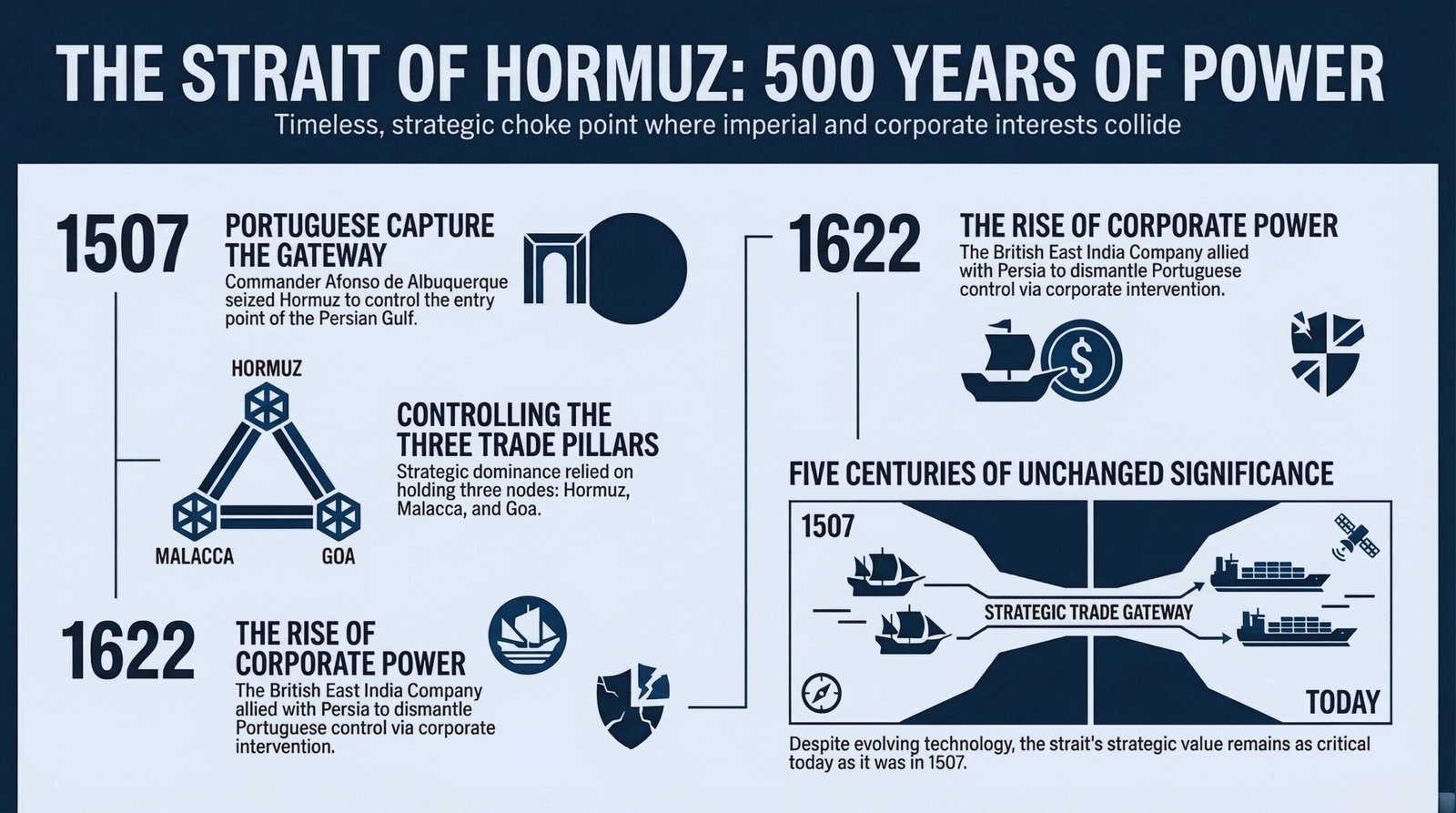
In 1507, the Portuguese commander Afonso de Albuquerque captured Hormuz and built a fortress overlooking the shipping lanes.

Portugal’s strategy was simple: control the key gateways of Asian trade.

Hormuz controlled access to the Persian Gulf. Malacca controlled Southeast Asian trade routes. Goa became the administrative capital of Portugal’s Indian Ocean empire.

For more than a century, ships entering the Gulf effectively paid tribute to the Portuguese crown.

But in 1622, the Persian Empire formed an unlikely alliance with the British East India Company to reclaim the strait. Together they expelled the Portuguese.

It was one of the earliest examples of corporate power shaping global trade routes.

Five centuries later, the ships are different. But the strategic importance of the strait remains exactly the same.

The Illusion of Alternatives

Whenever tensions rise in the Gulf, a simple question emerges: Why not bypass the strait?

The answer lies in the sheer scale of global energy flows.

Oil moves through Hormuz at volumes that pipelines simply cannot replace.

Saudi Arabia’s East-West Pipeline and the UAE’s Habshan–Fujairah pipeline do bypass the strait. But even at maximum capacity, together they can carry less than half of the oil that normally flows through Hormuz.

Countries like Iraq and Kuwait have almost no meaningful bypass infrastructure at all. Geography has effectively locked the global energy system into this narrow corridor.

The Logistics of Scale

Sometimes the best way to understand scale is through a simple comparison.

A typical Very Large Crude Carrier (VLCC) can transport about 2 million barrels of oil in a single voyage.

Now consider air cargo.

A massive aircraft like a Boeing 747 can carry the equivalent of roughly 700 barrels of crude oil by weight.

To replace the cargo of just one oil tanker, you would need nearly 3,000 cargo flights. And that is only for a single shipment.

Shipping crude by sea costs only a few dollars per barrel. Moving it by air would multiply the cost many times over.

In global energy logistics, the sea is not just the cheapest route. It is the only viable one.

When Risk Gets Priced

Energy markets are extremely sensitive to risk. They do not wait for supply to stop. They react the moment the probability of disruption increases.

Over the past week, tensions in the Gulf have started showing up in real ways.

Shipping costs have begun to rise. Insurance premiums for vessels passing through Hormuz have increased. Some operators are delaying or rerouting shipments, even at higher costs.

Oil prices have turned volatile — not because supply has stopped, but because uncertainty has increased.

And that shift is already showing up in India.

Oil marketing companies have raised prices of premium petrol variants by ₹2–3 per litre, signaling early adjustments to global conditions. Globally the gasoline prices have increased anything between 5%-25% in different nations

This is how energy markets function.

Risk shows up in logistics first. Then in prices. And eventually in everyday consumption.

Why India Is Watching the Water

For India, the Strait of Hormuz is not just a distant geopolitical flashpoint. It is deeply connected to our economic stability.

India imports more than 85% of its crude oil, with a large share sourced from producers in the Gulf. A significant portion of these shipments travels through Hormuz before reaching Indian ports.

When tensions escalate in this region, the effects show up quickly: Higher oil prices. Pressure on inflation. Currency volatility. Rising import costs.

Even small movements in energy prices can ripple through the broader economy. Which is why policymakers and markets in India watch the Gulf so closely.

The World’s Most Important Chokepoint

In the vast map of global trade routes, the Strait of Hormuz looks small. Yet every day, a significant share of the world’s energy passes through this single gateway.

For decades, global systems have been built around one assumption — that this route remains open. Most of the time, it does. But moments like these reveals how concentrated the system really is.

A single chokepoint. A narrow corridor of water. A supply chain that stretches from the Gulf to gas stoves and fuel pumps across the world.

Which is why, when tensions rise in the region, markets aren’t just watching the conflict. They’re watching the strait.

Because sometimes, the global economy moves through a corridor barely six kilometres wide.

Until next Sunday!

Disclaimer: This update is for informational purposes only. Please consult a SEBI-registered advisor before investing.

Enjoyed this week’s Sunday Shots? Share it across WhatsApp, LinkedIn, or X — and invite someone else into the conversation.
Subscribe to Sunday Shots for a fresh perspective delivered every week.

Lorem ipsum dolor sit amet, consectetur adipiscing elit. Ut elit tellus, luctus nec ullamcorper mattis, pulvinar dapibus leo.

Wars Are Fought on Battlefields. But Won in Balance Sheets.

This week, markets reacted before diplomacy could catch up.

As tensions between Israel and Iran escalated sharply, oil prices jumped, global equities turned volatile, and investors quickly moved toward traditional safe havens.

The reason lies in a narrow stretch of water that sits at the centre of global energy markets: the Strait of Hormuz.

Roughly 21 million barrels of oil move through this corridor every day — about one out of every five barrels consumed globally.

If that route were disrupted even briefly, the impact would travel instantly across global markets, affecting fuel prices, inflation expectations, currencies, and interest rates.

Where Capital Hides

When geopolitical shockwaves hit, capital immediately searches for a bunker.

Historically, this has meant a surge in demand for Gold and the US Dollar.

Gold represents the ultimate stateless money — an asset with no counterparty risk and one that cannot be printed or frozen by a warring government.

Watching these assets during a crisis offers a real-time thermometer of global fear. But moments like this reveal something deeper.

Wars may appear to be fought with missiles, soldiers, and strategy. Yet history repeatedly shows that the real engine of conflict is economic power.

Battlefields may decide battles. But balance sheets often decide wars.

The Business of War

In 1935, decorated US Marine General Smedley Butler wrote a small but provocative book titled War Is a Racket.

His argument was blunt. Wars, he said, often enrich a narrow set of industries while the broader public bears the cost.

A few decades later, US President Dwight Eisenhower issued a similar warning.

In his farewell speech, he cautioned about the rise of the “military–industrial complex” — the powerful relationship between governments, armed forces, and defence contractors.

Once countries build large defence industries, war preparation itself becomes an economic ecosystem.

Factories depend on defence contracts. Jobs depend on military spending. Technologies emerge from military research.

War, in that sense, becomes more than a political event. It becomes an industry.

Wars Are Won Economically

Military historians often emphasize strategy and leadership. Economists look somewhere else: industrial capacity.

During World War II, the United States transformed its economy almost overnight. Automobile companies began producing tanks. Electronics firms manufactured radar systems. Shipyards expanded at extraordinary speed.

Within a few years, American factories were producing more military equipment than entire continents combined.

At one point, the United States was producing a new aircraft roughly every five minutes.

The war was fought across Europe and the Pacific. But the economic engine powering it was American industry.

Production capacity, supply chains, and financing ultimately determined how long nations could sustain the conflict.

The New Arsenal: Sanctions & Spending

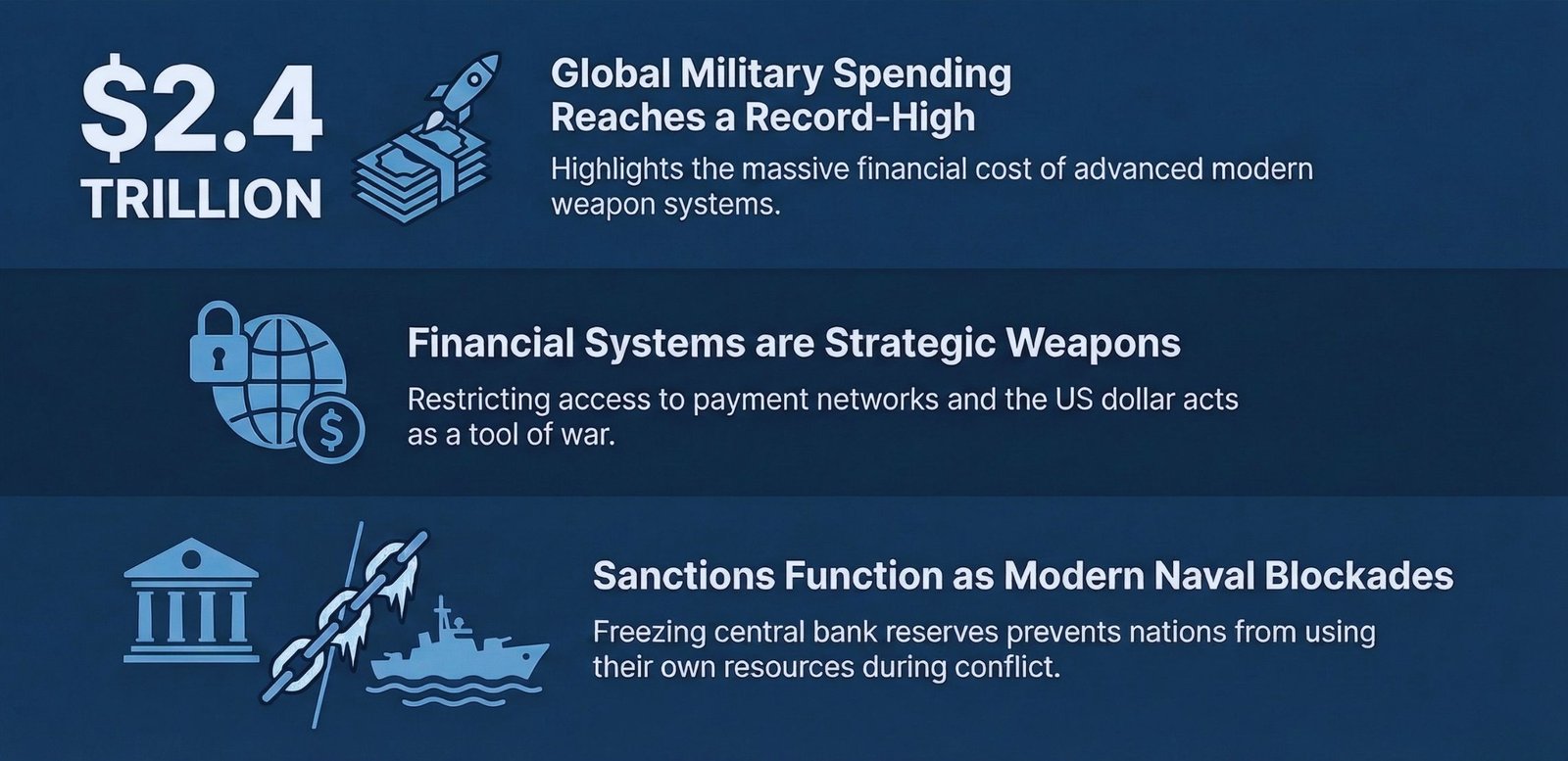
Modern warfare is becoming dramatically more expensive. Global military spending crossed $2.4 trillion last year, the highest level ever recorded.

Advanced weapon systems require enormous investments in technology, research, and manufacturing, turning prolonged conflict into a severe test of financial endurance.

But today’s wars are fought with more than weapons. Financial systems themselves have become strategic tools.

Cutting a nation off from global payment networks, freezing central bank reserves, or restricting access to the US dollar can act as powerful economic weapons.

In many ways, modern sanctions function as the financial equivalent of a naval blockade. They prove that a nation’s currency and banking infrastructure are just as critical to national security as its borders.

Why Markets React So Quickly

When geopolitical tensions rise, financial markets immediately begin pricing the economic consequences. They do this across three main channels:

  • Energy Risk: Conflicts in the Middle East almost instantly affect oil prices because energy supply routes are among the most strategically important assets in the global economy.
  • Government Spending: Wars typically lead to rising defence budgets, shifting fiscal priorities, and expanding national debt.
  • Supply Chain Disruption: Shipping routes, commodity flows, and global trade networks can all become uncertain.

Markets do not wait for wars to unfold. They begin pricing the economic consequences immediately.

Markets and Memory

Financial markets have lived through wars before.

From world wars to regional conflicts, geopolitical shocks have repeatedly disrupted markets in the short term.

Yet history shows that while wars reshape economies and industries, markets eventually adapt.

Because beneath every geopolitical shock lies the same force that ultimately drives markets forward: the global economy.

The Invisible Battlefield

Every war is fought on two fronts. The visible one is the battlefield. The invisible one is the economy.

Sustaining a war requires factories, fuel, logistics, and above all, financing.

As Napoleon once famously said: An army marches on its stomach.

Modern economists might add something else: An army also marches on capital markets.

History keeps repeating the same lesson: Wars may begin with politics, but they are sustained—and often decided—on balance sheets.

Because in the end, wars may be fought by soldiers, but they are financed by economies.

Until next Sunday!

Disclaimer: This update is for informational purposes only. Please consult a SEBI-registered advisor before investing.

Enjoyed this week’s Sunday Shots? Share it across WhatsApp, LinkedIn, or X — and invite someone else into the conversation.
Subscribe to Sunday Shots for a fresh perspective delivered every week.

Lorem ipsum dolor sit amet, consectetur adipiscing elit. Ut elit tellus, luctus nec ullamcorper mattis, pulvinar dapibus leo.

Elevate the Way You Manage Your Wealth

For a trusted wealth experience—powered by people and technology, crafted around you.

Join the Journie

Subscribe to Journie Shots — thoughtful, well-curated insights and market stories delivered every Sunday.