
Japan’s Rising Bond Yields — The Capital That Built the World Is Coming Home
For nearly three decades, the global financial system quietly relied on one unwavering assumption: Japan would always be the world’s cheapest source of capital.
A country of near-zero rates, near-zero inflation, and a central bank that bought bonds at will.
While the U.S. set the rhythm of global markets, Japan supplied the liquidity.
Its households, pension funds, insurers, and mega-banks sent trillions of yen abroad — quietly financing growth across the U.S., Europe, and Asia. Japanese capital was the silent backbone of the global expansion story.
But what happens when the quietest player makes the biggest move?
This year, we are witnessing that historic pivot.
Japan of Yesterday: The Lost Decades and Zero-Interest Era
To understand today’s seismic shifts, we must first rewind to the early 1990s.
In the late 1980s, Japan experienced a massive asset bubble. Real estate and stock market prices soared to unprecedented levels. But by 1990, the bubble burst violently, plunging Japan into what is now known as the Lost Decades — a prolonged period marked by stagnation, deflation, and weak growth.
In response, the Bank of Japan (BoJ) engineered one of the most radical monetary experiments in modern history — combining a Zero Interest Rate Policy with massive bond purchases and an unprecedented framework called Yield Curve Control (YCC), which directly capped long-term yields near 0%.
This created a unique financial ecosystem where:
- Borrowing was almost free
- Long-term bond yields barely moved
- Investors looked outward to earn returns
Japan gradually became the world’s largest creditor nation, quietly financing global growth while grappling with a debt-to-GDP ratio above 260%.
The Anchor Moves, The Tide Shifts Everywhere
Fast forward to 2025. After decades of near-zero yields, Japan’s long-term government bond yields are surging to multi-decade highs:
- 10-year JGB yield is around 75%, the highest in nearly two decades
- 30-year yield has risen above 3%
- The 40-year yield has touched almost 7%, a record high
Why does this matter?
Because Japan carries a staggering debt load and holds over $3.3 trillion in foreign assets. The BoJ’s decades-long strategy of YCC and ultra-loose policies has been instrumental in sustaining this equilibrium.
However, with inflation rising above 3.6%, and the government unveiling stimulus packages worth over ¥20 trillion, the BoJ has begun tapering bond purchases — signaling an end to “free money” and allowing yields to rise.
A country that kept global borrowing costs suppressed for 30 years is now letting its own cost of money reprice.
When Yields Rise, the World’s Money Comes Home
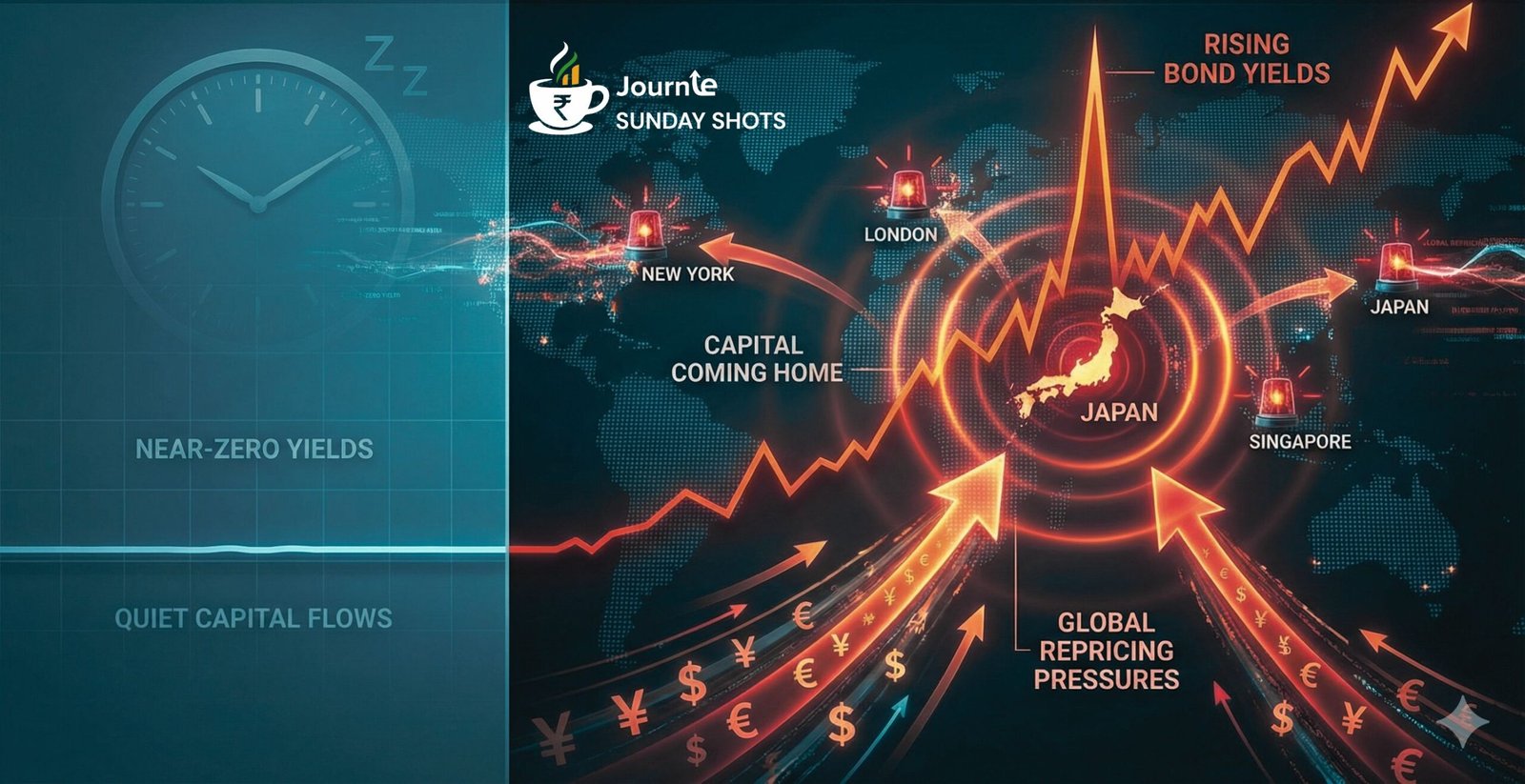
For years, Japanese investors borrowed yen at near-zero interest and invested overseas seeking better returns — a phenomenon known as the yen carry trade. From Asian equity markets to U.S. Treasuries, Japanese money flowed far and wide.
But rising yields mean rising borrowing costs. Suddenly, the trade becomes riskier, more expensive, and less attractive.
What follows is both predictable and powerful: a capital flow reversal — Japanese investors begin selling foreign assets and bringing money home.
And this matters because Japanese institutions hold:
- $1+ trillion in U.S. Treasuries
- Over $3.3 trillion in total foreign assets
- Trillions more in global corporate bonds, equities, and EM markets
Even a 10% repatriation sends ripples through global markets.
The Global Echo
The effects are unmistakable:
- Global bond yields could rise as Japanese demand fades
- Capital-starved emerging markets could face volatility and outflows
- Currency markets may see the yen strengthen sharply, affecting exports and trade competitiveness
- U.S. Treasuries and global bonds may experience repricing pressures
A quiet reversal in Tokyo becomes a loud repricing everywhere.
The Japan Policy Dilemma: Inflation vs. Stability
The BoJ and Japanese policymakers face a difficult balancing act:
- Should they keep yields artificially low to support government debt servicing and social programs?
- Or allow yields to rise naturally, risking fiscal instability and market shocks?
The BoJ’s current approach is cautious tapering, but rapid market shifts and fiscal pressures could force more dramatic intervention.
What’s Next? Three Possible Paths
- Soft Drift (Most Likely)
Yields rise gradually, capital repatriation remains slow, and global markets adjust without much disruption. - The Volatility Loop (Increasingly Probable)
Periodic yield spikes, yen surges, unwind of carry trades, and intermittent BoJ intervention. - Disorderly Repricing (Low Probability, High Impact)
A sharp yen rise, large foreign-asset selling, global yield spikes, and broader market turbulence.
- Soft Drift (Most Likely)
The mere existence of this third scenario is enough to make global allocators watch Japan very closely.
Why Should We Care?
Japan’s bond market is no longer an isolated story; it is a global inflection point.
This shift affects borrowing costs in India and emerging markets, introduces volatility in currency markets, and challenges risk pricing globally.
The era of Japan as the world’s cheapest capital source is ending.
How governments, markets, and investors navigate this new terrain will define and shape global financial markets for years to come.
Japan’s rising bond yields are a wake-up call from the land that built global liquidity — a structural shift in global finance now reshaping the next decade’s financial landscape.
The decades-long story of ultra-low interest rates and silent capital flight is unwinding, with consequences rippling far beyond Japan’s shores.
For investors, policymakers, and markets, this is a moment to watch closely, understand deeply, and prepare accordingly.
Thanks for reading this Sunday Shot. Remember, behind every macro shift is a story — and Japan’s story is one every global investor should know.
Until Next Sunday!

Disclaimer: This update is for informational purposes only. Please consult a SEBI-registered advisor before investing.